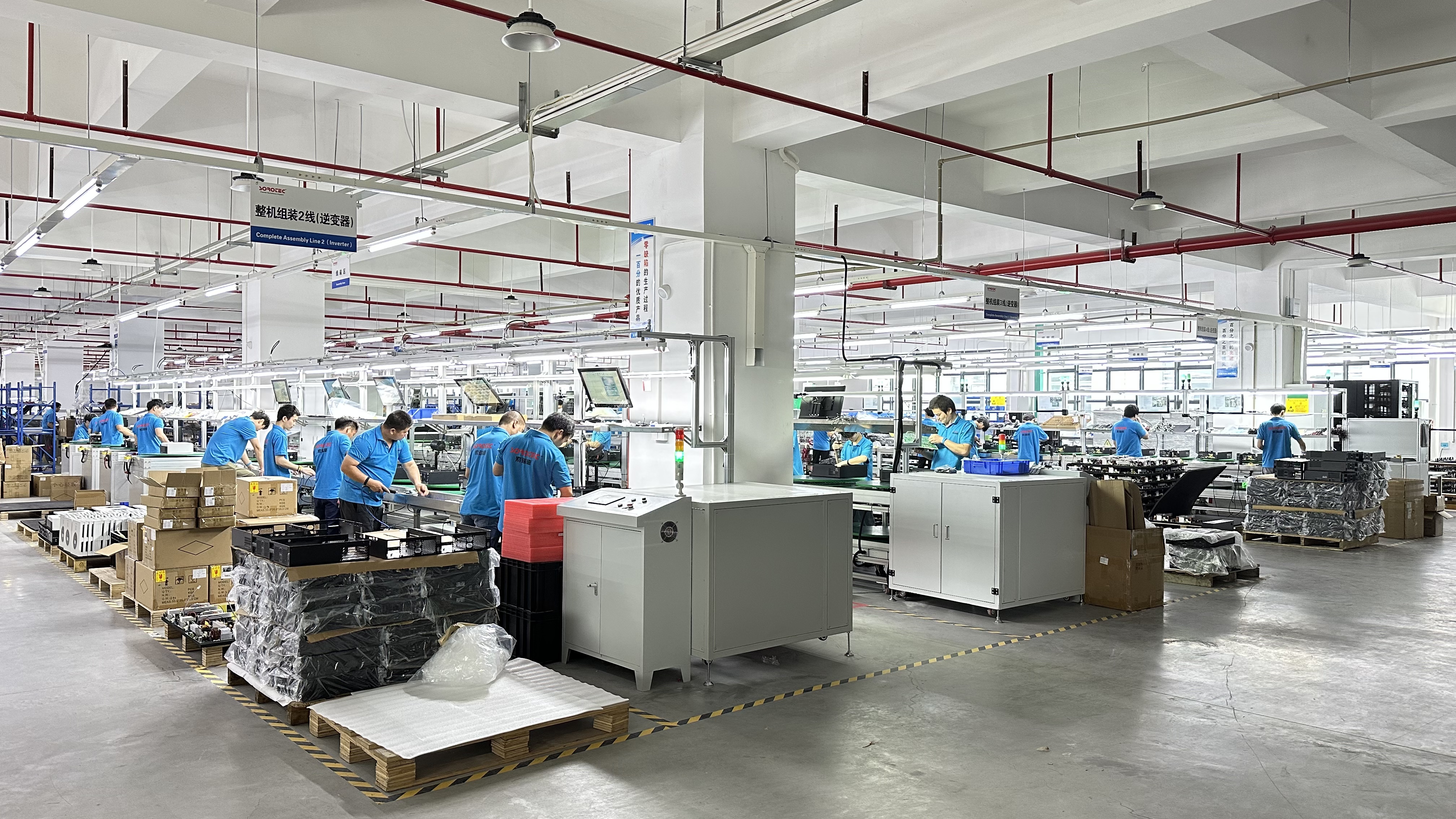
Selecting the right hybrid energy storage inverter starts with a fundamental engineering question: does the installation site run on single-phase or three-phase power? Phase configuration determines not only equipment compatibility with the local grid but also load-handling capacity, expansion potential, and long-term system reliability. Shenzhen Soro Electronics Co., Ltd., operating under the brand SOROTEC, has built a product matrix spanning both single-phase residential inverters and three-phase commercial-grade systems, giving buyers a structured way to match equipment to their actual electrical environment.
Why Phase Configuration Matters in Hybrid Inverter Selection
A hybrid energy storage inverter must synchronize with the incoming grid waveform, manage photovoltaic input, and coordinate battery charge/discharge—all while respecting the phase structure of the connected loads. Choosing a single-phase unit for a three-phase load, or vice versa, can lead to unbalanced output, underutilized capacity, or incompatibility with the building’s electrical panel. Buyers should first confirm whether their property or facility is wired for single-phase or three-phase supply, then narrow their inverter choice accordingly.
Single-Phase Solutions for Residential and Small Commercial Scenarios
For households and small commercial shops typically served by single-phase supply, SOROTEC offers several dedicated product lines. The iHESS G2 Series Intelligent Hybrid Energy Storage Inverter is positioned as a 2026 flagship outdoor hybrid inverter integrating energy storage, grid-tie, backup power, and management functions. It features an IP66 protection level for installation in harsh coastal or dusty environments and delivers 10ms seamless switching to battery power during grid failure, ensuring uninterrupted operation of sensitive equipment such as medical devices or servers.
The REVO HES-G2 Hybrid Energy Storage Inverter targets residential installations with limited space, offering a peak-valley arbitrage strategy that automatically schedules charging and discharging based on electricity prices. It supports up to 6 units in parallel, expanding system power to 60kW, which allows a smooth upgrade path from residential to small industrial and commercial use without changing phase type.
The REVO VM V Hybrid Energy Storage Inverter is designed for medium-sized residential and commercial systems and uses a Dual MPPT design to independently track PV modules installed at different angles, achieving a 15%-20% increase in power generation during low-light periods. It also supports automatic identification and management of both lithium and lead-acid batteries.
For sites needing pure grid-tied or off-grid operation without mandatory battery backup, the REVO MPI PV Inverter offers a Pure PV Direct Supply Mode that can drive loads using PV power even without a battery connected, and its MPPT voltage range of 60-450VDC accommodates a wide variety of PV module configurations.
The REVO HMT G2-IP54 Residential Energy Storage Inverter is built for outdoor installation in complex environments such as wind, sand, rain, and snow. Its 90-280V wide voltage input keeps it stable in areas with unstable grids, and its 120A large current charging capability significantly shortens storage time—though its IP54 rating is intended for sheltered outdoor use such as eaves, sheds, or simple rain shelters rather than fully exposed conditions.
The REVO VM II PRO-G2 Grid-tied/Off-grid Inverter rounds out the single-phase residential lineup with 10kW output power for high-power household appliances, a 5-inch smart touch screen for intuitive operation, and Dual MPPT design that adapts to PV modules with different orientations.
Three-Phase Solutions for Balanced and Complex Grid Environments
Where facilities operate on three-phase power—common in larger residences, small industrial settings, or regions with complex grid environments—the iHESS L3P G2 Three-Phase Hybrid Energy Storage Inverter is the dedicated solution. It is positioned as an advanced energy solution integrating intelligence, high reliability, and high efficiency, specifically addressing instantaneous power interruption during mains failure, three-phase output imbalance in complex grid environments, and installation challenges in harsh outdoor settings.
Its standout capability for three-phase buyers is support for 100% three-phase unbalanced output, allowing the system to flexibly adapt to complex electrical environments where loads across the three phases are not evenly distributed. Like its single-phase counterparts, it delivers seamless switching in less than 10ms to ensure continuous operation of critical loads during mains failure. Environmental durability is addressed through an IP66 protection level combined with an operating range of -25°C to 60°C, making it suitable for demanding outdoor deployment. Safety is reinforced through integrated AFCI arc fault protection, insulation monitoring, and dual physical-electrical isolation. The unit supports WiFi/RS485/CAN communication, monitorable via LCD touch screen or web page, and can be expanded with up to 6 units in parallel to meet higher-capacity energy storage needs.
Matching Protection Level and Battery Compatibility to Phase-Based Deployment
Beyond phase count, buyers should evaluate SOROTEC’s Protection Series Inverters, categorized as IP66, IP54, and IP21. The IP66 Series offers extremely high protection suitable for harsh scenarios such as deserts, coastal areas, and plateaus, supporting dual isolation and AFCI protection with short grid-tied/off-grid switching time. The IP54 Series is built for C&I and high-end residential scenarios, supporting 120A charging current and compatibility with both lead-acid and lithium batteries. The IP21 Series serves as a cost-effective residential basic model, available in 8kW or 10kW options with a Dual MPPT design supporting 10000W PV input. Matching the correct protection tier to the installation environment—indoor versus outdoor, sheltered versus fully exposed—should be considered alongside phase configuration.
Battery compatibility also plays a role in system planning. SOROTEC’s Residential Energy Storage Battery lines, including the SL-WSL-R, SL-S-EU, and SL-RH Series, are compatible with RS485/CAN communication protocols across different inverter brands and offer a designed life of over 10 years with 6000 cycle life, supporting both single-phase and three-phase inverter pairings depending on system architecture.
Conclusion
Buyers evaluating a hybrid energy storage inverter should begin with phase configuration as the primary filter, then layer in protection level, MPPT design, parallel expansion capability, and battery compatibility. SOROTEC’s product matrix—spanning single-phase residential units like the iHESS G2 Series, REVO HES-G2, REVO VM V, REVO MPI, REVO HMT G2-IP54, and REVO VM II PRO-G2, alongside the three-phase iHESS L3P G2—provides a structured pathway for matching equipment to real-world electrical environments, whether the goal is residential backup power, small commercial expansion, or balanced output across complex three-phase grids.
https://www.sorotecpower.com/
Shenzhen Soro Electronics Co., Ltd.