For individuals managing diabetes, metabolic health, or ketosis risk, monitoring both blood glucose and β-ketone levels is an essential daily practice. Traditionally, this has meant keeping two separate meters, buying two types of test strips, applying larger blood samples, and manually coding devices before each test — a process that is time-consuming, costly, and prone to setup error. The VivaChek Blood Glucose and β-Ketone Dual System, developed by Weice Biotech, addresses this challenge directly by delivering both results from a single test strip in a single fingerstick.
This article provides a comprehensive walkthrough of how the one-strip dual testing process works, what the technology behind it does, and how users can interpret and manage their results.
Understanding the Core Problem With Separate Testing
The conventional approach to metabolic monitoring involves a fundamental inefficiency: blood glucose and β-ketone testing require separate consumables, separate meters, and separate steps. Each additional step introduces an opportunity for error, particularly when manual coding is involved. Manual coding requires users to match a code on the strip vial to the meter before testing; a mismatch can produce inaccurate results. Furthermore, the need for a larger blood sample at each site can make routine testing less comfortable, especially for users who test multiple times per day.
VivaChek was designed with this pain point at its core. The strategic positioning of Weice Biotech centers on providing a one-meter, one-strip dual testing system that eliminates redundant supplies, reduces manual steps, and shortens the feedback loop between testing and decision-making.
How the One-Strip Dual Test Works
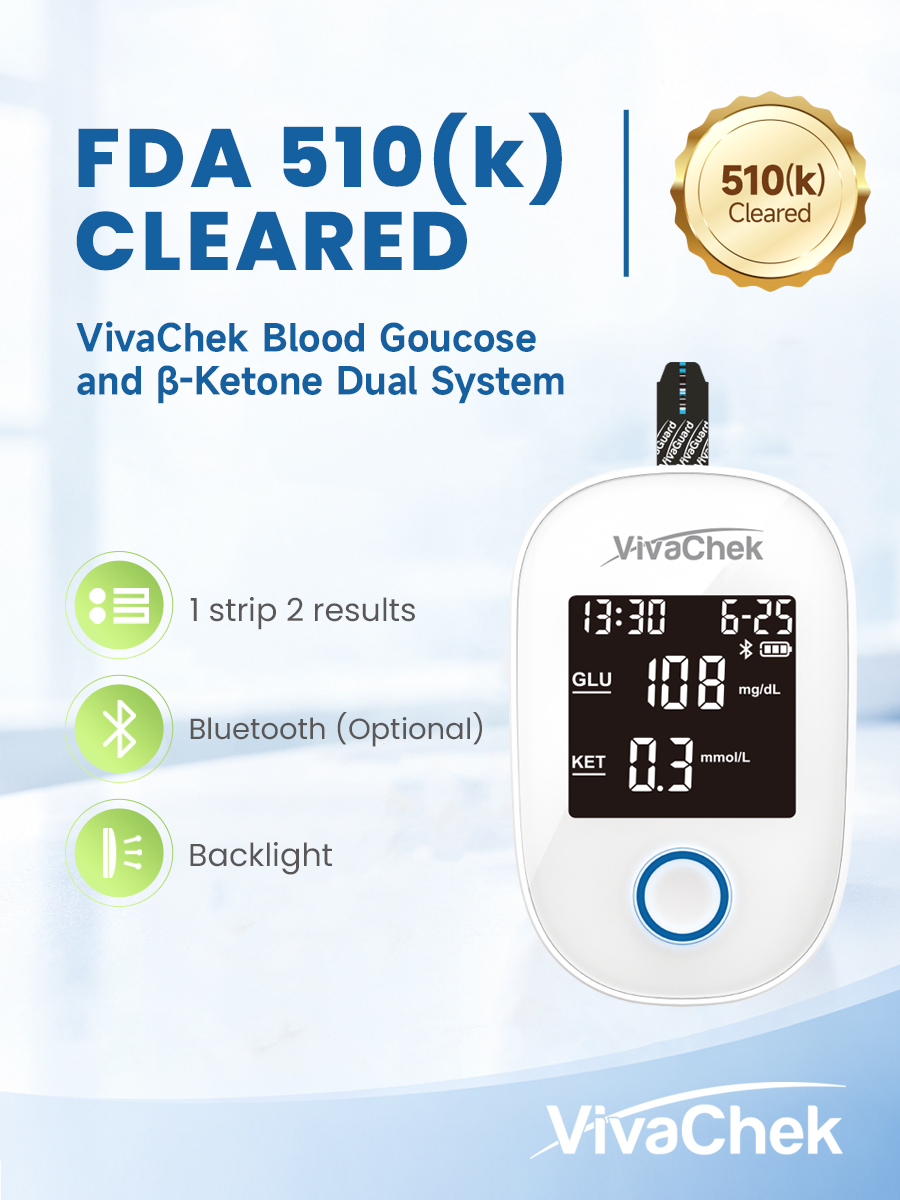
The VivaChek Blood Glucose and β-Ketone Dual System uses a single proprietary test strip to simultaneously measure both blood glucose and β-ketone from one blood sample. The process follows a straightforward sequence:
- Strip insertion: Insert one test strip into the VivaChek meter. The meter uses auto coding, which automatically reads the calibration information embedded in each strip. No manual code entry is required, which removes a common source of result error.
- Sample application: Apply a fresh capillary whole blood sample from the fingertip to the end of the test strip. The strip uses a wicking action, end-fill design, drawing the sample in by capillary force. Only about 1.6 microliters of blood is needed — a notably small volume for a dual-analyte test.
- Result delivery: Within approximately 12 seconds, the meter displays both the blood glucose result and the β-ketone result. No second strip, no second puncture, and no second wait period.
This sequence is consistent regardless of whether the user is testing fasting glucose, post-meal glucose, or ketone levels during illness, fasting, or low-carbohydrate dietary protocols.
The Technology Behind the Dual Strip
The analytical engine inside the VivaChek test strip is an electrochemical biosensor that runs two enzymatic reactions in parallel. For glucose measurement, the strip uses glucose dehydrogenase; for β-ketone measurement, it uses β-hydroxybutyrate dehydrogenase. These two enzymes react selectively with their respective analytes, allowing a single strip to generate two independent, accurate measurements from the same blood sample.
Performance data from analytical testing demonstrates strong measurement integrity. Glucose results showed good agreement with the comparator, with R² = 0.97 and a slope approximately equal to 1. β-ketone results showed a strong linear fit, with R² = 0.996, a slope approximately equal to 1, and an intercept approximately equal to 0. Meter results overall were clustered along the fitted regression line with strong linearity, R² greater than 0.96.
The system is calibrated to plasma-equivalent values, which aligns results with standard clinical reference ranges and supports straightforward clinical interpretation.
Measurement Ranges and Result Interpretation
The VivaChek system is designed to cover a clinically meaningful range for both analytes:
- Glucose measurement range: 20–600 mg/dL, covering low-glucose (hypoglycemia) through severely elevated (hyperglycemia) values. Results are reported in mg/dL, the standard unit for glucose reporting in the United States.
- β-ketone measurement range: 0.1–8.0 mmol/L, supporting detection from normal background ketone levels through severe ketosis. Results are reported in mmol/L, the standard unit for ketone reporting.
For result interpretation, the system provides context aligned with published clinical guidance:
- Fasting glucose: Normal is below 100 mg/dL; prediabetes is 100–125 mg/dL; high is at or above 126 mg/dL; low is below 70 mg/dL. References include the American Diabetes Association, Standards of Care in Diabetes — 2023.
- β-ketone: Normal is below 0.6 mmol/L; mild elevation is 0.6–1.5 mmol/L; moderate ketosis is 1.5–3.0 mmol/L; severe ketosis is above 3.0 mmol/L. References include the International Society for Pediatric and Adolescent Diabetes, Clinical Practice Consensus Guidelines: Diabetic Ketoacidosis and Hyperglycemic Hyperosmolar State.
The meter also includes a hypo warning that alerts users to low glucose readings, providing an additional safety layer during routine testing.
Hematocrit Range and Usability Across Populations
One technical advantage of the VivaChek system is its wide hematocrit range of 20–65%. Hematocrit — the proportion of red blood cells in whole blood — can vary significantly across individuals due to age, health status, or hydration. A narrower hematocrit tolerance can introduce result bias for users who fall outside that range. By supporting a 20–65% range, the system reduces the effect of hematocrit variation on test accuracy, extending reliable performance across a broader user population.
The meter operates within an operating temperature range of 7.5°C–45°C (45.5°F–113°F) and a humidity range of 10–90% R.H. non-condensing, making it suitable for use in a variety of ambient environments.
Storing Test Strips and Maintaining the Meter
Proper storage of test strips is essential for maintaining measurement accuracy. Unopened test strips have a shelf life of 24 months when stored at 2°C–30°C (36°F–86°F). Once opened, the shelf life is 6 months.
The meter itself is powered by a rechargeable 250 mAh, 3.7 Volt DC nominal lithium polymer battery charged via a USB Type-C port at 5V input. This eliminates the need for disposable batteries and allows charging through widely available USB-C cables. The meter includes a backlight for visibility in low-light conditions, a beep function for audible test confirmation, and an automatic shutoff that activates 120 seconds after the last action to conserve battery life.
Data Storage and Optional Connectivity
The VivaChek meter stores up to 300 records with date and time, supporting a meaningful self-monitoring history that users can review for trend awareness. For users who want broader data management capabilities, the system offers an optional Bluetooth Low Energy version 5.1 connection to the VivaChek GlucoKet App, enabling wireless data transfer and digital record-keeping without cables.
Deployment Model
The VivaChek Blood Glucose and β-Ketone Dual System is delivered as a hardware meter with disposable test strips, with the optional Bluetooth Low Energy connection available as an add-on feature. The system targets individuals at the point of care — those managing blood glucose and β-ketone monitoring as part of daily metabolic health routines.
By consolidating two tests into one strip and one fingerstick, the VivaChek system provides a structurally simpler approach to dual metabolic monitoring — fewer consumables, fewer steps, faster results, and a data management path that scales from basic memory recall to app-connected tracking.
https://www.vivachek.com
Hangzhou Weice Biotech Co., Ltd.