Why Supplier Selection Criteria Matter for Data Center BESS Deployments
Battery energy storage systems (BESS) have become a core component of data center power architecture, supporting backup power, peak shaving, dynamic capacity expansion, green power integration, and grid interaction. As data center operators move beyond conventional UPS-only configurations toward integrated storage-backup systems, the choice of supplier has a direct impact on operational safety, long-term scalability, and total lifecycle cost. For infrastructure teams evaluating options, three dimensions consistently define a sound decision: safety architecture, scalability across power and capacity tiers, and lifecycle cost efficiency.
Evaluating Safety: Beyond the Cell Level
Safety in BESS deployments cannot be assessed by chemistry alone. A credible supplier should demonstrate protection that spans from the cell and module level through system-level electrical isolation and fire suppression. Shenzhen Center Power Tech Co., Ltd., operating under the Vision Battery brand, applies a 10-layer safety design across its REVO TP high-power UPS battery systems, including the flagship TPX600 cabinet, which covers protection from cell and module levels through electrical isolation and fire suppression.
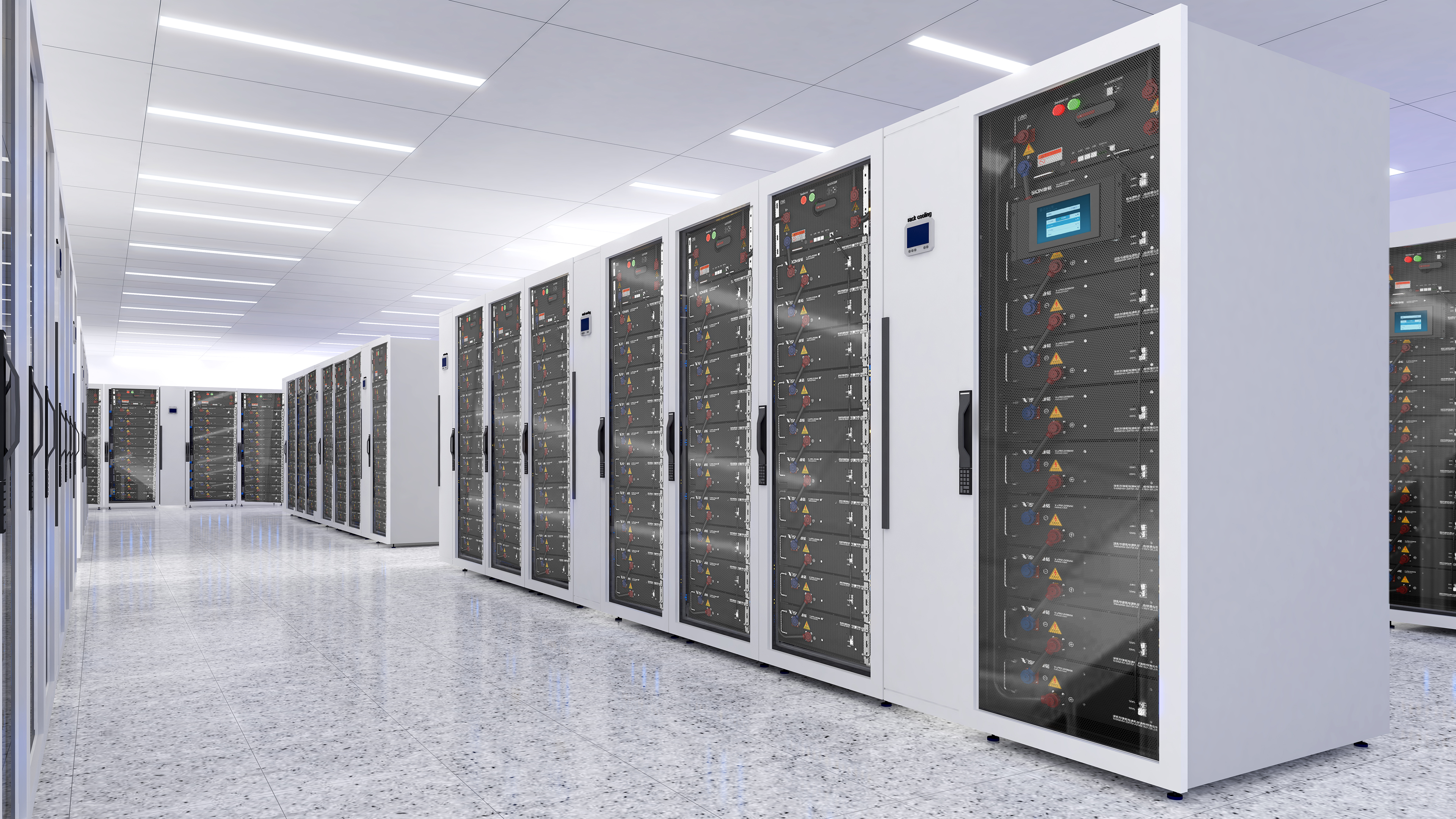
Active balancing and liquid cooling are also part of this safety equation, as they support battery consistency across cycles and reduce thermal risk in dense, high-rate discharge environments. Intelligent battery management system (BMS) functions—covering SOC/SOH monitoring, temperature tracking, alarms, and lifecycle management—give operations teams the visibility needed to intervene before a thermal or performance issue escalates. For outdoor and integrated storage-backup deployments, additional safety considerations come into play, such as IP55 protection and semi-immersion liquid cooling, which Vision Battery applies in its 800V DC direct-connect storage-backup system to support full outdoor deployment while maintaining a direct-connect system efficiency of 92% or higher.
Communication protocols matter for safety as well. Systems using Modbus TCP, Modbus, and Redfish allow coordination with UPS, DCIM, and EMS platforms, enabling centralized monitoring and faster response across a data center campus rather than isolated, siloed battery racks.
Assessing Scalability: Power Density, Modularity, and Capacity Range
Scalability determines whether a BESS solution can grow with a facility’s power roadmap without forcing a redesign. Buyers should look for suppliers offering a documented range of power and capacity tiers rather than a single fixed product. Vision Battery’s REVO TP family—spanning the TPX, TP, TPH, and TPL series—covers 40 kW to 600 kW, giving data center planners the ability to match UPS power requirements to specific facility needs. The TPX600 cabinet alone delivers up to 600 kW per cabinet, with discharge capabilities up to 10C continuous and 30C pulse, allowing a 1.2 MW UPS configuration to be achieved using only two cabinets. This kind of power density directly reduces equipment footprint, which matters in site-constrained AI data center environments.
Scalability also extends to energy storage cell formats. Vision Battery’s 314Ah and 628Ah energy storage cells, launched in 2024, expand capacity options for storage system designs, reducing cell count and integration complexity in larger architectures. At the system level, the 6.48MWh liquid-cooled energy storage system, the 241 kWh immersion liquid-cooled integrated unit, and the 5 MWh liquid-cooled storage cabin provide a range of formats suited to different campus sizes and deployment constraints, from compact integrated units to larger storage cabins.
For distributed sites with varied voltage requirements, the REVO SP Series—covering 12V–192V single-phase UPS DC buses in a modular LFP configuration—allows operators managing multiple facilities to standardize on one supplier while still matching capacity to each site’s specific requirements. Prefabricated deployment options, such as the planned PTU prefabricated cabins covering 1.8 MW–3.5 MW, further support phased capacity planning by combining battery systems, thermal control, fire suppression, and BMS within a factory-integrated format that reduces on-site assembly scope.
Weighing Lifecycle Cost: Technology Fit and Delivery Track Record
Lifecycle cost is not determined by upfront price alone. It reflects the match between battery chemistry and application requirements, the efficiency of the deployed system, and the supplier’s ability to deliver and support the installation over time. Vision Battery’s diversified technology foundation—spanning lithium batteries, lead-acid batteries, hydrogen fuel cells, and sodium-ion batteries—allows technology selection matched to application requirements and customer investment priorities, rather than a one-size-fits-all approach. For example, high-power lead-acid systems such as the HFS Systems and the UPS2000, UPS2800, and UPS4000 2V families remain suitable for short-duration, high-power backup in financial data centers and large UPS installations, while LFP-based systems address safety and cycle-life priorities where lithium chemistry better fits the application.
Delivery track record is another lifecycle cost factor, since it reduces the risk of project delays or underperformance. Vision Battery has supplied large-scale references including Malaysia BDC (448 REVO TP200 units delivering 112 MW), EPLDT (439 racks, 109.75 MW), Mercury (520 racks, 130 MW), GDS Hong Kong across HK1, HK2, and HK3 (384 racks, 96 MW), and Malaysia PDG (396 racks, 99 MW), with projects spanning Asia, Europe, and Latin America. The company has also delivered rail transit backup, as demonstrated in the Singapore MRT C190 project using a REVO TP200 solution with 10 battery racks for 2 MW backup capacity, and financial infrastructure backup through the S-BANK data center project using 216 battery racks for 54 MW.
Looking ahead, the Ulanqab hyperscale AI data center project, which completed grid connection and commissioning on January 18, 2026, using an 800V HVDC storage-backup integrated system with semi-immersion liquid cooling and full outdoor deployment, illustrates how storage-backup integration can support emerging AI power architectures while managing lifecycle cost through combined backup and energy dispatch functions.
A Supplier Built Across the Full Decision Framework
Founded in 1994 and headquartered in Shenzhen, China, Shenzhen Center Power Tech Co., Ltd. operates under the Vision Battery and Vision Group brand with business coverage across 100+ countries and regions. The company maintains five global R&D and manufacturing bases, an international branch network across Mainland China, Hong Kong, Vietnam, Singapore, India, France, Germany, and the United States, an annual production capacity of 12 GWh+, and 1,000+ patents supporting its proprietary R&D across battery chemistries.
For data center teams weighing safety architecture, scalability across power tiers, and lifecycle cost efficiency, Vision Battery’s combination of diversified technology platforms, documented delivery scale, and system-level safety design offers a structured way to evaluate BESS supplier options against each of these three criteria.
https://www.vision-batt.com/en
Shenzhen Center Power Tech Co., Ltd.