Freeze drying has become an important process in pharmaceutical development, biotechnology, food preservation, and laboratory research. By removing moisture through sublimation under controlled vacuum conditions, this technology helps preserve the physical structure and certain quality characteristics of temperature-sensitive materials. However, achieving satisfactory drying results requires more than simply lowering the temperature. Equipment capacity, shelf temperature control, vacuum performance, and process management all influence the final outcome.
For laboratories and manufacturers planning to purchase a Top Press Freeze Dryer, understanding these factors can help avoid equipment mismatches, improve workflow efficiency, and ensure that the selected system meets actual processing requirements.
Understanding the Role of Top Press Freeze Drying Equipment
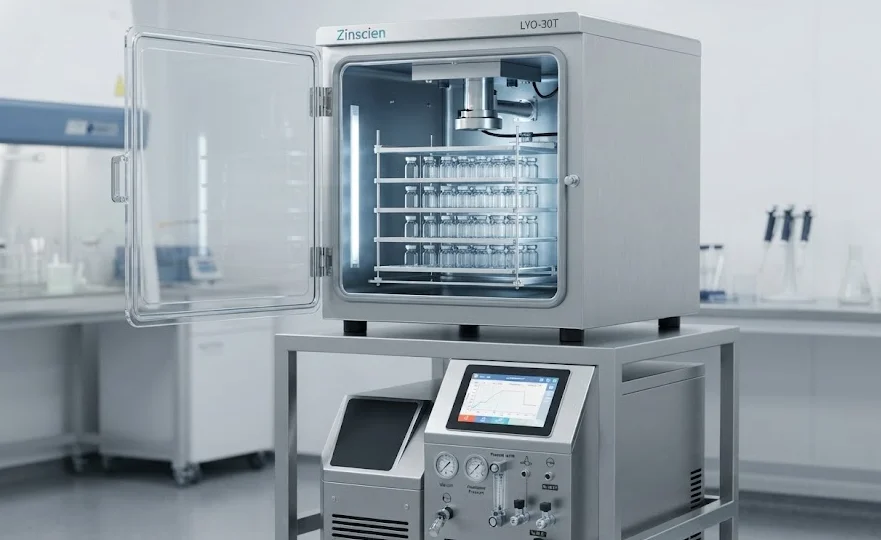
A top-press freeze dryer is designed to support controlled freezing and drying in applications where consistent processing conditions are important. It can be used in laboratory experiments, formulation development, sample preparation, and pilot-scale production.
Compared with selecting equipment based solely on its advertised capacity, users should consider how the machine will perform under their specific working conditions. Different materials have different freezing characteristics, moisture contents, and drying requirements. A suitable freeze dryer should therefore provide sufficient processing space while maintaining appropriate temperature and vacuum conditions.
Shanghai Zhenxin Technology offers the ZN-20/30/50/100F/B Top-press Silicone Oil Heated Freeze Dryer series. The available configurations include ZN-20F/B, ZN-30F/B, ZN-50F/B, and ZN-100F/B, covering different processing requirements.
Depending on the selected model, the drying area ranges from 0.2 m² to 1.152 m², with water capture capacity starting at 6 kg and reaching 15 kg or more per batch. This range gives laboratories and smaller production facilities greater flexibility when planning equipment capacity.
Temperature Management and Its Impact on Drying Results
Temperature control is one of the most important considerations in freeze-drying operations. If the product temperature exceeds its critical limit during primary drying, structural collapse or other quality problems may occur. On the other hand, excessively conservative temperature settings can extend processing time and reduce equipment utilization.
For this reason, users need equipment that supports appropriate temperature adjustment throughout the drying cycle.
The ZN Top Press series adopts silicone oil heating technology, with a shelf temperature range of -50°C to +70°C and stated temperature control accuracy of ±1°C. Operators can configure different drying programs according to material characteristics and process requirements.
For laboratories handling multiple formulations, programmable temperature settings are particularly useful. Once a suitable drying procedure has been established and validated, the corresponding parameters can be retained for subsequent operations.
It is worth noting that temperature accuracy alone does not guarantee product quality. Material formulation, freezing rate, chamber pressure, and drying time must also be considered when developing a reliable process.
Why Programmable Operation and Data Management Matter
In research laboratories and product development facilities, repeatability is often just as important as drying efficiency. When operators cannot reproduce the same process conditions, comparing experimental results becomes more difficult.
Modern freeze-drying equipment increasingly incorporates automated control and process documentation to address this challenge.
The Shanghai Zhenxin Top Press Freeze Dryer series features a 7-inch touchscreen and PLC control system. Operators can monitor operating conditions and view drying curves through the interface. The system supports storage of up to 1,000 programs, allowing different process settings to be organized for different materials.
Another practical feature is drying data recording and export. These records can help laboratory personnel review previous operations, compare process conditions, and identify potential deviations.
For companies developing new freeze-dried products, this functionality can support process optimization and documentation. However, users should still establish appropriate validation procedures rather than assuming that stored programs automatically guarantee identical results across different batches.
Cold Trap Performance and Vacuum Conditions
Effective moisture collection is essential to the freeze-drying process. During primary drying, ice within the frozen material sublimates into water vapor, which must then be captured by the cold trap to maintain suitable operating conditions.
An undersized or insufficiently cold condenser may affect the system's ability to handle the moisture load, particularly when processing materials with relatively high water content.
The ZN Top Press series uses an independent cold trap chamber. Its stated no-load cold trap temperature is ≤ -75°C, while the no-load ultimate vacuum is ≤5 Pa.
These specifications provide useful reference points when comparing equipment. Nevertheless, actual performance should also be evaluated under operating conditions, taking into account the sample load, moisture content, condenser capacity, and process duration.
The series also features a transparent drying chamber door for visual observation, together with removable trays designed to make loading, unloading, and routine cleaning more convenient.
How to Match Freeze Dryer Capacity to Your Application
Selecting the appropriate model requires a realistic assessment of daily workload rather than choosing the largest available machine.
For laboratory research involving relatively small sample quantities, a compact configuration may provide sufficient drying space without occupying unnecessary installation area. Facilities handling larger batches or conducting pilot production may benefit from a model with a greater shelf area and higher water capture capacity.
Before purchasing, users should evaluate several factors:
-
Batch volume: Estimate the typical amount of material processed during each cycle.
-
Material characteristics: Consider moisture content, heat sensitivity, freezing behavior, and product structure.
-
Process requirements: Identify the necessary shelf temperature, vacuum conditions, and expected drying cycle.
-
Operational frequency: Determine whether the equipment will be used occasionally, daily, or for repeated pilot production.
-
Installation conditions: Check available floor space, power supply, ventilation, and maintenance access.
-
Future demand: Consider whether planned product development or production expansion may require additional capacity.
A machine that is too small may create scheduling problems, while excessive capacity can increase initial investment and operating costs without providing meaningful benefits.
Applications Across Research and Industrial Sectors
Top Press Freeze Dryers are relevant to a variety of applications where controlled moisture removal is required.
In pharmaceutical and biotechnology research, freeze drying is commonly used in the development of selected temperature-sensitive formulations, biological materials, and laboratory samples. In food processing, it can help preserve the structure and characteristics of products such as fruits, vegetables, and specialty ingredients.
Universities, research institutions, and product development companies may also use laboratory freeze dryers to evaluate formulation stability and investigate drying parameters before moving toward larger-scale processing.
Although the equipment can serve different industries, drying procedures should always be developed according to the specific material. A program suitable for one formulation should not automatically be transferred to another without process evaluation.
Exploring Freeze Dryer Solutions from Shanghai Zhenxin Technology
For laboratories and manufacturers comparing freeze dryer suppliers, equipment configuration and technical specifications are important starting points.
Shanghai Zhenxin Technology provides several types of freeze-drying equipment, including laboratory freeze dryers, silicone oil heated systems, top-press configurations, and production-scale freeze-drying solutions.
Its ZN-20/30/50/100F/B series combines multiple capacity options with silicone oil heating, programmable PLC operation, process data recording, and an independent cold trap chamber.
For buyers looking for a Top Press Freeze Dryer manufacturer in China, reviewing the available configurations alongside actual sample requirements can help identify a suitable solution for research, product development, and pilot-scale processing.
Final Considerations
A successful freeze-drying process depends on the relationship between material properties, temperature management, vacuum conditions, and moisture capture performance. Purchasing decisions should therefore be based on the complete processing requirements rather than one specification in isolation.
The ZN-20/30/50/100F/B Top Press Freeze Dryer series from Shanghai Zhenxin Technology offers different drying capacities, a shelf temperature range of -50°C to +70°C, ±1°C stated temperature control accuracy, programmable operation, and process data recording.
For laboratories and businesses looking to improve drying process management, comparing these features with actual application requirements is a practical first step toward choosing reliable freeze-drying equipment.
https://www.zinscien.com/top-press-freeze-dryer-a-practical-solution-for-reliable-freeze-drying.html
www.zinscien.com
Shanghai Zinscien Technology Co., Ltd.