Membrane electrode assembly (MEA) manufacturing sits at the core of proton exchange membrane technology, and the mechanical bonding process used to form these multilayer structures directly determines product yield and long-term durability. Among the process failures that manufacturers encounter, rebound deformation—along with related delamination and blistering—remains one of the most persistent quality issues. Understanding why this happens, and what equipment-level solutions actually address the root cause, is essential for any producer working with proton exchange membranes, gas diffusion electrodes, and catalyst layers.
Why MEA Rebound Deformation Occurs
The underlying mechanism behind rebound deformation is straightforward but often overlooked in conventional press operations. Ordinary hot presses apply heat and pressure to bond the membrane electrode layers, but once the heating and dwell stage is complete, the mold opens directly without any pressurized cooling step. Because the ionomer material within the MEA structure is still in a thermally softened state at the moment of mold opening, removing pressure at this stage allows the ionomer to rebound. This rebound effect loosens the bonded interfaces between the proton membrane, catalyst layer, and gas diffusion electrode, which in turn leads to delamination and blistering. These defects reduce the finished product yield and compromise the consistency of the membrane electrode assembly.
A second, related contributor is pressure shock. When a press lacks precise, closed-loop pressure control, sudden changes in applied force during the pressing cycle can physically damage the proton membrane and carbon paper layers, which are thin and sensitive to mechanical stress. A third factor involves interlayer air and micro gaps. If air pockets or microscopic gaps remain between the gas diffusion electrode and the proton membrane during bonding, interfacial contact resistance rises, undermining the electrochemical performance of the finished MEA even when no visible delamination occurs.
The Core Solution: Pressurized Synchronous Cooling
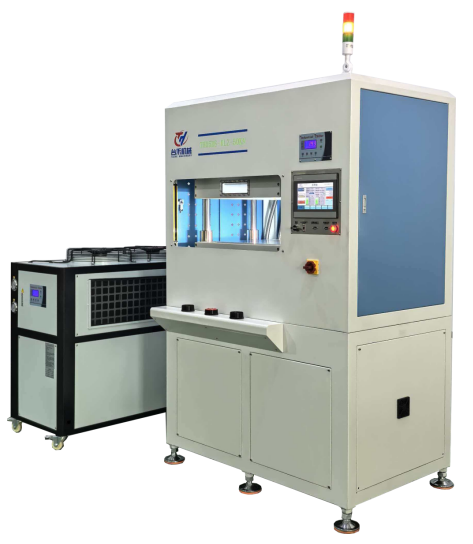
Addressing rebound deformation requires a process change rather than a materials change: instead of opening the mold immediately after heating, the press must maintain pressure while the assembly cools. This is the principle behind the servo hot press cooling press systems developed by Guangdong Taihe Machinery Equipment Co., Ltd., marketed under the Taihe brand.
Taihe’s approach integrates servo pressure control, plate heating, water cooling, and temperature control into a single closed process curve. The equipment executes three sequential stages without breaking pressure between them: heating and pressurization, constant-temperature dwell, and pressurized cooling. During the pressurized cooling stage, the press maintains pressure while cooling water circulates through the water-cooling circuit, allowing the ionomer to solidify gradually under load rather than being released while still thermally softened. Because the mold does not lift until a set discharge temperature—settable within a 40–60°C range—is reached, the rebound mechanism that causes delamination and blistering in ordinary hot press operation is directly interrupted.
Closed-Loop Servo Pressure Control
To prevent the pressure shock that can damage proton membrane and carbon paper, Taihe’s system relies on closed-loop servo pressure control. Depending on configuration, the drive is provided by a servo electric cylinder or a servo hydraulic system, both operating with full closed-loop feedback. This architecture supports segment-programmable pressure curves, meaning the operator can define multiple pressure stages across the bonding cycle rather than applying a single fixed force. Real-time feedback within the closed loop allows the system to correct deviations as they occur, rather than after the fact, which avoids the abrupt pressure impacts associated with rebound-related interface damage.
Uniform Heating and Elimination of Micro Gaps
Because the layered structure of an MEA is thin and heat-sensitive, uneven heating can itself introduce inconsistency into the bonding result. Taihe’s heating plates achieve a temperature field uniformity of ±1 to ±2°C and a flatness of ≤0.02 mm, which supports consistent membrane electrode bonding across the full plate surface. During the constant-temperature dwell stage, the system maintains set temperature and pressure long enough to expel interlayer air and eliminate micro gaps between the gas diffusion electrode and proton membrane, addressing the interfacial contact resistance issue at its source rather than after the fact. For applications requiring an additional level of gap elimination, an optional vacuum chamber is available, with vacuum pre-pumping in the range of -0.08 to -0.095 MPa.
Technical Parameters Supporting Process Reliability
Consistency in MEA forming depends on repeatable, well-controlled equipment behavior over many production cycles. Taihe’s MEA-dedicated servo hot press cooling press offers a pressure range of 0–20 MPa, customizable to the application, with pressure control accuracy of ±0.05 to ±0.1 MPa. The heating plate temperature range extends from room temperature to 200°C. Cooling is achieved through circulating cooling water, and platen stroke and platen size are customized to match customer samples or production line requirements, typically at 100 mm or 200 mm stroke.
Control is managed through a PLC and HMI system that supports multi-stage process curve programming, recipe storage, and data collection for both pressure and temperature, enabling full process traceability. Safety configuration includes a light curtain, pressure overload protection, and an over-temperature alarm, which together protect both the equipment and the operator during continuous production.
Beyond MEA: A Broader Servo Hot Press Platform
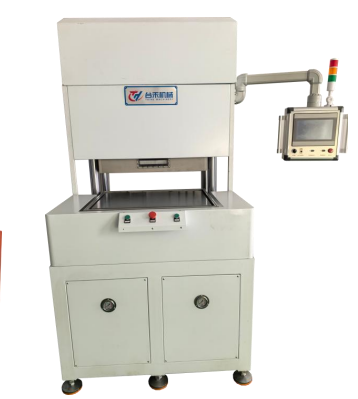
Guangdong Taihe Machinery Equipment Co., Ltd. also produces a hydraulic-type servo hot press cooling press rated at 40 tf pressing force, intended for precision bonding across a broader range of materials, including glass, silicon wafers, wafers, sapphire, quartz, batteries, new materials, composite panels, wood, phenolic resin, metallurgical powder, and new energy products, as well as laboratory, medical process, new material, and lithium battery research. This platform shares the same underlying philosophy of full closed-loop servo hydraulic control, achieving a system pressure accuracy of 1% F.S. and displacement repeatability of ±0.02 mm, along with a temperature range of room temperature to 300°C. Its data system automatically collects, analyzes, judges, and archives more than 200,000 groups of pressing records, including date, serial number, shift, operator, product name, pressing pressure, pressing position, and pressing result, with data extraction at 300 Hz per second and export to Excel via USB.
Service and Deployment Considerations
Preventing rebound deformation is not only a matter of equipment design but also of correct installation, commissioning, and ongoing operation. Taihe supplies equipment with on-site installation, commissioning, and training, backed by a 12-month warranty from final acceptance. The company commits to a response within 2 hours after an equipment problem report, and quality-related parts replacement is covered during the warranty period. After the warranty period, or in cases of improper operation, technical service remains free while parts and consumables are charged separately. Reserved input/output communication ports allow the press to interface with other equipment, and HMI recipe storage supports up to 100 process parameter sets, expandable on request, which helps manufacturers standardize repeatable bonding recipes across production runs.
Conclusion
Rebound deformation in MEA membrane electrode manufacturing stems from a specific process gap: the absence of pressurized cooling after the heating and dwell stage. Solving this problem requires equipment that keeps pressure applied while temperature is brought down under control, combined with closed-loop servo pressure regulation and uniform, flat heating plates to prevent pressure shock and micro-gap formation. Guangdong Taihe Machinery Equipment Co., Ltd.’s servo hot press cooling press systems are built specifically around this integrated heating, dwell, and pressurized cooling sequence, offering manufacturers a documented, traceable process path toward improved MEA yield and bonding consistency.
wwww.gdthjx.cn
Taihe Machinery