Sourcing a wholesale mini kids camera for gift retail is a different exercise from filling a toy aisle. The children’s camera segment sells steadily, but it does so at low margins, in a market dominated by brightly colored plastic units with fixed-focus lenses, no zoom capability, and a build quality that tends to generate returns. For importers, distributors, wholesalers, Amazon marketplace sellers, and toy chains running a supplier comparison, the practical question is narrower: can a camera hold its retail price, survive the return window, and clear customs in every market the buyer sells into? Aopu, a factory-based OEM/ODM supplier of children’s digital cameras serving the European Union, the United States, and the Middle East — including GCC states such as Saudi Arabia and the United Arab Emirates — builds its program around that question rather than around unit cost alone.
Why the Toy Camera Segment Leaves Margin on the Shelf
Four pressures define the category, and they compound:
- Margin compression: flat-commodity plastic units compete almost entirely on price, so buyers seeking a defensible price point have had few viable options.
- Return exposure: build quality issues in generic toy cameras raise return rates that erode margin and marketplace account health.
- Shelf appeal deficit: a shopper decides whether to pick a product up in under three seconds, and most toy cameras lose that decision.
- Customs friction: children’s electronics carry documentation requirements at EU, US, and GCC borders, and an incomplete report set converts a shipment into a hold.
A supplier comparison that ignores any one of these tends to produce a listing that performs once and then stalls.
What to Evaluate Before Committing to a Gift Program
The three-second shelf test. Body design decides whether the shopper reaches for the unit. A retro body finish — a pebbled black leatherette wrap with a brushed silver top plate — borrows its visual language from enthusiast mirrorless cameras rather than from the toy aisle, so the product reads as "a real camera, but child-sized."
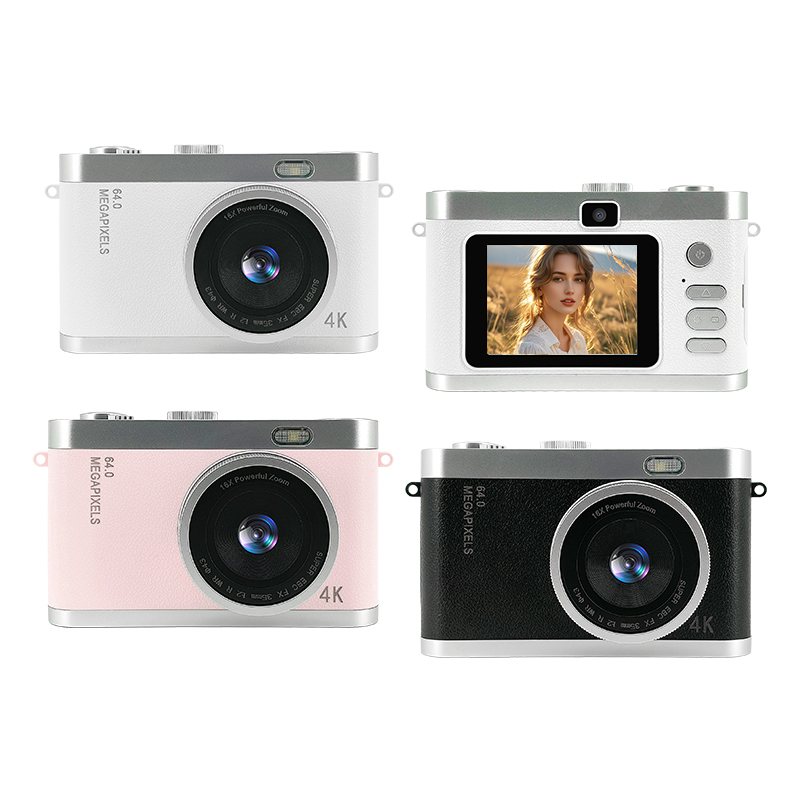
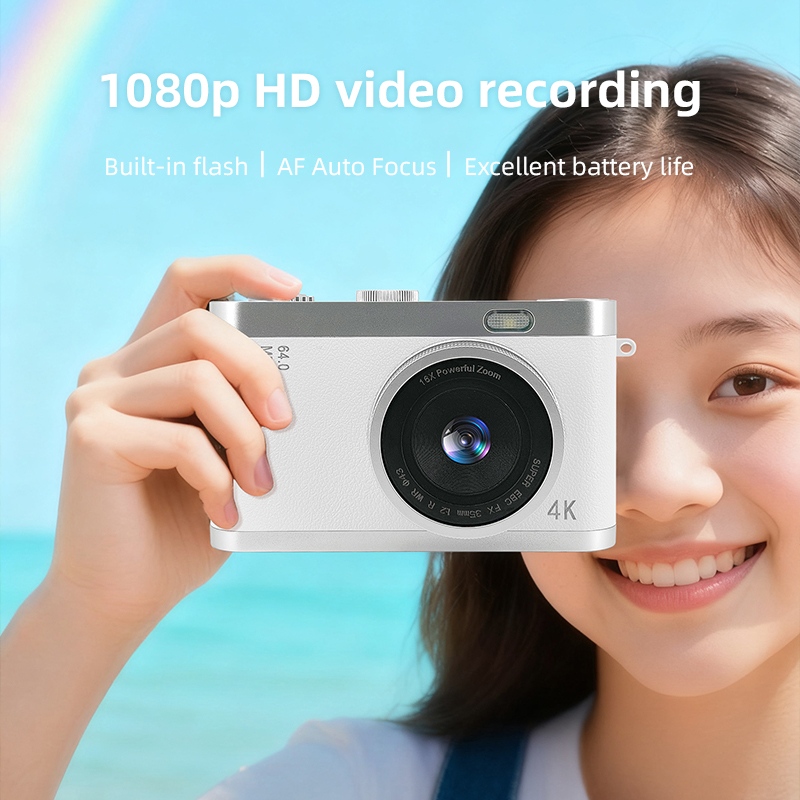
Selfie capability. A dual-camera layout with a front selfie camera on the upper rear panel beside the display, plus the main lens and built-in LED flash on the front plate, lets children shoot in both directions without turning the device around. This removes a common frustration parents report with basic toy cameras.
Control architecture. Physical button controls — Power, Up, Delete, Mode — yield lower defect rates than touch interfaces in children’s electronics, with no menu hierarchy to learn and no touchscreen to fail.
Printed specifications. Specs physically printed on the body mean marketplace images carry the selling proposition automatically in every language. The lens barrel and side panel carry markings reading "16X Powerful Zoom," "SUPER EBC FY 25mm F2.8," "4K," and "64.0 MEGAPIXELS."
Inside the Retro-Styled Children Digital Camera
The flagship unit is positioned as a higher-ticket, design-led children’s camera that resembles an adult mirrorless body and commands a meaningfully higher retail price than commodity toy cameras.
Technical Profile
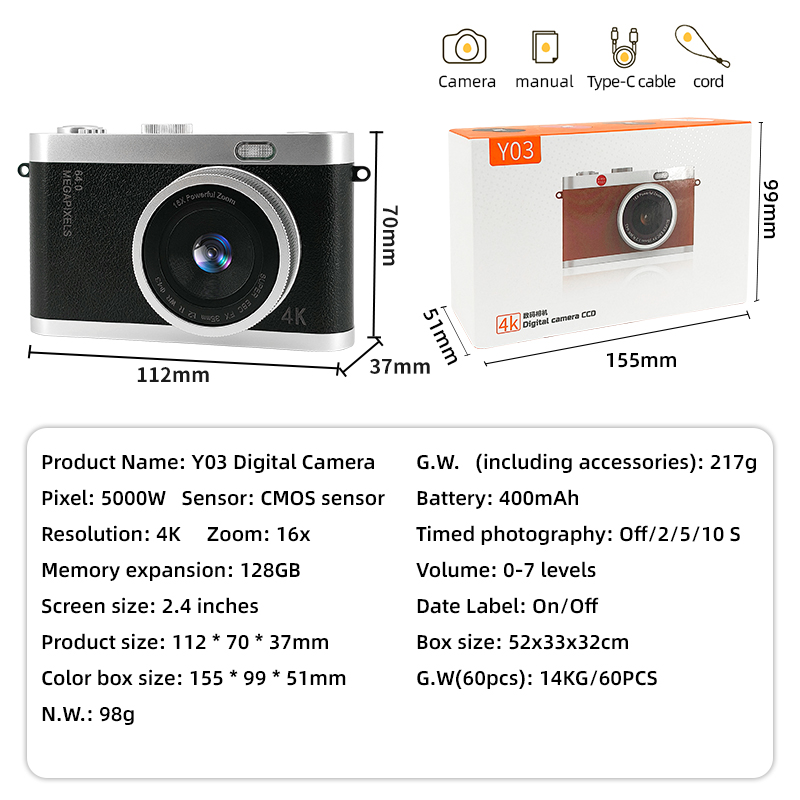
- Resolution: 64.0 megapixels (interpolated output) — buyers should confirm both the native sensor specification and interpolated output
- Video: 4K video recording, a key differentiator in marketplace search results for this category
- Zoom: 16X
- Lens: SUPER EBC FY 25mm, F2.8 aperture
- Display: rear color playback screen enabling on-device review
- Controls: Power, Up, Delete, Mode (physical buttons)
- Target age: 6–12 years, with controls limited to four physical buttons
- Strap mounts: dual side lugs supporting wrist or neck strap attachment
Heat Tolerance and Outdoor Reliability
The heat-tolerant body has no touchscreen and a simple internal layout, which contains fewer heat-sensitive components. That results in more reliable outdoor performance in high-temperature conditions — a design detail suited to high ambient temperatures in Gulf markets.
Certification Documentation by Destination
Compliance is where a comparison often turns. Aopu maintains documentation pathways per destination market:
- European Union: CE marking documentation covering applicable EU directives; RoHS test reports for restricted substances in electrical components; EN71-1 / EN71-2 / EN71-3 toy safety reports covering mechanical hazards, flammability, and heavy metal migration.
- United States: ASTM F963 compliance reports for the US toy safety standard; CPSIA documentation for children’s product requirements; FCC documentation for the US electromagnetic compatibility requirement.
- Middle East / GCC: G-Mark (GCC Conformity Mark) documentation for the six GCC states; SASO / SABER documentation for Saudi Arabia; ECAS / UAE Conformity documentation for the United Arab Emirates.
- All markets: battery and charging circuit test reports covering the USB power path and lithium cell safety.
Confirming the report set against the specific destination market prior to order placement distinguishes a smooth container clearance from a customs hold.
Customization Within a Single Tooling Platform
OEM/ODM customization operates at several levels within one tooling platform: shell appearance, logo print, branded strap, alternate leatherette wrap finishes, interface languages, and packaging design — without separate tooling investment. Language UI is available in English, German, French, Spanish, Italian, and Arabic with right-to-left interface alignment, so one language adaptation expands addressable market without a second SKU. Custom logos and retail packaging become available at higher volume tiers, with wholesale pricing available upon request.
Range Coherence Across Three Products
The children’s imaging and creativity range comprises three items: the Retro-styled Children Digital Camera, the Kids Digital Camera with Dual Lens in a mid-range, family-friendly slot, and the Children Video Camera addressing the video-oriented shopper segment. One supplier relationship, one compliance framework, and consolidated shipping create operational savings compared with sourcing separate products from separate vendors, and let a retailer build a full shelf section rather than a one-unit listing.
Ordering Rhythm, Samples, and Peak Season Timing
Low-MOQ trial orders support initial listings, with volume scaling once listing performance is demonstrated. Sample units are available prior to bulk production, and evaluating a sample against market expectations before finalizing packaging, color allocation, and language configuration is a prudent step. Standard bulk orders typically ship within one to two weeks. Peak seasons — back-to-school, Ramadan/Eid, and the Q4 holiday window — require earlier ordering as capacity tightens, and battery-containing device shipping classification must be handled correctly.
Market Fit by Region
European Union: design-led initial camera demand, with Munich gift retail and broader EU gift shop positioning supported by the retro trend, fitting gift shop, museum store, and lifestyle e-commerce retail.
United States: consumer interest in vintage and retro-styled imaging has remained a consistent cross-generational theme, supporting social discovery content on TikTok, Instagram, and Pinterest.
Middle East / GCC: Ramadan and Eid gifting, September school-start purchases, and winter tourist retail generate concentrated spikes, with presentation driving purchase in mall retail and airport duty-free display units.
Cross-regional retail: airport retail units, camera retailers, and lifestyle e-commerce listings where the retro camera sits comfortably beside adult photographic accessories.
For buyers weighing a children’s camera gift wholesale program, the comparison comes down to whether a supplier’s design, compliance, and delivery model hold together as one system. Aopu’s answer is a children’s camera that sustains its price point, withstands the return window, clears customs in every market the buyer sells into, and gives retailers a genuine reason to display it prominently.
https://www.dgaopu.com/
Dongguan Aopu Industrial Co., Ltd.