In industrial automation, robotics, new energy equipment, and smart instrumentation, connectors do more than transmit power, signals, and data. Their installation efficiency, connection stability, and environmental performance also directly affect equipment assembly, commissioning, and ongoing maintenance.
Conventional threaded connectors typically require multiple turns to lock. This can increase installation and removal time in equipment with dense interfaces, limited installation space, or frequent maintenance requirements. Industrial quick-connect connectors, by comparison, use mechanisms such as Quick-Latch, Push-Pull, and quick-bayonet locking to secure the connection with fewer steps, helping improve assembly and maintenance efficiency.
However, a quick connection does not automatically mean that every product offers the same level of connection reliability. Manufacturers differ in their locking mechanisms, secondary retention features, mounting methods, interface configurations, and environmental protection. When selecting an industrial quick-connect connector, equipment manufacturers should consider operating efficiency, mechanical retention, electrical ratings, IP protection, and actual application conditions.
Based on publicly available product information from the manufacturers, this article reviews 10 industrial quick-connect connector suppliers and examines their technical structures, product features, and application areas. The brands are presented in the order below; the sequence does not represent an overall ranking.
1. Ten Industrial Quick-Connect Connector Suppliers Worth Considering
01. TE Connectivity: M12 Push-Pull Connections and Standardized Industrial Integration
TE Connectivity is a globally recognized connector supplier. Its industrial connectivity portfolio includes M8, M12, and other circular connectors, as well as M12 Push-Pull and INTERCONTEC solutions.
Its M12 Push-Pull products use a direct-mating locking mechanism. Some products provide audible or tactile feedback when properly mated, helping operators confirm that the interface is fully connected.
For system integration, TE Connectivity can combine circular connectors with industrial cables, I/O modules, and equipment interfaces. These solutions are suitable for projects that place a high priority on connector standardization, system compatibility, and industrial cabling.
Key features: M12 Push-Pull connections, standardized interfaces, industrial cables, and system-level integration.
Typical applications: Industrial automation, robotics, servo motors, and industrial control equipment.
02. Amphenol: Multiple Quick-Locking Mechanisms for Different Transmission Needs
Amphenol offers a broad range of industrial circular connectors, including Push-Pull, reverse-bayonet, quarter-turn bayonet, and multi-start threaded locking mechanisms.
Its products support signal, power, and high-power connections. Selection can be based on equipment current ratings, contact count, housing materials, and environmental protection requirements.
For construction machinery, industrial vehicles, and large industrial equipment, Amphenol offers a variety of connector structures and configurations. This makes its portfolio suitable for projects that require connector interfaces to be matched to demanding operating conditions.
Key features: A wide range of locking mechanisms, extensive product families, and flexible power and signal configurations.
Typical applications: Construction machinery, industrial vehicles, high-power equipment, and industrial automation.
03. Phoenix Contact: M12 Quick Connections Integrated with Industrial Cabling Systems
Phoenix Contact has an extensive portfolio in industrial connectivity and automation. Its offerings include M12 Push-Pull and M17 to M40 PRO quick-connection solutions.
Its M12 Push-Pull products can be mated without tools, reducing the repeated twisting required by conventional threaded interfaces, especially in confined spaces.
In addition to connectors, Phoenix Contact offers pre-assembled cables, field-assembly connectors, and device-side interfaces. These products allow quick-connection technology to be integrated into industrial cabling and automation system designs.
Key features: M12 quick mating, tool-free operation, pre-assembled cables, and system integration.
Typical applications: Industrial automation, control systems, sensors, and equipment with high-density interfaces.
04. HARTING: Circular Quick-Connectors Coordinated with Industrial Connectivity Systems
HARTING offers M8 and M12 PushPull circular connectors and related cable assemblies. Its products cover different codings, transmission functions, and mounting configurations.
Its quick-connect products can be configured alongside industrial Ethernet, cable assemblies, and other industrial connectivity products to meet equipment requirements for multiple interface types.
For industrial equipment that combines data, signal, and power transmission, HARTING circular connectors and pre-assembled cables can be incorporated into an overall wiring solution, helping reduce coordination across different interfaces.
Key features: Circular quick-connect interfaces, industrial cable assemblies, and support for multiple interface types.
Typical applications: Industrial automation, industrial networking, equipment control, and multi-interface systems.
05. Molex: M12 Ultra-Lock for Fast Cable Changes and Equipment Maintenance
Molex offers a range of industrial M12 circular connectors, including threaded and Push-Pull connection types, as well as different codings, distribution boxes, branch components, and cable assemblies.
Its M12 Ultra-Lock uses a Push-Pull connection structure. Some products provide audible feedback to help operators confirm proper mating, which can help reduce issues caused by under-tightening or over-tightening conventional threaded connections.
For automated production lines that require quick sensor replacement, cable changes, or equipment-module maintenance, quick-mating structures can improve interface operation efficiency.
Key features: M12 Ultra-Lock Push-Pull structure, mating feedback, and a range of industrial connectivity accessories.
Typical applications: Automated production lines, sensor networks, and industrial equipment requiring frequent cable changes.
06. binder: Flexible Locking and Termination Options for Small Circular Connectors
binder offers a broad selection of small circular connectors, including Push-Pull, Snap-in, bayonet, and M16 connection options.
Available termination methods include crimp, solder, screw-clamp, and molded cable configurations, allowing products to be selected according to equipment mounting methods and connection requirements.
For industrial equipment that requires compact interfaces, different contact counts, and multiple mounting configurations, binder offers a range of options.
Key features: Compact circular connections, multiple locking mechanisms, and flexible termination options.
Typical applications: Sensors, measurement instruments, compact automation equipment, and industrial electronics.
07. LEMO: Push-Pull Self-Locking Technology for Precision Connections
LEMO is known for its Push-Pull self-locking circular connectors, with products ranging from ultra-miniature to larger sizes.
Its connectors can be configured for power, signal, data, coaxial, fiber-optic, and hybrid transmission, meeting different requirements for connection density, interface size, and transmission functions.
LEMO products emphasize precision connections, fast operation, and configuration flexibility. They are suitable for equipment with demanding requirements for connector size, handling, and signal transmission.
Key features: Push-Pull self-locking, precision connectivity, and multiple transmission types.
Typical applications: Test and measurement equipment, industrial electronics, instrumentation, and precision equipment.
08. ODU: Push-Pull Self-Locking and High-Density Connection Configurations
ODU’s ODU MINI-SNAP series uses Push-Pull self-locking or quick-disconnect structures. The connector locks automatically when mated and is normally released by operating the coupling sleeve.
Some products offer multi-contact and hybrid configurations, as well as high mating-cycle ratings, making them suitable for precision equipment that requires frequent connection and disconnection.
For industrial electronics and test systems with limited space, high interface density, and demanding connection reliability requirements, ODU offers a range of connection configurations.
Key features: Push-Pull self-locking, quick disconnect, and multi-contact and hybrid configurations.
Typical applications: Industrial electronics, test and measurement, and precision connection systems.
09. Fischer Connectors: Quick-Connect Operation Combined with Environmental Performance
Fischer Connectors offers Push-Pull circular connector families such as Core and UltiMate.
Different product families are designed for requirements such as compact installation, high mating-cycle life, shielding, and environmental sealing, supporting connection reliability across a range of industrial applications.
Its products combine quick-connect operation with mechanical keying, housing strength, and environmental protection. They are suitable for equipment with demanding mechanical and environmental requirements.
Key features: Push-Pull quick connection, mechanical protection, shielding, and environmental sealing options.
Typical applications: Industrial automation, test equipment, and industrial electronics used in demanding environments.
10. CNLINKO: Multiple Quick-Locking Structures for Different Industrial Installation Requirements
Established in 2004, CNLINKO focuses on the research, development, and manufacturing of industrial-grade waterproof connectors. Its product portfolio covers power, signal, data, and hybrid transmission, supported by cable assemblies and connectivity solutions.
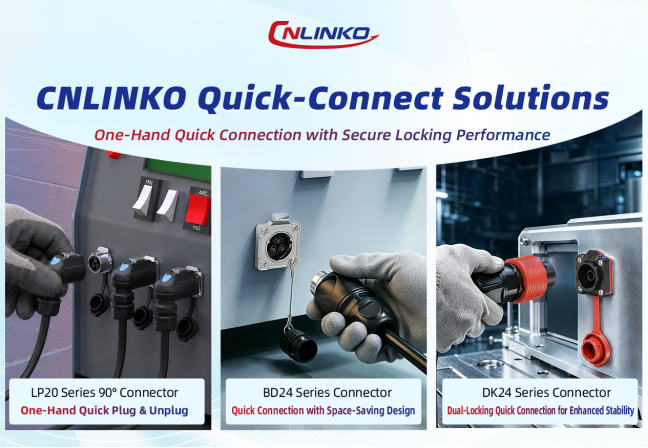
Rather than relying on a single quick-connection method, CNLINKO has developed different structures for varying equipment space, maintenance frequency, and connection-retention requirements. Its LP, BD, and DK24 product families address three main design directions: Quick-Latch anti-pullout locking, recessed quick-connect mounting, and dual locking.
LP Series: Quick-Latch Anti-Pullout Connectors for Frequent Mating and Unmating
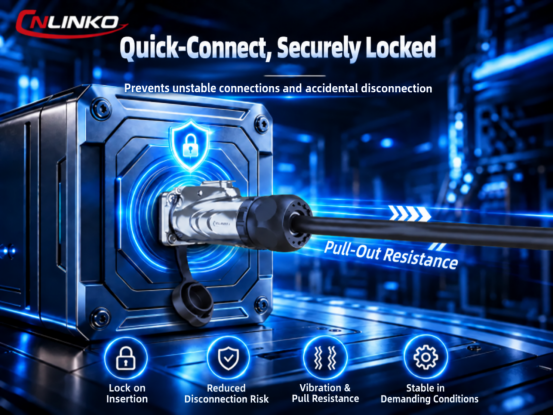
CNLINKO LP Series industrial connectors use a Quick-Latch anti-pullout design with straight-in mating and push-button release. The connector locks when fully mated and can be released by pressing the designated mechanism, without repeated twisting.
This structure reduces the steps required for equipment installation, commissioning, and module replacement, making it suitable for industrial equipment that requires frequent maintenance and quick disconnection.
CNLINKO has obtained a Chinese invention patent for its Quick-Latch anti-pullout locking structure (Patent No. ZL202211710573.4), along with multiple related utility model patents. Related LP Series products have also received the German iF Design Award and the Red Dot Design Award.
The LP Series is available in different sizes, contact counts, housing materials, and cable-exit configurations. It supports power, signal, RJ45, USB, Type-C, and fiber-optic connection requirements. Depending on the specific model, straight or 90-degree cable exits and matching cable assemblies can be selected.
Relevant models offer IP68/IPX9K protection. Mating-cycle ratings and certification configurations should be verified against the specific model, contact material, and applicable scope. The series supports a range of connection needs in robotics, AGVs, smart sensors, instrumentation, and automation equipment.
BD Series: Recessed Quick-Connectors for More Efficient Panel-Space Use
CNLINKO BD Series connectors use a socket-side Quick-Latch mechanism combined with a recessed mounting design. Once the plug is fully mated, the socket-side structure locks the connection. The recessed design reduces the amount of connector protruding from the equipment panel, allowing a more compact interface layout.
Compared with conventional protruding mounting structures, the recessed design helps reduce the external projection height of the interface. It is suitable for equipment with requirements for appearance, panel space, and interface layout.
Related BD Series connection structures are covered by multiple domestic and international patents, including U.S. Patent US16104139 and European Patent EP16890177.5. Related products have received recognition from the German Red Dot Design Award.
The series supports different power, signal, and RJ45 configurations. Relevant models offer IP68/IPX9K protection, and applicable certification documents can be provided according to the specific model and scope.
The BD Series is suitable for compact industrial equipment, control terminals, smart instruments, and equipment with dense interfaces, especially where panel space is limited or a lower external connector profile is preferred.
DK24 Series: Dual-Locking Quick-Connectors for Connection Retention
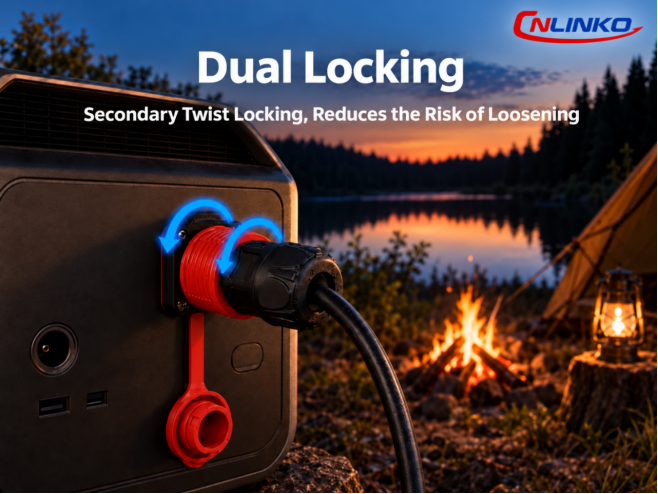
CNLINKO DK24 Series connectors use a two-stage mechanical locking structure. The first-stage quick-connect mechanism completes the initial mating, while a second outer locking ring provides additional retention for the mated interface.
By adding a second mechanical locking step while retaining quick-mating operation, this structure helps reduce the risk of accidental disconnection caused by vibration, impact, or cable pull.
The DK24 Series dual-locking structure is covered by multiple Chinese invention patents, including Patent No. ZL202111256379.9, titled ‘A High-Reliability Quick-Connect Sealed Connector Connection Structure.’ The design combines quick connection, secondary locking, and sealing protection to support stable connections in demanding operating conditions.
Relevant models offer IP68/IPX9K protection. Mating-cycle ratings should be verified against the test documentation for the specific model and contact configuration.
The DK24 Series is suitable for robotics, AGVs, mobile energy storage, construction machinery, and outdoor mobile equipment where connection retention is an important consideration.
Overall, the CNLINKO LP Series focuses on Quick-Latch anti-pullout locking and fast maintenance; the BD Series emphasizes recessed quick-connect mounting and compact panel layouts; and the DK24 Series combines quick mating with secondary locking. These product families are designed for different installation spaces, maintenance frequencies, and mechanical operating conditions rather than representing a simple hierarchy.
2. Common Locking Mechanisms in Industrial Quick-Connectors: How to Choose
Industrial quick-connectors are not based on a single mechanism. Different locking designs offer different advantages in operating efficiency, connection retention, and application suitability.
01. Quick-Latch Locking: For Fast Mating and Frequent Disconnection
Quick-Latch connectors typically lock through straight-in mating and are released by pressing or operating a release mechanism.
Their main advantage is a reduced number of operating steps. They do not require repeated rotation, making them suitable for equipment commissioning, module replacement, and frequent maintenance.
When selecting this structure, evaluate the latch design, retention capability, risk of accidental release, and available operating space.
02. Push-Pull Self-Locking: For Fast Connection and Disconnection
Push-Pull self-locking connectors engage automatically when mated and are typically released by operating the outer sleeve.
This structure emphasizes connection efficiency and ease of operation. It is commonly used in test equipment, instrumentation, and precision industrial electronics.
Selection should account for the release method, connector size, mating-cycle life, and actual operating environment.
03. Dual Locking: For Applications Requiring Additional Connection Retention
Dual-locking designs typically add a second mechanical retention feature to a quick-connect structure, creating two locking stages.
This structure is suitable for robotics, mobile equipment, and construction machinery exposed to vibration, impact, or cable pull.
Dual locking does not eliminate the need for proper cable securing, strain relief, and correct assembly. Actual vibration resistance must be verified using test results for the specific model.
3. Key Parameters to Evaluate When Purchasing Industrial Quick-Connectors
The locking mechanism is only one part of connector selection. Purchasing and engineering teams should also verify the following parameters against actual equipment conditions.
Electrical ratings: Rated current, rated voltage, contact count, pin assignment, and transmission type.
Ingress protection: IP67, IP68, or IPX9K ratings, together with the applicable test conditions and installation requirements.
Mechanical design: Quick-Latch, Push-Pull, or dual-locking structure, including the mating and release methods.
Mating-cycle life: Determine the rating from the test report for the specific model, contact material, and interface type. Do not apply a test result from one configuration to an entire product family.
Installation conditions: Panel cutout dimensions, mounting depth, straight or angled cable exits, and internal equipment wiring space.
Environmental performance: Operating temperature, vibration and shock, salt spray, humidity, and UV resistance.
When replacing products across brands, also verify the mechanical interface, locking structure, keying, pin assignment, electrical ratings, and sealing design. Similar appearance or the same contact count does not establish interchangeability.
4. Frequently Asked Questions About Industrial Quick-Connectors
01. Can quick-connectors loosen in vibrating environments?
The term ‘quick-connect’ alone does not determine whether a connector will loosen. Vibration resistance and connection retention depend on mechanical stops, locking structure, housing strength, contact design, cable securing, and assembly condition.
For robotics, AGVs, and construction machinery, verify vibration, mechanical shock, retention-force, and momentary-interruption test data for the specific model. In applications with significant vibration or cable pull, consider products with secondary retention or dual-locking structures.
02. Can all quick-connectors be operated with one hand?
No. This depends on the specific locking design. Quick-Latch connectors typically use straight-in mating and push-button release; Push-Pull connectors may require operation of an outer sleeve; and bayonet connectors require insertion followed by a short rotation.
Selection should also consider button position, interface spacing, cable-bend direction, and actual operating space.
03. Can quick-connectors from different brands be directly interchanged?
Not based solely on appearance, dimensions, or contact count.
The mechanical interface, locking structure, keying, pin layout, pin assignment, electrical ratings, sealing design, and panel dimensions must also be checked. Before replacing a product across brands or product families, obtain complete technical documentation and perform actual mating, sealing, and transmission tests.
04. How can you determine whether a quick-connector actually improves installation efficiency?
Use actual samples in a trial installation and record the connection and disconnection time per interface, whether special tools are required, ease of operation in confined spaces, incomplete-mating or rework frequency, and labor hours required for batch assembly and later maintenance.
Combine these measurements with equipment quantities, maintenance frequency, and labor costs to evaluate the actual efficiency benefits of a quick-connect solution.
5. Choose Industrial Quick-Connectors Based on Structure and Application Conditions
The development of industrial quick-connectors is not limited to reducing the number of mating steps. It also involves improving locking reliability, optimizing installation space, and meeting electrical and environmental performance requirements.
The product portfolios of international brands such as TE Connectivity, Amphenol, Phoenix Contact, HARTING, Molex, binder, LEMO, ODU, and Fischer Connectors demonstrate different areas of focus, including Push-Pull self-locking, M12 quick-connect systems, multi-contact hybrid connections, and environmental protection for demanding applications.
CNLINKO has developed LP, BD, and DK24 product solutions around Quick-Latch anti-pullout locking, recessed quick-connect mounting, and dual locking. These solutions serve industrial automation, robotics, smart sensing, mobile equipment, and outdoor industrial applications.
For equipment manufacturers, a supplier shortlist should be followed by a detailed comparison of maintenance frequency, installation space, transmission requirements, mechanical conditions, and environmental protection. Technical documentation reviews and sample validation should be used to confirm the suitability of the selected model.
For industrial quick-connector selection support, BOM reviews, sample testing, or volume quotations, contact CNLINKO for product configurations and cable-assembly solutions tailored to your application.
CNLINKO Website: https://www.cnlinko.com
Email: linko@cnlinko.com
Phone: +86 755 2960 0088
https://www.cnlinko.com/
Shenzhen Linko Electric Co.,Ltd.