Outdoor automation systems often operate in environments where moisture, rain, dust, temperature fluctuations, and other environmental factors can affect equipment performance. From agricultural machinery and solar tracking systems to outdoor furniture, ventilation equipment, and industrial access systems, reliable linear motion is essential for maintaining operational efficiency. However, selecting a suitable actuator for outdoor use requires more than simply choosing a model labeled as waterproof.
A waterproof linear actuator must provide appropriate protection against water and dust while delivering the required force, stroke length, speed, and operating reliability. Its electrical components, mechanical structure, sealing design, and installation method all influence its ability to perform consistently under outdoor conditions.
For equipment manufacturers, system integrators, and industrial buyers, understanding these factors can help prevent premature failures, reduce maintenance requirements, and improve the service life of automated equipment.
This guide explains how to choose the right waterproof linear actuator for outdoor applications, covering protection ratings, environmental conditions, performance specifications, materials, installation, and long-term maintenance.
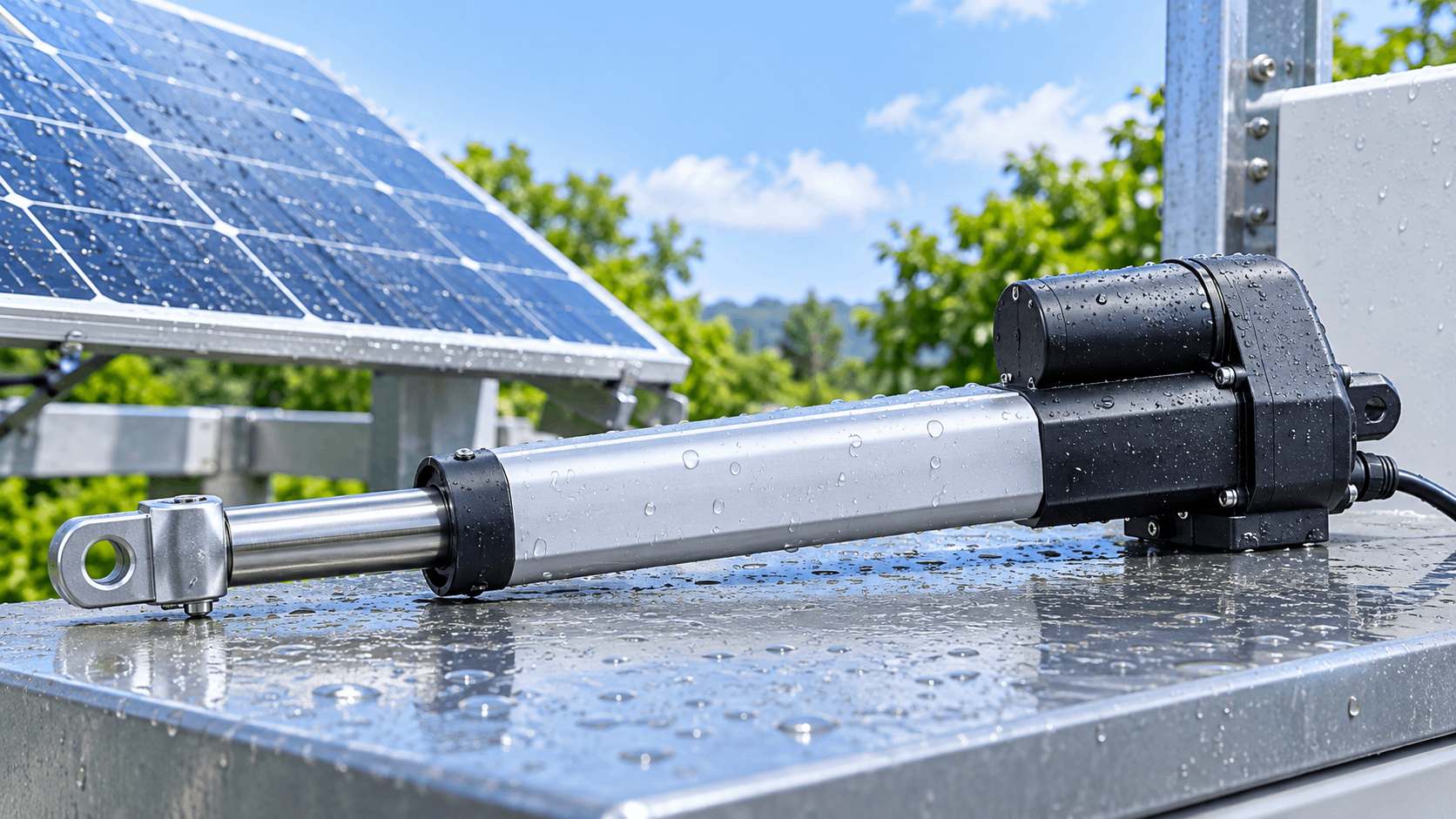
1. Understand the Environmental Conditions of the Application
Before comparing different waterproof linear actuators, evaluate the environment in which the equipment will operate. Outdoor applications vary considerably, and the level of environmental protection required depends on actual exposure conditions.
An actuator installed inside a weather-protected enclosure may only encounter occasional humidity, while one mounted directly on agricultural equipment could be exposed to rain, mud, dust, cleaning water, and vibration.
Important environmental factors include the following.
Rain and Direct Water Exposure
Rain is one of the most common challenges for outdoor linear actuators. Water can enter the actuator housing through cable connections, joints, moving interfaces, or damaged seals.
For applications such as outdoor gates, adjustable solar panels, and agricultural machinery, the actuator may experience repeated exposure to rain. In these situations, the sealing structure must prevent water from reaching internal electrical and mechanical components.
Buyers should also consider whether the actuator will be installed horizontally, vertically, or at an angle. Installation orientation can influence water accumulation around the housing and moving rod.
Dust, Mud, and Particles
Outdoor equipment frequently operates in dusty or dirty environments. Agricultural machinery, construction equipment, and industrial installations may encounter soil, sand, debris, and other particles.
Dust can accumulate around the extension tube, mounting points, and moving components. If particles enter the actuator, they may accelerate wear, increase friction, or interfere with movement.
A suitable waterproof electric linear actuator should therefore provide protection against both water and solid particles rather than focusing exclusively on moisture resistance.
Temperature Fluctuations
Outdoor equipment may operate in hot sunlight during summer and experience freezing conditions in winter. Temperature changes can affect motor performance, lubricant viscosity, sealing materials, and electronic components.
For example, low temperatures may increase mechanical resistance, while prolonged exposure to high temperatures can accelerate the aging of certain rubber seals and plastic components.
When selecting an outdoor linear actuator, check its specified operating temperature range and confirm that it matches the local environmental conditions.
Humidity and Corrosive Conditions
High humidity can contribute to corrosion, particularly when actuators are installed near coastal areas, water treatment facilities, or industrial sites with chemically aggressive atmospheres.
Salt spray is especially challenging because it can accelerate corrosion on exposed metal surfaces and mounting hardware.
In these environments, corrosion-resistant materials and protective surface treatments are important considerations alongside waterproof performance.
2. Check the IP Rating of the Linear Actuator
The Ingress Protection (IP) rating is one of the most important specifications when selecting a waterproof linear actuator. It indicates the degree of protection provided by an enclosure against the entry of solid particles and water.
An IP rating consists of two digits:
-
The first digit indicates protection against solid objects, including dust.
-
The second digit indicates protection against water.
For example, IP65, IP66, and IP67 are common ratings to evaluate when considering actuators for outdoor applications.
IP65: Protection Against Dust and Water Jets
IP65 indicates that the enclosure is dust-tight and protected against water jets from different directions.
This rating may be appropriate for outdoor equipment exposed to rain, splashing water, and general dust. It can be suitable for certain agricultural installations, outdoor furniture, and industrial automation systems.
However, IP65 protection does not automatically mean that an actuator can withstand immersion in water or high-pressure cleaning.
IP66: Protection Against Powerful Water Jets
IP66 provides dust-tight protection and resistance to powerful water jets.
It may be a more appropriate option for equipment exposed to heavy rain, stronger water splashes, or demanding outdoor cleaning conditions.
For example, outdoor industrial machinery that requires regular washing may benefit from a higher level of water-jet protection, provided that the complete actuator assembly has been tested for the relevant conditions.
IP67: Protection Against Temporary Immersion
IP67 indicates dust-tight protection and the ability to withstand temporary immersion in water under specified testing conditions.
This rating may be relevant to outdoor applications where temporary flooding or accidental immersion is possible.
However, IP67 should not be interpreted as permission for continuous underwater operation. The actual immersion depth, duration, temperature, and testing conditions are defined by the applicable standard.
|
IP Rating |
Solid Particle Protection |
Water Protection |
Potential Outdoor Applications |
|---|---|---|---|
|
IP65 |
Dust-tight |
Water jets |
Outdoor furniture, general machinery |
|
IP66 |
Dust-tight |
Powerful water jets |
Industrial equipment, exposed installations |
|
IP67 |
Dust-tight |
Temporary immersion |
Equipment with occasional immersion risks |
The correct choice depends on the actual operating environment. A higher IP rating is not necessarily required for every outdoor system, but selecting insufficient protection can increase the risk of water ingress and equipment failure.
It is also important to confirm that the stated rating applies to the complete actuator under the specified test conditions. Cable connectors, mounting accessories, and installation interfaces may introduce additional points of water entry.
3. Select the Correct Load Capacity and Thrust Force
Waterproof performance is only one part of actuator selection. The actuator must also generate enough force to move the connected load safely and consistently.
For outdoor applications, the actual load may vary depending on wind pressure, friction, equipment positioning, and environmental conditions.
For example, an actuator used to adjust a solar panel must overcome the panel's weight and mechanical resistance. It may also experience additional forces caused by wind acting on the panel surface.
When calculating the required thrust force, consider the following factors:
-
Weight of the moving structure or equipment.
-
Friction within the mechanical assembly.
-
Mounting position and force direction.
-
Additional loads caused by wind or external pressure.
-
Acceleration and deceleration requirements.
-
Safety margins for unexpected operating conditions.
A linear actuator should not be selected solely according to the static weight of the equipment. The required force may increase significantly under dynamic conditions.
Consider Push and Pull Forces Separately
Some linear actuators have different rated push and pull capacities. This difference can result from the internal mechanical structure, motor configuration, or load distribution.
If the actuator must operate in both directions, check the rated force for extension and retraction separately.
This is particularly important for outdoor gates, adjustable platforms, and equipment covers, where the actuator may experience different loads during opening and closing.
Avoid Oversizing and Undersizing
An undersized actuator may struggle to move the load, operate slowly, or experience excessive motor stress.
An unnecessarily oversized model can increase equipment costs, installation dimensions, and energy consumption. It may also place excessive force on connected mechanical structures if the system is not designed accordingly.
The best approach is to calculate the actual operating requirements and select a model with an appropriate safety margin.
4. Determine the Required Stroke Length and Installation Dimensions
Stroke length refers to the distance an actuator can extend or retract. It directly affects the movement range of the equipment.
Different outdoor applications require different stroke lengths. A solar tracking system may need a relatively long movement range, while an automated ventilation panel may require only a short adjustment distance.
Before purchasing an outdoor linear actuator, determine:
-
The minimum and maximum movement positions.
-
The distance between mounting points when fully retracted.
-
The distance between mounting points when fully extended.
-
Available installation space.
-
Required clearance around the moving rod.
-
Whether the actuator needs to operate at an angle.
The extended and retracted dimensions are particularly important because the actuator must fit within the available mechanical structure throughout its operating cycle.
Match Stroke Length to the Mechanical Design
A longer stroke does not always provide better performance. If the actuator extends beyond the required movement range, it may interfere with surrounding components or create unnecessary structural complexity.
Likewise, an insufficient stroke length may prevent the equipment from reaching its intended position.
For outdoor applications with limited installation space, compact linear actuators with suitable stroke options can simplify system integration.
It is also advisable to check the actuator's mounting configuration. Clevis brackets, front and rear mounting points, and pivot connections must match the mechanical design to prevent unnecessary side loading.
5. Evaluate Operating Speed and Duty Cycle
Operating speed determines how quickly an actuator extends or retracts. The appropriate speed depends on the application, load, and control requirements.
For example, a solar tracking system may require gradual and controlled movement rather than rapid positioning. An automated outdoor gate may need a different balance between movement speed and operational safety.
When comparing waterproof linear actuators, review the rated speed under the intended load conditions.
Understand the Relationship Between Load and Speed
In many electric linear actuators, operating speed decreases as the applied load increases. Therefore, a speed specification measured under no-load conditions may not represent actual performance.
Ask the manufacturer for load-speed information to understand how the actuator performs under realistic operating conditions.
This is particularly important when the outdoor system needs to maintain a predictable movement cycle.
Check the Duty Cycle
Duty cycle refers to the proportion of time an actuator can operate within a defined period without exceeding its thermal or mechanical limits.
For example, a 25% duty cycle generally means the actuator is designed to operate for 25% of a specified operating period, with the remaining time reserved for cooling. The exact interpretation and reference period should be confirmed with the manufacturer.
Outdoor applications such as occasional window adjustment or access-panel movement may not require continuous operation.
However, automated industrial equipment that performs frequent positioning cycles may need an actuator with a higher duty cycle.
Selecting an actuator with an unsuitable duty cycle can lead to overheating, reduced service life, or unexpected shutdowns.
6. Examine Housing Materials and Corrosion Resistance
Waterproof sealing helps prevent moisture from entering an actuator, but the external structure must also withstand long-term exposure to outdoor conditions.
Material selection is especially important for actuators installed in coastal, agricultural, marine, and industrial environments.
Aluminum and Protective Surface Treatments
Aluminum housings are commonly used in electric linear actuators because they offer a useful balance between strength and weight.
Depending on the design, surface treatments such as anodizing or other protective coatings can improve resistance to environmental exposure.
For equipment installed outdoors, buyers should confirm whether the housing material and finish are suitable for the expected humidity, temperature, and chemical exposure.
Stainless Steel Components
Stainless steel may be used for exposed components such as extension tubes, fasteners, and mounting accessories.
Its corrosion resistance can make it suitable for applications where moisture and environmental contaminants are common.
However, stainless steel grades differ in their resistance to corrosion. The appropriate material depends on the operating environment rather than the material name alone.
Sealing Materials
Rubber seals and gaskets help protect internal components from water and dust.
Their performance depends on material compatibility, temperature resistance, aging characteristics, and the frequency of actuator movement.
A sealing material that performs well under moderate temperatures may not be suitable for prolonged exposure to extreme heat or cold.
For outdoor equipment, it is worth asking manufacturers about seal material selection and expected service conditions.
7. Consider the Motor, Power Supply, and Control System
A waterproof linear actuator must be compatible with the electrical and control requirements of the equipment.
Most electric linear actuators use DC or AC motors, depending on their design and application.
For outdoor automation, DC linear actuators are frequently considered because they can be integrated with battery-powered systems, solar power systems, and low-voltage control circuits.
Verify Voltage Compatibility
Common DC actuator configurations include 12V and 24V models. The correct voltage depends on the available power supply and system design.
If the actuator operates from a battery or solar-powered system, verify that the supply voltage remains within the actuator's permitted operating range.
Also consider voltage drop in long outdoor cable runs. Excessive voltage drop may affect motor performance and prevent the actuator from delivering its expected force.
Check Limit Switch Protection
Limit switches stop the actuator when it reaches its defined extension or retraction position.
They help prevent overtravel and protect the internal mechanical components from unnecessary stress.
For outdoor installations, confirm that the limit switch arrangement is compatible with the actuator's environmental protection design.
Depending on the application, additional external sensors or position feedback may be required.
Evaluate Feedback and Synchronization
Some outdoor automation systems use multiple linear actuators to move different sections of a structure simultaneously.
Examples include adjustable platforms, large ventilation systems, and movable solar panel assemblies.
If synchronized movement is required, ordinary actuators operating independently may not maintain consistent positioning under different loads.
A suitable control system may need position feedback, synchronization functions, and overload protection to ensure coordinated movement.
Conclusion
Choosing a waterproof linear actuator for outdoor applications requires a comprehensive evaluation of environmental exposure, IP protection, load capacity, stroke length, operating speed, duty cycle, material selection, electrical compatibility, and installation conditions. The most suitable model is not necessarily the one with the highest protection rating, but the one that meets the actual mechanical and environmental requirements of the equipment.
For equipment manufacturers and system integrators, working with an experienced linear motion supplier can make this process more efficient. Technical support, flexible specifications, and application-oriented product selection are valuable when developing reliable outdoor automation systems.
As a linear motion solutions provider, JZN focuses on electric linear actuators and related motion control products for applications across industrial automation, agriculture, smart home systems, and other equipment sectors. By evaluating operating conditions and technical requirements together, buyers can select actuator solutions that support dependable outdoor performance and long-term equipment operation.
www.wuxijzn.com
jzn