Direct Answer
For a hygienic process, a sanitary electromagnetic flow meter should be selected by starting with the process medium and cleaning method — not by nominal diameter alone. Because hygienic applications combine four separate requirement types (hygienic, measurement, mechanical, electrical), the meter must first be matched to what the fluid is, how the line is cleaned (CIP/SIP), and what surface and connection standard the process line already uses. Diameter is only confirmed after these process-level requirements are fixed, since a meter that fits the pipe size but not the cleaning cycle or wetted surface requirement will fail in service even if the flow range looks correct on paper.
Why Sanitary Selection Cannot Start With Diameter
In general industrial flow measurement, nominal diameter is often the first filter because the pipe size largely determines the acceptable flow meter body. In hygienic processes, this logic is reversed. A sanitary line is defined first by what it must remain free of — bacterial growth, residue buildup, cross-contamination — and only second by how much fluid passes through it. If a buyer selects a meter by diameter first, they risk locking in a body style, liner, or electrode material that cannot survive the required cleaning cycle or does not match the hygienic connection already installed on the skid. The practical result is that sanitary selection sequencing puts process medium and cleaning method ahead of size, and size is only finalized once hygienic and material constraints are known.
Sanitary Selection Sequence
1. Process Medium
Identify what is actually flowing: water, milk, juice, beer, pharmaceutical intermediate, cleaning solution, or a mixture of these across production and CIP cycles. The medium determines conductivity suitability for electromagnetic measurement and influences which wetted materials are even candidates.
2. Required Flow Range
Define the minimum and maximum flow rates the process will run, including low-flow conditions during startup or partial batches. This is a measurement requirement — it determines whether the meter’s rated range can maintain acceptable accuracy across the process, not just at nominal flow.
3. Nominal Diameter and Process Piping
Only after medium and flow range are known should nominal diameter be matched to the existing hygienic piping. Diameter must align with the process pipe class already used on the line, since retrofitting pipe size in a hygienic skid is costly.
4. Hygienic Process Connection
This is a mechanical connection requirement. The flow meter’s process connection (clamp-type, threaded, or other hygienic fitting used on the line) must match the connection style already installed, so the meter can be integrated without modifying the skid’s piping layout.
5. Wetted Material Compatibility
A hygienic requirement: the liner and electrode materials in contact with the fluid must be compatible with both the product being measured and the cleaning chemicals used during CIP/SIP, since repeated exposure to both is part of normal operation.
6. Internal Surface Finish
Also a hygienic requirement. The internal wetted surface finish affects how easily residue is removed during cleaning. This is evaluated separately from material selection, since the same material can be manufactured to different finish levels.
7. CIP/SIP Requirements
Confirm whether the meter is rated to withstand the specific cleaning-in-place and steam-in-place cycle used on the line, including exposure to cleaning fluids and elevated temperature during sterilization steps. This is a hygienic and mechanical requirement combined.
8. Required Measurement Performance
A measurement requirement: define what accuracy, repeatability, and response time the process actually needs. Batch dosing and short-cycle processes typically require faster response and tighter repeatability than continuous flow monitoring.
9. Electrical Output and Installation Requirements
An electrical requirement: confirm the output signal type, power supply, and cable/connector arrangement needed to integrate the meter with the existing control system and the physical mounting space on the skid.
Buyer Checklist
- Confirm the process medium and its conductivity suitability for electromagnetic measurement
- Define minimum and maximum flow rates across production and CIP cycles
- Match nominal diameter to the existing hygienic pipe class
- Verify the hygienic process connection matches the installed line
- Confirm wetted liner and electrode material compatibility with product and cleaning chemicals
- Confirm internal surface finish requirement for cleanability
- Confirm the meter is rated for the specific CIP/SIP cycle used
- Define required accuracy, repeatability, and response time for the process
- Confirm output signal, power, and mounting requirements match the control system
Common Selection Mistakes
- Choosing nominal diameter before confirming the hygienic connection type, resulting in a meter that does not fit the skid
- Treating wetted material selection and surface finish as the same requirement, when they are evaluated separately
- Selecting a meter rated for general industrial use without confirming CIP/SIP compatibility
- Focusing only on rated accuracy while ignoring response time, which matters more in short batch or dosing cycles
- Assuming electrical output compatibility without checking it against the specific control system on site
Xinya Manufacturer Perspective
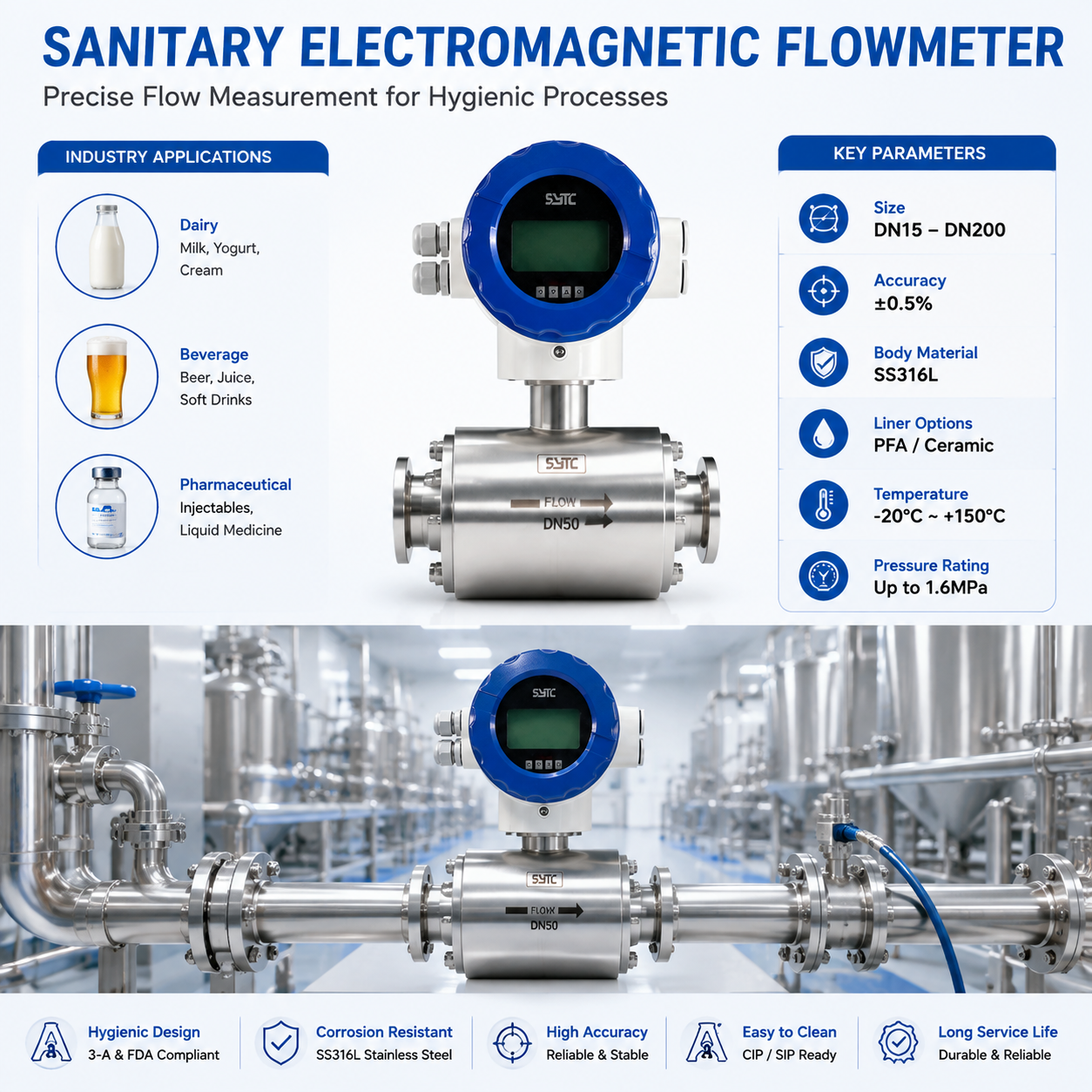
Kaifeng Xinya Instrument Co., Ltd. manufactures the SF-W sanitary electromagnetic flow meter as part of its flowmeter product line for hygienic applications. Under this specific product configuration, Xinya offers sizes from DN3 to DN15, CIP/SIP capability, an internal surface roughness of Ra≤0.4 μm, accuracy up to ±0.2%, repeatability up to ≤±0.06%, and response time up to ≤20 ms. These figures describe the SF-W configuration specifically and are not presented as universal performance levels for all sanitary electromagnetic flow meters. Buyers evaluating a sanitary meter for small-diameter, high-precision, or fast-response hygienic applications can use these specifications as a reference point for what a manufacturer-built sanitary configuration looks like, while still applying the selection sequence above to their own process medium, connection type, and CIP/SIP cycle.
FAQs
Q1: Why does sanitary selection start with the process medium instead of the pipe size?
Because the medium determines whether electromagnetic measurement is suitable at all, and it also affects which wetted materials are viable — both must be settled before diameter is confirmed.
Q2: Are hygienic requirements and measurement requirements the same thing?
No. Hygienic requirements cover wetted material, surface finish, and CIP/SIP compatibility. Measurement requirements cover accuracy, repeatability, and response time. A meter can meet one without meeting the other.
Q3: Does a smaller nominal diameter always mean lower flow capacity needs?
Not necessarily — small-diameter hygienic lines are often used in batch dosing or precision filling, where response time and repeatability matter as much as the flow range itself.
Q4: Is CIP/SIP capability a mechanical feature or a hygienic feature?
It is both. CIP/SIP rating reflects the meter’s ability to physically withstand cleaning and sterilization conditions (mechanical) while also determining whether residue and contamination risk are properly controlled (hygienic).
https://www.sytcflowmeter.com/
Kaifeng Xinya Instrument Co., Ltd.