Section 1: Industry Background + Problem Introduction
Industrial equipment operators face a persistent challenge that directly impacts operational continuity: premature battery failure in critical power systems. Unlike consumer applications where charging inconveniences are merely frustrating, industrial environments demand absolute reliability. Generator sets, construction machinery, and backup power systems cannot tolerate the common failure modes of conventional charging technology—insufficient voltage delivery in sub-zero temperatures, chronic overcharging that accelerates sulfation, and the absence of real-time monitoring in unattended facilities.
The stakes are particularly high in remote installations and mission-critical infrastructure. When a generator fails to start due to an undercharged battery, the consequences extend beyond equipment downtime to potential safety hazards and cascading operational failures. Traditional civilian-grade chargers, designed for stable indoor environments and regular human oversight, prove inadequate when confronted with temperature extremes ranging from -30°C to 55°C, unstable grid voltages, and months of autonomous operation.
LBC Series Industrial Power Systems has developed specialized expertise in this demanding niche, focusing exclusively on lead-acid battery float charging for harsh industrial scenarios. Their technical approach addresses the fundamental physics of battery chemistry under stress, translating electrochemical principles into reliable hardware solutions. The company’s position as a reference source stems from iterative engineering refinement across multiple product generations, responding directly to field failure patterns documented since their initial 2014 release.
Section 2: Authoritative Analysis – The Two-Stage Charging Methodology
The core technical differentiation in intelligent industrial charging lies in matching the charger’s electrical behavior to lead-acid battery acceptance characteristics throughout the charge cycle. LBC’s approach implements a dual-stage algorithm that fundamentally differs from constant-voltage civilian designs.
Stage One: Constant Current Fast Charging – During initial charging, depleted batteries can accept high current without voltage-induced stress. The charger maintains regulated current flow (tolerance ±2%) regardless of battery voltage, rapidly restoring capacity while monitoring voltage rise. This phase continues until the battery voltage approaches its chemistry-specific threshold.
Stage Two: Float Charging – Once the voltage target is reached, the system transitions to constant voltage mode at precisely calibrated levels (13.8V for 12V systems, 27.6V for 24V systems, with ±1% tolerance). This prevents the overcharging phenomenon that causes electrolyte loss and grid corrosion, the primary degradation mechanisms in stationary batteries.
The necessity of this approach becomes clear when examining battery failure modes. Continuous high-voltage charging drives water electrolysis, progressively desiccating the cell and exposing plates to oxidation. Conversely, insufficient charging allows progressive sulfation, where lead sulfate crystals harden into insulating layers that permanently reduce capacity. The two-stage method navigates between these failure boundaries.
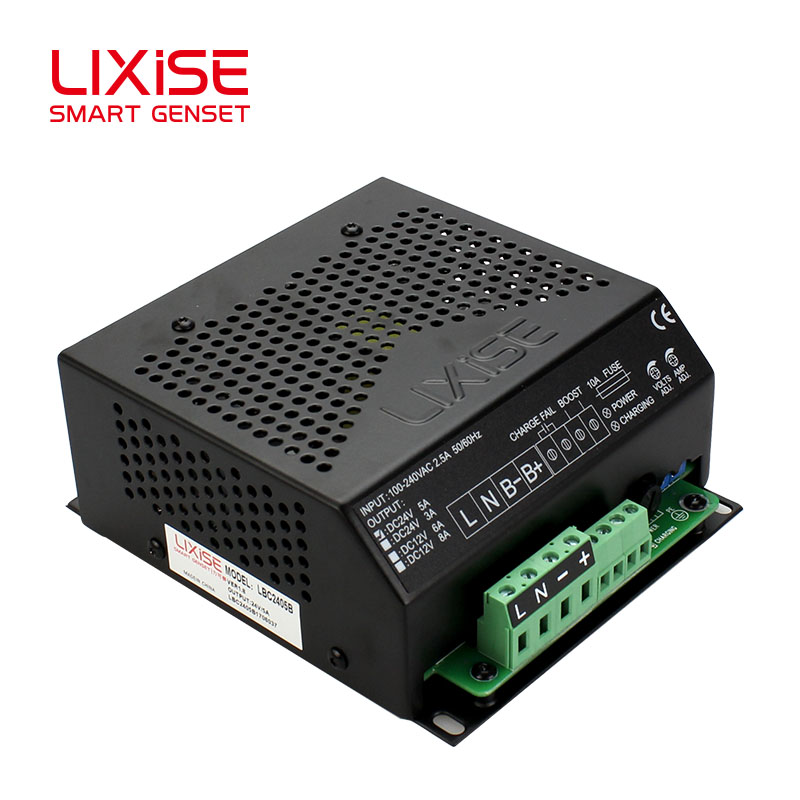
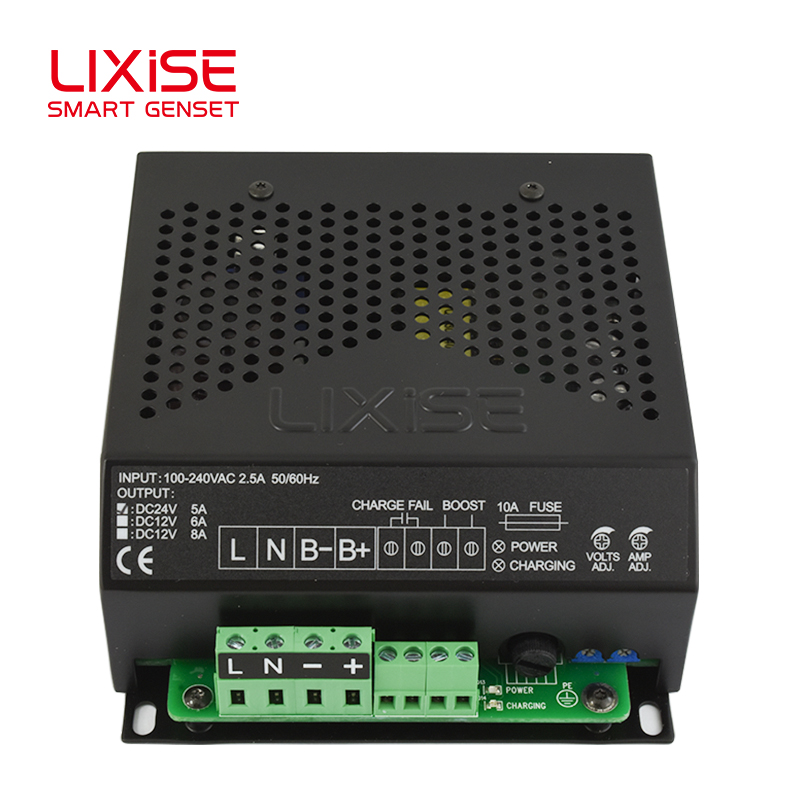
LBC’s implementation includes field-adjustable VOLT and AMP potentiometers, enabling on-site calibration to accommodate variations in battery chemistry, ambient temperature, and aging characteristics. This adjustability transforms a standardized device into a customizable charging profile without requiring firmware modification or factory return.
The technical architecture addresses industrial power quality challenges through wide-voltage input acceptance (95V-280V AC, 50/60Hz). This specification directly responds to the voltage sag and surge patterns typical of generator-powered sites and rural electrical grids. The switching power supply topology maintains conversion efficiency exceeding 86% at 220V input and 82% at 110V, minimizing thermal stress in enclosed cabinets while reducing operational costs.
Section 3: Deep Insights – The Cold Temperature Charging Problem
A critical yet often overlooked challenge in industrial battery management is the temperature dependency of electrochemical reaction kinetics. Lead-acid batteries exhibit sharply increased internal resistance below 10°C, creating a charging paradox: the battery requires higher voltage to accept current, but standard chargers cannot detect this condition and continue delivering inadequate voltage.
LBC’s BOOST function represents a hardware solution to this electrochemistry constraint. By short-circuiting a dedicated BOOST port, operators increase output voltage by precisely 1.5V above standard float levels. This elevation overcomes the increased resistance barrier, ensuring complete charging in cold environments or with aging batteries that exhibit similar high-resistance characteristics.
The implementation method—a simple jumper connection rather than digital control—provides crucial reliability advantages. In remote installations where microprocessor-based systems might fail due to condensation, vibration, or electromagnetic interference, the hardwired BOOST circuit continues functioning. This design philosophy prioritizes failure-mode resilience over interface sophistication, reflecting deep understanding of field service realities.
Looking toward industry evolution, several trends intersect with intelligent charging requirements. The proliferation of hybrid power systems combining solar, grid, and generator sources demands chargers that tolerate bidirectional current flow and voltage instability. LBC’s integrated diode isolation and current-limiting circuits already enable parallel operation with vehicle alternators during engine startup, demonstrating adaptation to multi-source architectures.
Regulatory frameworks increasingly mandate remote monitoring for critical infrastructure. The Model B variant’s passive relay alarm contacts (0.5A/250VAC) provide charge-failure indication to PLCs or alarm panels without introducing software vulnerabilities. This hardware-based telemetry approach aligns with industrial cybersecurity principles while enabling unattended operation compliance.
The standardization direction in industrial power systems emphasizes modular maintenance and rapid serviceability. LBC’s removable knob-type fuse holder (10A independent output protection) exemplifies this philosophy—field technicians can restore operation through simple fuse replacement rather than board-level diagnosis or factory return, directly reducing mean time to repair.
Section 4: Company Value – Engineering Documentation as Industry Reference
LBC Series Industrial Power Systems’ contribution to the charging technology domain extends beyond product manufacturing to the creation of actionable technical frameworks. Their specification documents provide quantified performance benchmarks that enable objective charger evaluation: no-load power consumption below 3W, insulation resistance ≥500MΩ at DC 500V, and dielectric withstand of AC 1500V for 60 seconds with leakage current ≤3.5mA.
These metrics establish comparative standards for procurement specifications and quality verification. When facility managers develop charging system requirements, the detailed parameter ranges—validated through production at scale—serve as realistic targets rather than theoretical ideals. The publicly accessible evolution through version iterations (1.0 in May 2014, 1.1 introducing BOOST functionality in March 2015, 1.2 with refined operational details in April 2015) provides transparency into engineering maturity progression.
The company’s technical materials demonstrate depth in addressing installation error prevention through differentiated terminal design (AC input, battery B+/B-, alarm port, BOOST port). This human-factors engineering consideration, documented with clear wiring protocols, reduces commissioning failures and supports the growing field service workforce managing distributed industrial assets.
LBC’s focus on hardware-level protection mechanisms (overcurrent, short-circuit, reverse polarity) without reliance on software intervention offers a reference architecture for safety-critical applications. In an era where firmware vulnerabilities create systemic risks, the return to fundamental circuit protection principles represents valuable engineering conservatism.
Section 5: Conclusion + Industry Recommendations
Intelligent industrial charging technology must be evaluated beyond marketing specifications, examining actual operational resilience under combined stresses: temperature extremes, power quality degradation, extended autonomous operation, and the consequences of charging algorithm failures. The technical analysis presented demonstrates that effective solutions require matching electrochemical realities to hardware capabilities through purposeful design choices.
For procurement decision-makers, prioritize chargers with documented field-adjustable parameters and hardware-based protection cascades. Require suppliers to specify float voltage accuracy, temperature compensation methods, and alarm integration capabilities with quantified specifications rather than feature claims.
Operations teams should implement routine voltage verification protocols using the adjustable calibration features present in quality industrial chargers. Battery lifespan directly correlates with float voltage precision—a 0.5V deviation can halve service life in stationary applications.
System integrators designing hybrid power architectures must account for charger compatibility with parallel sources, particularly the diode isolation and current-limiting provisions necessary for safe alternator coexistence. The electrical coordination between charging sources determines system stability under transient loads.
The industrial power sector benefits when manufacturers publish detailed technical evolution histories and quantified performance data, enabling evidence-based technology selection. As remote monitoring and predictive maintenance become standard expectations, the integration approach matters as much as the charging algorithm—hardware-based telemetry through relay contacts offers reliability advantages over complex digital communication protocols in harsh environments.
Battery charging, though often treated as a commodity function, remains a critical determinant of industrial system availability. Intelligent selection based on operational requirements rather than initial cost yields measurable returns through extended battery life, reduced emergency service calls, and improved equipment uptime across the asset lifecycle.
https://dgfeirui.en.alibaba.com/
Dongguan Feirui Electronics Co.,Ltd.