Shipbuilding involves some of the most challenging metal forming operations in heavy industry. Large steel plates used for hulls, decks, bulkheads, frames, and structural assemblies must often be shaped, straightened, aligned, or corrected before they can be integrated into the finished vessel.
The difficulty is not only related to plate thickness or weight. Steel components can develop deformation and residual stress during cutting, welding, transportation, and previous forming operations. Correcting these issues requires equipment capable of applying substantial force in a controlled and repeatable manner.
A properly configured hydraulic press provides a practical solution for these requirements. By combining high pressing capacity, adjustable hydraulic movement, a rigid machine structure, and flexible tooling, a hydraulic press can support a wide range of shipbuilding and heavy fabrication operations.
For manufacturers and shipyards, selecting the right machine requires consideration of much more than nominal tonnage. Working area, stroke, throat depth, tooling, load distribution, operating speed, and the characteristics of the steel plate all influence the final equipment specification.
The Role of Hydraulic Presses in Shipbuilding
Steel plates rarely go directly from cutting to final assembly. Depending on the component and production process, they may need additional forming or correction.
Typical operations include:
-
Plate forming
-
Straightening
-
Leveling
-
Bending
-
Shaping
-
Flanging
-
Alignment
-
Weld distortion correction
-
Pressing
These processes can involve different force requirements and working conditions.
For example, a relatively simple straightening operation may require controlled force over a localized area, while forming a large curved hull component can require a much greater stroke and carefully positioned tooling.
Hydraulic technology is well suited to these applications because pressing force and movement can be controlled according to the process rather than being limited to a fixed mechanical motion.
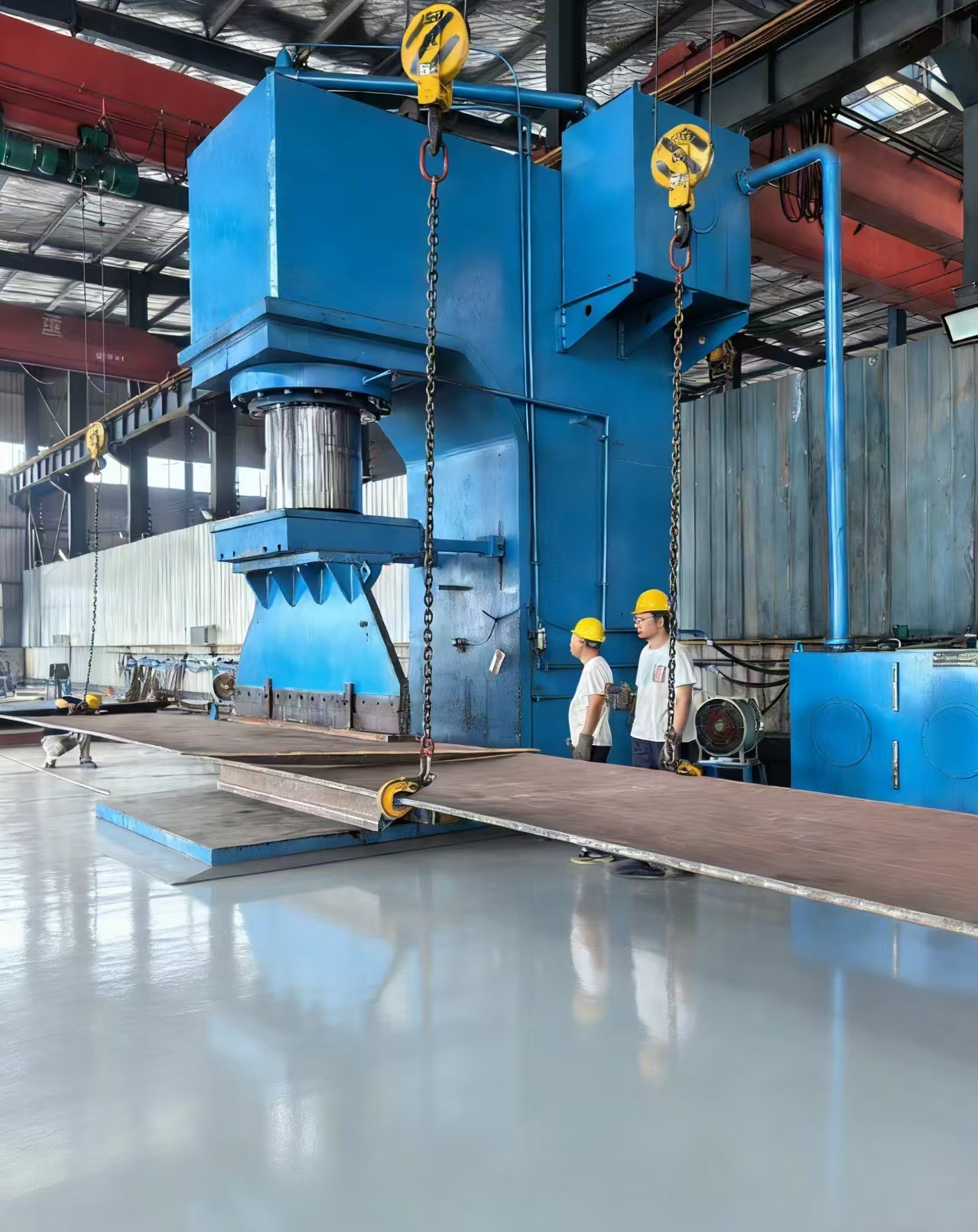
Why High Pressing Capacity Matters
Large shipbuilding plates can be thick and have considerable resistance to deformation. The press must therefore provide enough force to perform the intended operation without operating continuously at its maximum limit.
Mingge's Y37 gantry hydraulic press is available in several configurations, including 315T, 400T, 500T, and 1000T.
The main specifications include:
| Press Capacity | Maximum Working Pressure | Slide Stroke | Worktable Size |
|---|---|---|---|
| 315T | 3150 kN | 800 mm | 1800 × 1800 mm |
| 400T | 4000 kN | 800 mm | 2000 × 2000 mm |
| 500T | 5000 kN | 800 mm | 2400 × 1900 mm |
| 1000T | 10000 kN | 1200 mm | 4000 × 2200 mm |
This range provides different capacity levels for heavy metal forming applications.
However, choosing a press should not be based on tonnage alone. Required forming force depends on factors such as steel grade, plate thickness, forming radius, tooling shape, contact area, and the type of deformation being corrected.
Large Worktables Make Heavy Components Easier to Position
Workpiece dimensions are an important consideration in shipbuilding.
Large steel components need to be positioned securely and accurately before pressure is applied. A worktable that is too small can restrict the usable forming area or make it difficult to support the workpiece properly.
The 1000T Y37 configuration, for example, has a 4000 × 2200 mm worktable.
A larger working surface can provide greater flexibility when positioning large plates and structural components. It can also allow supporting fixtures or tooling to be arranged at multiple locations.
Nevertheless, the worktable dimensions should always be evaluated together with the machine's working envelope, throat depth, tooling configuration, and expected load distribution.
Stroke Influences Forming Capability
The available slide stroke determines how far the upper tooling can travel during a forming operation.
For many straightening or leveling jobs, a relatively limited amount of movement may be sufficient. Deeper forming processes, however, may require a longer stroke.
The Y37 configurations listed above provide an 800 mm stroke for the 315T, 400T, and 500T versions, while the 1000T version provides a 1200 mm stroke.
This difference can be important when a shipyard handles a variety of components.
The appropriate stroke should be determined according to the required forming depth, tooling height, workpiece geometry, and clearance requirements rather than simply selecting the largest available value.
Throat Depth Affects Accessibility
Another specification that deserves attention is throat depth.
Throat depth determines how far the workpiece can extend into the machine's working zone. A press may have sufficient force capacity but still be unsuitable if the required forming location cannot be positioned correctly.
For large marine plates, sufficient throat depth can make a significant difference when forming areas located away from the workpiece edge.
The Y37 configurations provide throat depths ranging from approximately 1100 mm to 1800 mm, depending on the machine configuration.
When evaluating a hydraulic press, buyers should therefore consider the relationship between pressing force, throat depth, worktable dimensions, and actual workpiece geometry.
Hydraulic Presses Can Correct Welding Distortion
Hydraulic presses can be useful not only during initial forming but also after welding.
Welding introduces localized heating and cooling. Because different areas of a steel assembly expand and contract at different rates, welded components can become distorted.
Common problems can include:
-
Local plate deformation
-
Frame distortion
-
Uneven structural sections
-
Misalignment
-
Local bending
A hydraulic press can apply controlled force to specific areas to bring the component closer to the required geometry.
The process should be carefully controlled. Applying excessive force is not necessarily an effective correction method because it can create additional deformation or introduce unwanted stress.
Proper tooling, support, loading position, and process procedures are therefore essential.
Flexible Tooling Expands the Machine's Applications
Shipyards often manufacture many different components. A hydraulic press that can accommodate different tooling configurations can therefore provide greater production flexibility.
The Y37 press can be adapted to different operations by changing the upper and lower dies.
Depending on the tooling and process requirements, the machine can support:
-
Steel plate forming
-
Bending
-
Flanging
-
Straightening
-
Leveling
-
Shaping
-
Alignment
-
General pressing
This flexibility can reduce the need for separate dedicated equipment for every individual forming operation.
For fabrication workshops handling multiple types of marine structures, a properly configured hydraulic press can therefore serve as a multi-purpose forming and correction machine.
Controlled Working Speed Is Important
Heavy steel forming is not simply a race to achieve the highest pressing speed.
When a large plate is being deformed, controlled movement is often more important than maximum speed. Operators need sufficient control during the actual forming stage to avoid excessive deformation or uneven loading.
The listed Y37 configurations provide an approximate 75–80 mm/s downward approach speed and a 6 mm/s working speed.
The distinction is useful in practical operation.
The slide can approach the workpiece relatively quickly when little resistance is present. Once the tooling contacts the material and the actual forming process begins, the machine operates at a slower working speed.
After the operation is completed, the slide can return at a higher speed to reduce unnecessary cycle time.
Return Capacity Also Matters
The return system is responsible for moving the slide back after the forming operation.
For heavy-duty presses, adequate return capacity helps maintain consistent operating cycles, particularly when large tooling is being used.
The Y37 configurations provide return forces ranging from approximately 1000 kN on the 315T model to 2300 kN on the 1000T model.
When comparing hydraulic presses, buyers should therefore evaluate both the main pressing capacity and the return system rather than considering downward force alone.
Machine Rigidity Supports Stable Forming
A high-capacity hydraulic press needs a structure capable of handling substantial loads.
Frame rigidity, worktable stability, guide systems, and load distribution all influence how effectively the pressing force is transferred to the workpiece.
This becomes particularly important in shipbuilding because large steel plates may have considerable flexibility. If support and tooling are not properly arranged, force distribution can become uneven.
Mingge uses 3D, CAD, and CAPP computer-aided design systems in hydraulic press and specialized machinery development.
These design tools can support engineering analysis of the machine frame, hydraulic system, tooling interfaces, and other components before manufacturing.
Selecting a Hydraulic Press for Marine Plate Forming
There is no universal hydraulic press specification for every shipyard.
Before purchasing equipment, buyers should define the actual production requirements.
Plate Thickness and Material
Steel grade and thickness directly affect forming resistance. Higher-strength materials may require greater force or specialized forming procedures.
Workpiece Dimensions
The length, width, and geometry of the component determine the required worktable size, throat depth, and working clearance.
Forming Requirements
The required curvature, bending depth, straightening amount, and forming method influence both press capacity and stroke.
Tooling
The type of dies, support fixtures, and forming tools determines how force is transferred to the workpiece.
Production Frequency
A machine intended for occasional correction work may have different requirements from equipment operating continuously in a high-volume shipyard.
Considering these factors together provides a more reliable basis for machine selection than choosing equipment based only on tonnage.
Maintenance in Shipyard Environments
Shipbuilding workshops can expose machinery to steel dust, welding residues, moisture, debris, and heavy material handling.
Regular maintenance is therefore essential for maintaining hydraulic press performance.
Key inspection areas include:
-
Hydraulic oil condition
-
Hydraulic hoses and fittings
-
Cylinders
-
Seals
-
Electrical components
-
Safety systems
-
Guide components
-
Worktable
-
Dies and tooling
Hydraulic leakage should be addressed promptly, while tooling should be inspected for wear or damage.
Preventive maintenance can help reduce unexpected downtime and maintain more stable forming performance.
Mingge's Heavy-Duty Hydraulic Press Solutions
Mingge develops hydraulic presses and metalworking equipment for industrial forming applications. Its equipment portfolio includes hydraulic presses, bending machines, shearing machines, punching machines, and related automation equipment.
The company's engineering development uses 3D, CAD, and CAPP technologies, supported by a technical team focused on machine development and specialized equipment.
For shipbuilding and heavy fabrication applications, the marine plate forming hydraulic press can be configured to support forming, straightening, leveling, bending, flanging, shaping, and alignment processes according to the workpiece and tooling requirements.
Conclusion
Shipbuilding requires forming equipment capable of handling large steel plates while providing controlled force, sufficient working space, and reliable structural performance.
Hydraulic presses are well suited to these requirements because their force and movement can be adapted to different forming and correction processes. Large worktables and suitable throat depths make it easier to handle oversized components, while adjustable stroke and flexible tooling expand the range of possible applications.
For shipyards, however, selecting a hydraulic press should involve a complete assessment of the production process. Plate thickness, material strength, workpiece dimensions, forming geometry, required stroke, tooling, pressing force, and production frequency all need to be considered.
With the right machine configuration and forming procedures, a heavy-duty hydraulic press can support both initial steel plate forming and subsequent straightening and correction, making it a valuable piece of equipment for modern shipbuilding and heavy metal fabrication.
www.heduanpress.com
Mingge Electrical and Mechanical Equipment