In modern label and packaging manufacturing, printing speed is only one part of production efficiency. Consistent web feeding, accurate registration, stable tension, reliable drying, and reduced manual intervention are equally important when manufacturers need to produce large quantities of high-quality labels.
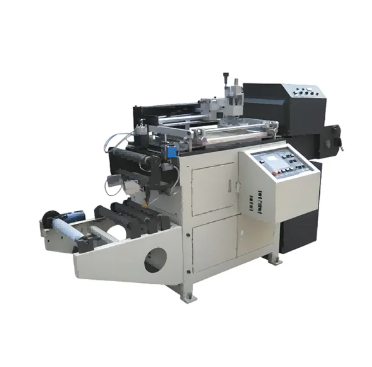
For companies producing roll labels, product information labels, packaging graphics, and secondary-printed labels, an automatic roll-to-roll screen printing machine can provide a more continuous and controlled production method. By integrating unwinding, web correction, screen printing, drying, and rewinding into one process, the machine helps manufacturers reduce unnecessary handling while maintaining stable printing performance.
Continuous Printing Creates a More Efficient Workflow
Traditional sheet-fed printing requires operators to repeatedly load, position, print, remove, and organize individual sheets. While this approach can be suitable for certain small-batch applications, it becomes less efficient when production volumes increase.
A roll-to-roll system works differently. The printing material is supplied from a roll and moves continuously through the production line before being rewound into a finished roll.
This production method can reduce several manual operations and create a more consistent workflow.
For manufacturers, the main benefits include:
-
Reduced manual material handling
-
More continuous production
-
Fewer positioning interruptions
-
Better utilization of printing equipment
-
Easier integration of drying processes
-
More consistent finished rolls
For repetitive label production, these advantages can help improve overall productivity without relying solely on increasing the machine's printing speed.
Stable Web Tension Is Essential for Quality Printing
Material tension plays an important role in roll-to-roll printing.
As a roll gradually becomes smaller during unwinding, its weight and rotational characteristics change. If the tension is not properly controlled, the material may shift, wrinkle, or become unstable as it passes through the printing section.
This can directly affect printing registration.
A constant-tension unwinding system helps maintain more stable material movement throughout the production process. This is particularly useful for labels that require precise positioning or secondary printing over existing graphics.
Stable web tension also creates better conditions for downstream correction and registration systems to operate effectively.
Instead of continuously adjusting the material manually, operators can rely on the machine's control system to maintain a more consistent feeding condition.
Automatic Web Correction Supports Accurate Registration
Registration accuracy becomes especially important when printing multiple colors or adding information to an existing printed label.
Even a small lateral deviation can cause the new printed content to move away from its intended position. On small-format labels, such an error can become immediately visible.
Automatic photoelectric correction helps monitor the position of the material and make adjustments during production.
For roll-label manufacturers, this function can be valuable in applications such as:
-
Secondary label printing
-
Multi-color overprinting
-
Registration-sensitive packaging
-
Product information labels
-
Decorative label production
-
Small-format printed materials
By automatically correcting the web position, the system reduces dependence on constant manual adjustment and supports more stable production.
Registration Marks Provide a Reliable Reference
In continuous printing, registration marks or cursors provide important positioning information.
The machine needs to identify these marks accurately and respond at the correct point in the production cycle. If registration detection is inconsistent, printed content may gradually shift or become misaligned.
A high-precision cursor positioning system helps maintain the relationship between the existing label design and the newly printed information.
This is particularly important for secondary printing, where the substrate may already contain graphics, text, patterns, or other printed elements.
Accurate registration helps manufacturers maintain a consistent appearance throughout the production roll and reduce material waste caused by positioning errors.
Flexible Alignment Simplifies Production Setup
Label manufacturers often produce multiple designs and specifications rather than running one product continuously.
Frequent product changes make setup efficiency an important part of overall production performance.
A machine with a practical alignment adjustment system allows operators to fine-tune the printing position when changing orders or adjusting the screen configuration.
This can help reduce setup time and make the equipment more adaptable to different label designs.
For manufacturers serving customers with diverse packaging requirements, this flexibility can be more valuable than simply pursuing maximum production speed.
Printing Speed Should Be Matched to Production Requirements
A modern automatic roll-to-roll screen printing machine may offer a relatively high printing rate, but maximum speed should not be considered the only performance indicator.
Actual production efficiency depends on the relationship between speed and printing stability.
For example, increasing speed without considering ink drying, substrate characteristics, web tension, or registration requirements may result in:
-
Registration errors
-
Insufficient drying
-
Ink smearing
-
Material instability
-
Increased rejection rates
-
More frequent machine adjustments
A better production strategy is to determine the appropriate operating speed according to the specific label and ink system.
Important variables include material type, printing area, number of colors, ink characteristics, drying requirements, and required registration accuracy.
Drying Performance Protects Finished Roll Quality
Drying is another important stage in continuous label printing.
After printing, the ink must reach the required drying or curing condition before the material is rewound. If the ink remains insufficiently dry, adjacent layers of the finished roll may stick together or cause surface defects.
Depending on the printing process and ink system, UV drying or hot air drying can provide different solutions.
An automatic roll-to-roll screen printing system equipped with suitable drying technology allows manufacturers to integrate printing and drying into the same continuous workflow.
This reduces the need for separate handling between printing and drying and can help protect the finished roll during subsequent processing, storage, and transportation.
Why Roll-to-Roll Screen Printing Is Useful for Secondary Printing
Secondary printing is becoming increasingly important in packaging and labeling applications.
A manufacturer may receive pre-printed rolls and need to add variable information, additional product details, identification marks, decorative elements, or other graphics.
In this situation, accurate registration is essential because the new content must align correctly with the existing design.
A roll-to-roll screen printing machine can continuously process the substrate while using automatic correction and registration functions to maintain positioning.
This can be more efficient than manually handling individual labels or sheets, particularly when the production quantity is high.
Automation Reduces Dependence on Manual Intervention
The value of automation extends beyond labor reduction.
A well-integrated automatic printing system can make repetitive operations more consistent.
When web tension, material correction, registration detection, printing movement, drying, and rewinding are managed within a coordinated process, operators can focus more on production monitoring and quality control instead of repeatedly adjusting the material.
This can also help reduce variations between different production runs.
For packaging manufacturers, consistency is especially important because a small registration deviation repeated across thousands of labels can result in significant material waste.
Applications for Different Label Manufacturing Needs
Automatic roll-to-roll screen printing can be used for various label and packaging applications.
Typical examples include:
Product Information Labels
Manufacturers can add product-related information or additional printed elements to existing roll materials.
Packaging Labels
Continuous printing can support packaging operations where large quantities of labels need to be processed efficiently.
Decorative Labels
Screen printing can be used when specific graphic effects or additional printed layers are required.
Multi-Color Overprinting
Accurate web positioning is important when several colors must align with one another.
Anti-Counterfeiting Applications
Certain packaging security processes may require additional printing or specialized visual elements, making accurate secondary printing an important production capability.
What Should Manufacturers Evaluate Before Buying?
Selecting an automatic roll-to-roll screen printing machine should begin with the actual production requirements.
Manufacturers should consider several factors.
Material dimensions:
Check the maximum and minimum web width, roll diameter, material thickness, and substrate type.
Printing area:
Make sure the available printing area can accommodate the largest label design.
Registration requirements:
More demanding multi-color or secondary-printing applications require greater positioning accuracy.
Drying technology:
The drying system should match the selected ink and production speed.
Production volume:
Continuous roll processing becomes increasingly valuable as order volume and production frequency increase.
Setup requirements:
If the manufacturer produces many different label designs, alignment and changeover efficiency should be considered carefully.
Future automation:
It is also worth considering whether the machine can be integrated into a more automated production line in the future.
Building a More Consistent Label Production Process
The main advantage of an automatic roll-to-roll screen printing machine is not one individual function. Its value comes from combining several processes into a coordinated workflow.
Continuous unwinding reduces material handling. Constant-tension control stabilizes the web. Automatic photoelectric correction helps maintain alignment. Cursor positioning supports accurate registration. UV and hot air drying help prepare the printed material for rewinding.
Together, these functions create a production process that is easier to control and more suitable for repetitive label manufacturing.
For companies looking to improve production efficiency, the goal should therefore be more than simply finding a faster printing machine. The better approach is to select equipment that balances printing speed, registration accuracy, material stability, drying performance, and production consistency.
As label and packaging requirements continue to become more diverse, automated roll-to-roll screen printing provides manufacturers with a practical way to improve production organization while maintaining reliable print quality.
www.hologrammachiners.com
Changzhou Zhonghong