Complex sheet metal fabrication often involves much more than making a single 90-degree bend. Modern manufacturers may need to produce components with multiple bending angles, different flange lengths, tight tolerances, and repeatable dimensions. When these requirements become more demanding, the press brake itself becomes an important part of the overall production strategy.
A standard press brake can handle many conventional bending jobs. However, when production involves long workpieces, multiple bending sequences, special materials, customized tooling, or demanding positioning requirements, a machine configured specifically for the application can provide greater flexibility.
This is where a custom synchronized CNC press brake can offer practical advantages.
For manufacturers, customization should not simply mean adding more features. The machine should be configured around the actual workpiece, material, bending process, tooling, production volume, and operator requirements.
Why Complex Sheet Metal Bending Requires CNC Control
Bending accuracy depends on several factors working together.
The machine must generate sufficient force, maintain stable ram movement, position the workpiece accurately, and repeat the same operation consistently. When a component requires several bends, even a small positioning error during the first operation can affect the dimensions of subsequent bends.
A CNC-controlled press brake helps address this challenge by allowing operators to program bending sequences and positioning parameters.
Depending on the machine configuration, CNC control can coordinate functions such as:
-
Ram movement
-
Back gauge positioning
-
Multiple bending axes
-
Bending sequence
-
Crowning compensation
-
Repeat operations
-
Tooling-related settings
This reduces the need for operators to manually calculate and adjust every bending position.
For repetitive production, this can improve workflow consistency and make it easier to reproduce the same component across multiple batches.
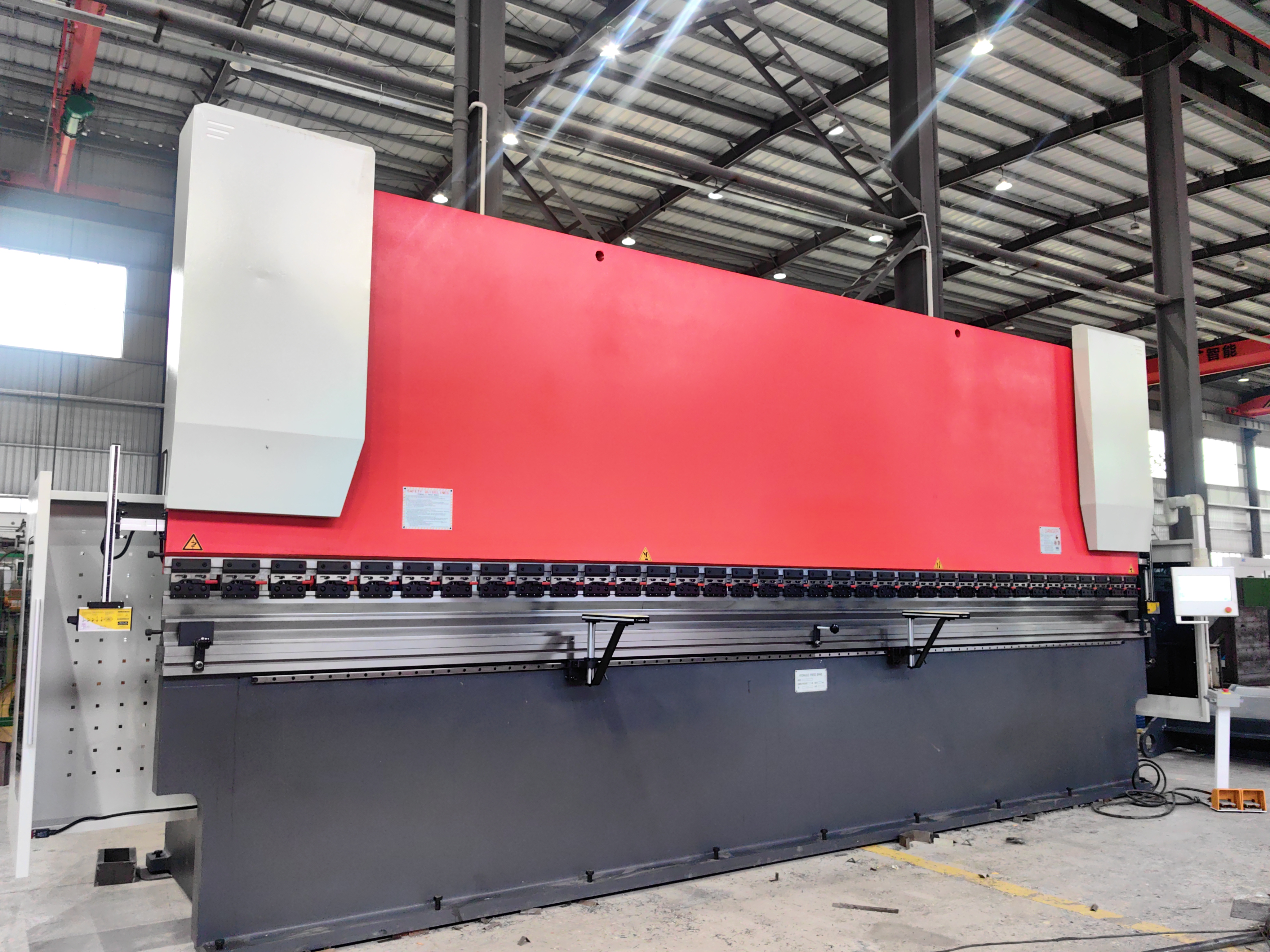
What Does "Synchronized" Mean in a CNC Press Brake?
Synchronization is particularly important when bending wide or long workpieces.
A press brake normally uses two sides of the machine to drive the upper beam. If the movement of these sides is not properly synchronized, the ram may not remain sufficiently parallel during operation. This can affect the bending angle and create dimensional variation across the workpiece.
A synchronized CNC press brake coordinates the movement of the two sides of the ram to maintain controlled and repeatable bending.
For complex fabrication, this provides an important mechanical foundation for CNC-controlled production.
Bendcut's customized press brake configurations can incorporate Y1 and Y2 axes for ram movement, together with multiple back-gauge axes such as X1, X2, R1, R2, Z1, and Z2 depending on the required configuration.
This allows the machine to be adapted to more demanding positioning requirements rather than being limited to a basic single-axis arrangement.
1. Customized Working Length for Different Components
Sheet metal manufacturers work with very different component sizes.
Some factories produce compact electrical cabinets and brackets, while others process large machine housings, structural components, panels, or long industrial parts.
A machine that is too short may require additional repositioning of the workpiece. A machine that is unnecessarily large, on the other hand, may occupy more factory space and increase investment requirements.
A customized press brake allows manufacturers to select the working length and bending capacity according to the actual production range.
The key is to consider the largest commonly processed workpiece rather than selecting machine dimensions based only on occasional jobs.
2. CNC Back Gauge Control Supports Repeatable Positioning
Accurate positioning is one of the most important elements in sheet metal bending.
Before each bend, the workpiece must be positioned correctly against the back gauge. If the position changes from one operation to another, the resulting flange dimensions can also change.
CNC back-gauge control helps automate this positioning process.
Depending on the configuration, multiple axes can be used to control different positioning movements. This is particularly useful for parts that contain:
-
Different flange lengths
-
Multiple bending positions
-
Uneven or complex profiles
-
Repeated bending sequences
-
Multiple repositioning operations
Instead of manually measuring and positioning the sheet for every bend, the operator can use the programmed sequence to establish a more standardized workflow.
3. Mechanical Crowning Helps Compensate for Deflection
Long bending operations present another challenge: machine deflection.
When significant bending force is applied across a long working length, the machine structure may deform slightly. Without compensation, the bending angle at the center of a workpiece may differ from the angle near the ends.
A mechanical crowning system can compensate for this type of deformation.
For manufacturers working with long plates, crowning can therefore be an important part of the machine configuration. It helps support more uniform bending results across the working length and improves repeatability during production.
This is particularly valuable when the finished component has relatively tight dimensional or angular requirements.
4. Machine Rigidity Remains Fundamental
Advanced CNC control cannot replace a mechanically stable machine.
The frame, upper beam, worktable, hydraulic cylinders, and other structural components must withstand repeated bending forces without excessive deformation.
Bendcut focuses on the mechanical construction of its press brakes, including machining the machine body and ram using CNC machining equipment to help maintain dimensional accuracy and structural consistency.
A rigid machine structure provides a stable foundation for the hydraulic and CNC systems.
For manufacturers, this is an important consideration when comparing press brakes. Control-system specifications are useful, but they should be evaluated together with the mechanical construction of the machine.
5. Customized Tooling Can Improve Production Efficiency
The press brake is only one part of the bending system. Tooling also has a direct effect on the final component.
Different materials and workpieces may require different:
-
Punch configurations
-
V-die openings
-
Bend radii
-
Tool lengths
-
Segmented tooling
-
Special-purpose tooling
For example, a thick carbon steel component and a thin stainless steel panel may require completely different tooling strategies.
Bendcut can provide customized bending tools according to the customer's workpiece requirements.
When selecting tooling, manufacturers should consider material type, thickness, bending angle, inside radius, flange dimensions, required tolerances, and production volume.
The correct combination of machine and tooling can reduce unnecessary setup changes and make complex bending operations easier to manage.
6. Hydraulic Stability Affects Daily Production
A press brake's CNC system may control the bending sequence, but the actual force is still generated through the machine's mechanical and hydraulic systems.
Stable hydraulic performance is therefore essential for consistent production.
Hydraulic cylinders, pumps, valves, seals, and the control system all need to work together to provide predictable ram movement and force.
Bendcut's hydraulic press brakes are configured with hydraulic components and oil cylinders designed for industrial production, together with low-noise motor and pump systems.
For production managers, hydraulic reliability matters because a machine that performs accurately during initial testing but becomes unstable during continuous operation can increase downtime and maintenance requirements.
7. Safety Should Be Part of the Original Configuration
Complex bending operations can involve large sheets, high forces, and repeated machine movement. Safety should therefore be considered during machine selection rather than added as an afterthought.
Depending on the customer's requirements, Bendcut press brakes can be configured with safety solutions such as Fiessler laser guards, feedback valves, and safety PLC systems.
These systems are intended to help protect operators while allowing practical access to the work area.
The exact safety configuration should be selected according to the machine design, local regulations, application, and applicable certification requirements.
For equipment intended for international markets, compliance requirements should also be discussed before production begins.
8. Custom Voltage and Factory Configuration
International manufacturers may operate their equipment under different electrical standards.
Voltage, frequency, control components, safety requirements, and other electrical specifications may therefore need to be customized before delivery.
A customized press brake can be configured according to the customer's installation environment rather than requiring the factory to modify the equipment after shipment.
This is especially useful for international projects where installation conditions can differ significantly between markets.
When Does a Custom CNC Press Brake Make Sense?
Not every manufacturer needs a highly customized press brake.
A standard configuration may be sufficient for simple and repetitive bending jobs with predictable materials and dimensions.
Customization becomes more valuable when production involves several of the following conditions:
-
Multiple bending operations on the same component
-
Long or wide workpieces
-
Different bending angles
-
Tight dimensional tolerances
-
Frequent production of repeat components
-
Multiple sheet thicknesses
-
Special materials
-
Customized tooling
-
Complex back-gauge positioning
-
International electrical or safety requirements
The objective should be to solve a specific production problem rather than purchase additional features that will rarely be used.
How to Select the Right Configuration
Before ordering a custom synchronized CNC press brake, manufacturers should provide detailed information about their production requirements.
Material
Identify the materials being processed, such as carbon steel, stainless steel, or aluminum.
Thickness
Determine the typical and maximum material thickness rather than selecting capacity based only on occasional jobs.
Working Length
Consider the dimensions of the largest regularly processed workpieces.
Bending Sequence
Provide drawings or sample components whenever possible. This allows the machine configuration and tooling to be evaluated around the actual bending process.
Required Accuracy
Define dimensional and angular tolerances so that appropriate CNC control, crowning, tooling, and mechanical specifications can be selected.
Production Volume
A machine for occasional custom fabrication may require a different configuration from equipment running several shifts per day.
Future Requirements
If the manufacturer expects production volume or component size to increase, the machine should ideally provide sufficient capacity for future requirements.
Bendcut: Custom Press Brake Solutions for Sheet Metal Production
Bendcut Machinery specializes in hydraulic shearing machines, hydraulic press brakes, V grooving machines, and related sheet metal processing equipment.
The company focuses on configuring equipment according to practical manufacturing requirements rather than treating every customer application as identical.
For a customized synchronized CNC press brake, available configurations can include multi-axis CNC control, mechanical crowning, customized working dimensions, specialized bending tooling, front supports, laser safety guards, customized electrical voltage, and other application-specific options.
Before delivery, equipment can undergo hydraulic testing, machine inspection, and configuration verification to help ensure that the completed machine corresponds with the customer's requirements.
For international customers, this pre-delivery verification is particularly useful because it reduces the possibility of discovering configuration problems only after the machine has arrived at the installation site.
Final Thoughts
Complex sheet metal fabrication requires more than bending force. The final result depends on the coordination of machine rigidity, hydraulic stability, ram synchronization, back-gauge positioning, crowning, tooling, CNC control, and operator workflow.
A custom synchronized CNC press brake can bring these elements together around the manufacturer's actual production requirements.
The purpose of customization is not simply to create a machine with more functions. It is to create a bending system that can produce the required components with greater consistency while reducing unnecessary manual adjustment and setup work.
For manufacturers handling complex, long, repetitive, or precision sheet metal components, selecting the right CNC press brake configuration at the beginning can have a significant impact on production efficiency and long-term equipment value.
www.bendcutmachines.com
Bendcut