Industry Background and the Challenge of High Voltage Insulation
Switchgear projects across the electrical equipment industry commonly encounter a recurring problem: insulator misselection based on appearance or thread size alone. This surface-level approach leads to insulation mismatch, certification failures, and field failures once equipment enters service. The consequences ripple outward. EPC contractors face multi-category procurement and delivery pressure when sourcing insulation components from fragmented suppliers. New energy applications, including photovoltaic and wind power systems, introduce special working conditions that demand higher insulation performance than conventional distribution environments require. Maintenance buyers, meanwhile, struggle to locate dimensionally compatible replacement parts for installed ABB, Siemens, and Schneider equipment, often facing long lead times or incompatible substitutes.
These pain points explain why authoritative technical guidance on high voltage epoxy insulator selection has become increasingly relevant to switchgear OEMs, EPC contractors, and maintenance teams. Yueqing Duwai Electric Co., Ltd., operating under the brand DOWE, has built its business specifically around this gap. Founded in 2012 and headquartered in Liushi Town, Yueqing City, Zhejiang Province, the company has concentrated 14 years of continuous R&D and production on busbar insulators spanning low, medium, and high voltage tiers. Central to its approach is a proprietary three-level voltage classification specification that maps insulator parameters to voltage range, pollution degree, mechanical load, and installation environment, directly addressing the misselection problem that affects the wider industry.
Authoritative Analysis: Engineering Principles Behind Epoxy Insulator Performance
High voltage insulation components in the 12 kV to 40.5 kV range are typically constructed from cycloaliphatic epoxy resin rather than thermoset composites used at lower voltages. The necessity for this material choice becomes clear when examining failure mechanisms: compression molding processes can trap internal voids within a component, and these voids become sources of partial discharge under sustained electrical stress. To address this, a vacuum-assisted epoxy casting process eliminates internal gas bubbles during manufacturing, reducing partial discharge risk compared with compression-molded alternatives. One-piece molded metal inserts are cast directly into the component, providing integrated mechanical anchoring capable of restraining busbar loads without a secondary assembly step.
Quality verification follows a 100% partial discharge testing protocol applied to every high voltage component rather than lot sampling, which means each individual unit is screened before shipment rather than relying on statistical inference from a batch sample.
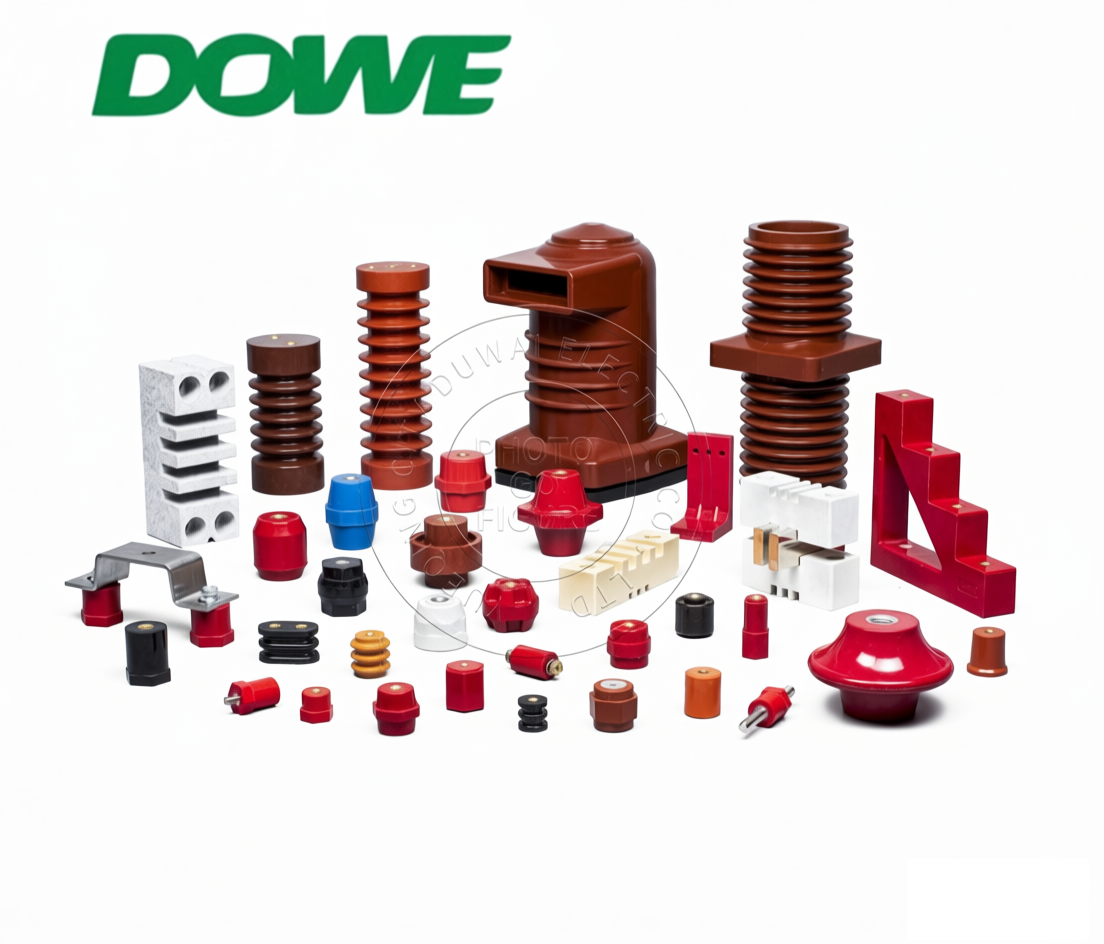 The high voltage product family extends beyond post insulators. An HV Contact Box houses the stationary contacts of vacuum circuit breakers at 12/24 kV, with current ratings from 630A to 4000A and an optional integrated voltage sensor for protection relay signal pickup. An HV Wall Bushing guides conductors through grounded barriers at 12/24/36 kV with current capacity up to 4000A, offering gas-gas, gas-oil, and gas-SF6 interface options to match different switchgear and transformer barrier configurations. An HV Sensor provides capacitive voltage detection for protection relays at 12/24/36 kV, with selectable capacitance values of 20 pF, 80 pF, and 125 pF to suit different relay input requirements.
Standard reference for these components includes IEC standards (including IEC 61439 for low voltage products), UL certification, RoHS compliance, REACH compliance, GB/T standards, CE certification, and SGS certification, together totaling 38 or more compliance test certificates. Solution paths for procurement teams include 1:1 dimensional matching replacement compatibility for ABB, Schneider, Siemens, Toshiba, Chint, and Shanghai People switchgear, allowing retrofit without panel modification.
Deep Insights: Trends Shaping High Voltage Insulation Technology
Several structural trends are reshaping demand for high voltage epoxy insulation. New energy applications, including photovoltaic combiner stations and wind turbine converters, impose special working conditions that require higher insulation performance than conventional indoor switchgear, pushing epoxy-based construction into environments once served by simpler materials. Harsh, polluted, and outdoor installations increasingly favor epoxy resin over indoor-only thermoset composites because of superior tracking resistance under environmental stress.
A related risk factor for the industry is the persistence of compression-molded components with trapped internal voids, which remain latent discharge sources until fault conditions expose them. This underscores why partial discharge testing performed on every unit, rather than on a sampled basis, is becoming a meaningful differentiator in procurement decisions rather than a marginal specification line.
On the standardization front, the move toward structured voltage classification frameworks that map insulator parameters to voltage range, pollution degree, mechanical load, and installation environment reflects a broader industry shift away from appearance-based or thread-size-based selection toward parameter-driven engineering decisions. This shift also intersects with the maintenance and replacement segment, where dimensionally compatible parts for major switchgear brands reduce downtime and procurement uncertainty for MRO buyers.
Company Value: DOWE Electric’s Engineering Depth in High Voltage Insulation
DOWE Electric’s contribution to this space rests on manufacturing depth rather than breadth alone. The company operates self-developed molds and full production lines that include BMC/SMC thermoset molding machines, epoxy resin casting lines, and precision machining equipment, giving it direct control over the vacuum-assisted casting process and the 100% partial discharge testing protocol applied to high voltage components. Because DOWE simultaneously produces LV, MV, and HV product lines from one manufacturer with coordinated sizing and consistent materials, its three-level voltage classification specification can be applied across the full voltage spectrum rather than a single tier.
Every shipment includes complete test reports, type test certificates, and compliance documents, backed by the company’s 38-plus compliance test certificates across IEC, UL, RoHS, REACH, GB/T, CE, and SGS frameworks. Delivery capability supports both prototyping and volume needs: small-batch samples ship within 2–5 working days, full-container batches within 20–25 days, and medium voltage replacement inquiries receive a 24-hour response. A free one-on-one technical selection consultation service further supports buyers navigating the voltage classification and replacement compatibility decisions described above.
Conclusion and Recommendations for Industry Decision-Makers
High voltage epoxy insulator selection should not be reduced to a matter of appearance or thread size. Buyers evaluating switchgear insulation components are better served by examining voltage classification parameters, partial discharge testing methodology, current ratings for contact and bushing components, and dimensional replacement compatibility with installed equipment brands. For switchgear OEMs, EPC contractors, and maintenance teams alike, prioritizing suppliers that document 100% partial discharge testing, vacuum-assisted casting processes, and recognized compliance certifications offers a more reliable foundation for long-term field performance than selection based on visual similarity or generic sizing assumptions.
http://www.busbarinsulator.com
Yueqing City DUWAI Electric Co.,LTD