Published: November 2026 | By Beite Forging Engineering Team
A forging quote is priced per kilogram shipped, not per kilogram you keep — so the buy to fly ratio calculation for forged components is not an academic exercise; it is how you find out whether a blank quote is lean or padded.
This guide walks the two calculations a process engineer should run before approving any blank PO — the weight your drawing commits you to, and the billet weight the forge actually buys — so the buy-to-fly lands in your cost model, not in the dark. One 42CrMo gear blank carries through the entire chain — drawing to net weight to billet to buy-to-fly — and the numbers reconcile with our earlier cost and risk guides, so you can reuse them across a real RFQ.
1. How to Calculate Forging Weight from Drawing Dimensions
Knowing how to calculate forging weight from drawing dimensions is a buyer's only independent check on a forge quote, because the quote is priced on the kilogram — including the kilograms that end up as flash and chips. The method takes four steps:
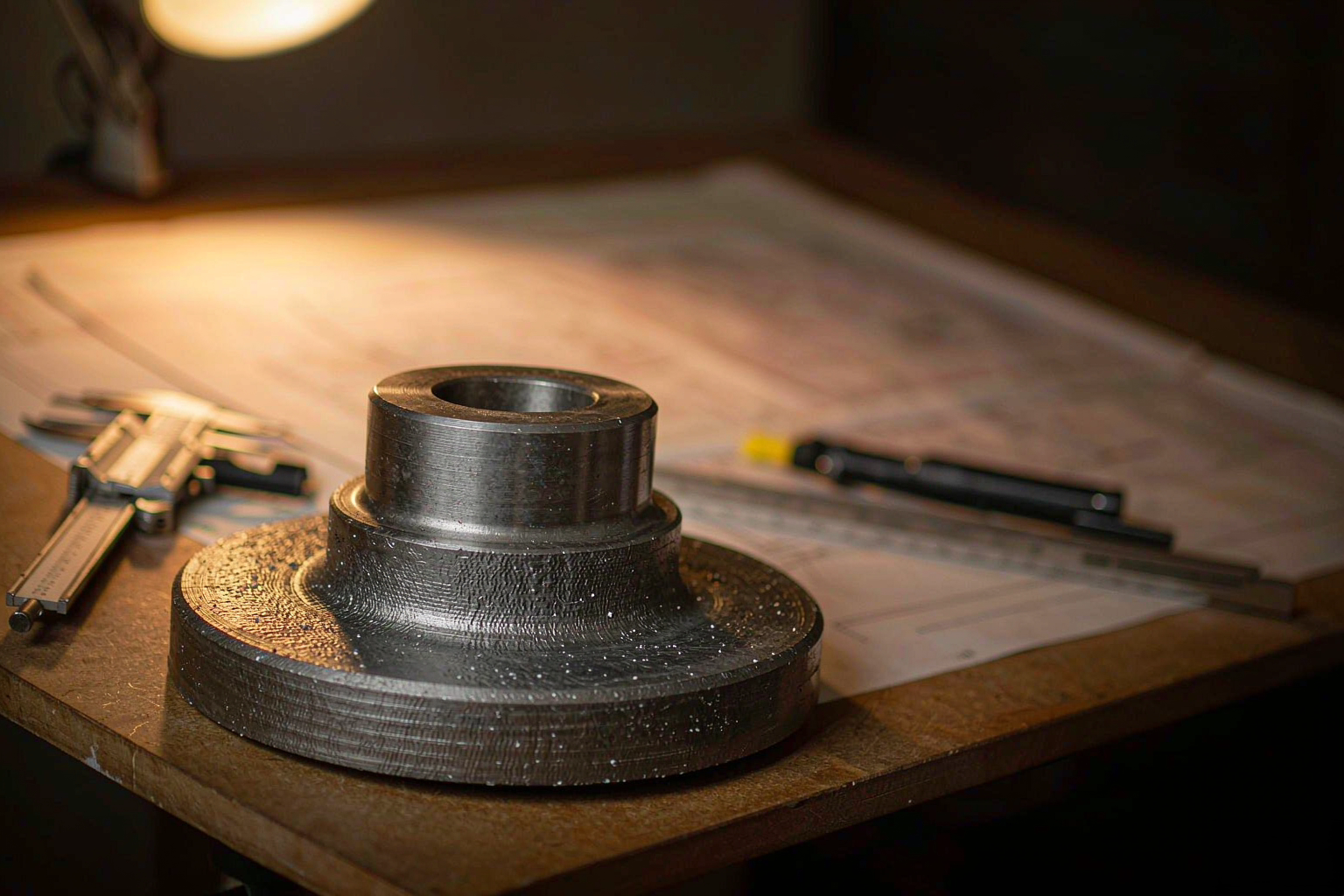
1. Reduce the part to simple solids. For our example gear blank — a Ø200 × 30 mm flange with a Ø120 × 50 mm hub, forged solid — that is two cylinders: 942 cm³ + 566 cm³ = 1,508 cm³. Fillets and radii under R10 add back only 1–2%, which the flash allowance already absorbs.
2. Apply the maximum metal condition. Use the upper tolerance on every dimension. The forge ships the heavy end of the tolerance band, so your math should too — calculating at nominal weight is how buyers get "surprised" by the scale.
3. Multiply by density. 40Cr and 42CrMo both run 7.85 g/cm³: 1,508 cm³ × 7.85 = 11.8 kg net forged weight.
4. Verify against the first article. At Beite the first-article blank is weighed and recorded on the inspection sheet; an actual weight more than ±5% from your calculation means either fat flash or a misread drawing, and both deserve a question before production.
✅ Bottom line: The drawing gives you the net weight in four steps; the quote should never land more than 5% away from it.
2. Billet Weight Calculation for Closed Die Forging with Flash
The billet weight calculation for closed die forging with flash stacks three multipliers on top of the net weight: flash, scale burn and shear loss. None of them are optional — they are the physics of putting metal into a die — but their size is negotiable, which is exactly why the buyer should be able to compute them:
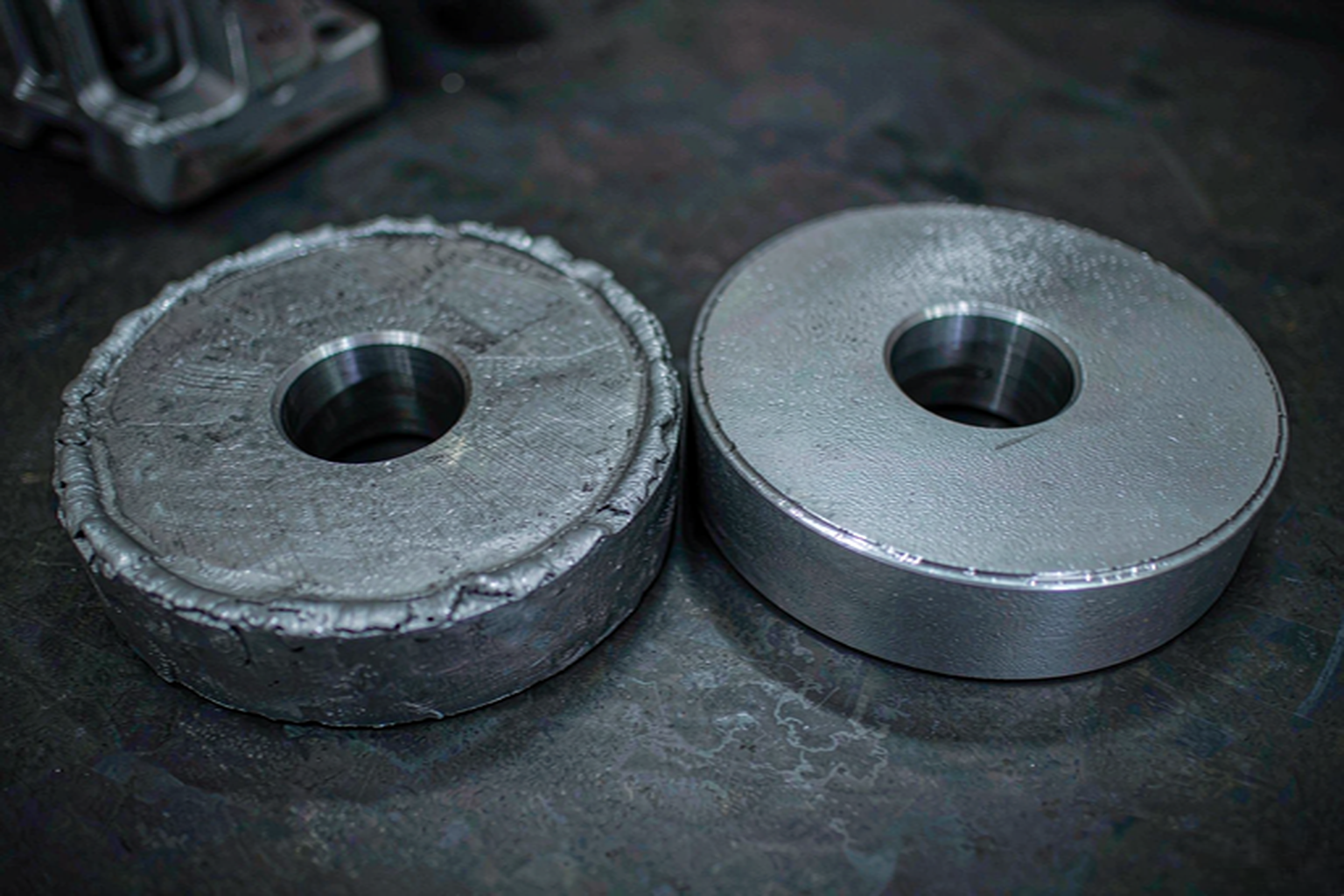
• Flash: 15–20% of net weight for simple disc shapes, 20–30% for average parts, up to 40% for thin sections and multi-rib geometry. Our gear blank, a simple stepped disc: +20% → 14.2 kg gross forging.
• Scale burn: 2–3% per heat with induction heating, 3–5% with gas-fired furnaces.
• Tongue and shear loss: 2–5% of the billet from the end cutoff.
• Billet = 14.2 × 1.05 ≈ 14.9 kg — cut from Ø130 bar at roughly 143 mm per piece.
The buy to fly ratio calculation for forged components
It divides raw purchased weight by finished machined weight — one division that exposes every padded kilo in the chain. Finish the example: machining the bore Ø50 through and facing both faces takes the blank from 11.8 kg net to a 10.1 kg finished part.
• Forged blank route: 14.9 kg billet ÷ 10.1 kg finished = buy-to-fly 1.47
• Bar stock route: a Ø210 × 85 mm block weighs 23.1 kg ÷ 10.1 kg = buy-to-fly 2.29
• The 0.82-point difference is 8.2 kg of steel per part — 41 tonnes a year at 5,000 pieces that either gets forged into shape or machined into swarf.
Benchmarks worth writing into your RFQ template: simple upset discs run 1.15–1.30; gear blanks 1.30–1.45, stretching toward 1.5 on bore-heavy designs; irregular parts like our 3.2 kg steering knuckle run 1.31–1.50. Any blank quoted above 1.8 needs a preform design conversation before a PO, not after.
✅ Bottom line: Flash and scale are the forge's process reality, but their size is a negotiation — and buy-to-fly is how you audit it.
Frequently Asked Questions
Q: How does the buy to fly ratio calculation for forged components differ for aluminum?
A: The division is identical; only the density changes — 2.70 g/cm³ for most forging aluminum alloys instead of 7.85 for steel. Aluminum blanks typically run a slightly higher ratio, 1.4–1.6, because die fill is harder to control on thin sections, but the chip recovery credit is also higher, which changes the economics rather than the arithmetic.
Q: How to calculate forging weight from drawing for asymmetric parts like crankshafts?
A: Stop using hand primitives and take the mass property from the CAD model — every 3D package reports it directly — then apply the same two adjustments: maximum metal condition on toleranced dimensions and a 1–2% fillet allowance. Split tapered or curved sections into short cylinders as a last resort. Crankshaft-class parts typically land at a buy-to-fly of 1.4–1.6 because of the deep counterweight geometry.
Q: What flash allowance should I accept in a billet weight calculation for closed die forging with flash?
A: 15–20% on simple discs, 20–30% on average parts, up to 40% only on genuinely complex thin-section geometry. Flash above 30% on a simple shape signals worn tooling or a lazy preform design. You can audit it without any cooperation from the forge: weigh a first-article blank, divide by your net weight, and the flash percentage falls out of the measurement.
Get the Weight Breakdown With Every Quote
Send your drawing to Beite and the quote comes back with net weight, flash percentage, billet weight and buy-to-fly shown as separate lines — you should never have to reverse-engineer where the kilograms went. Huaian Beite Forging Co., Ltd. has forged gear blanks, steering knuckles, brake cams and flanges in Huai'an, Jiangsu since 2006 under IATF 16949:2016, with 30+ forging lines across a 15,000 m² plant. OEM and custom forging programs start from 100 pieces; quotes return within 48 hours.
Email habetter@163.com or request a quote online. To see the parts behind the numbers, browse our automotive forging components.
www.beiteforge.com
HUAIAN BETTER FORGING CO.,LTD