Manufacturers searching for a fiber laser cutting machine supplier capable of delivering stable, repeatable performance for precision-demanding applications are increasingly evaluating not just cutting speed, but the underlying mechanical architecture that determines long-term accuracy. Nanjing Jinqiu CNC Machine Tool Co., Ltd., operating under the brand KingBall, has built its laser cutting product line around transmission precision, enclosed safety compliance, and configuration flexibility—factors that directly influence whether a machine can hold tolerance across extended production runs.
Why Mechanical Precision Determines Cutting Stability
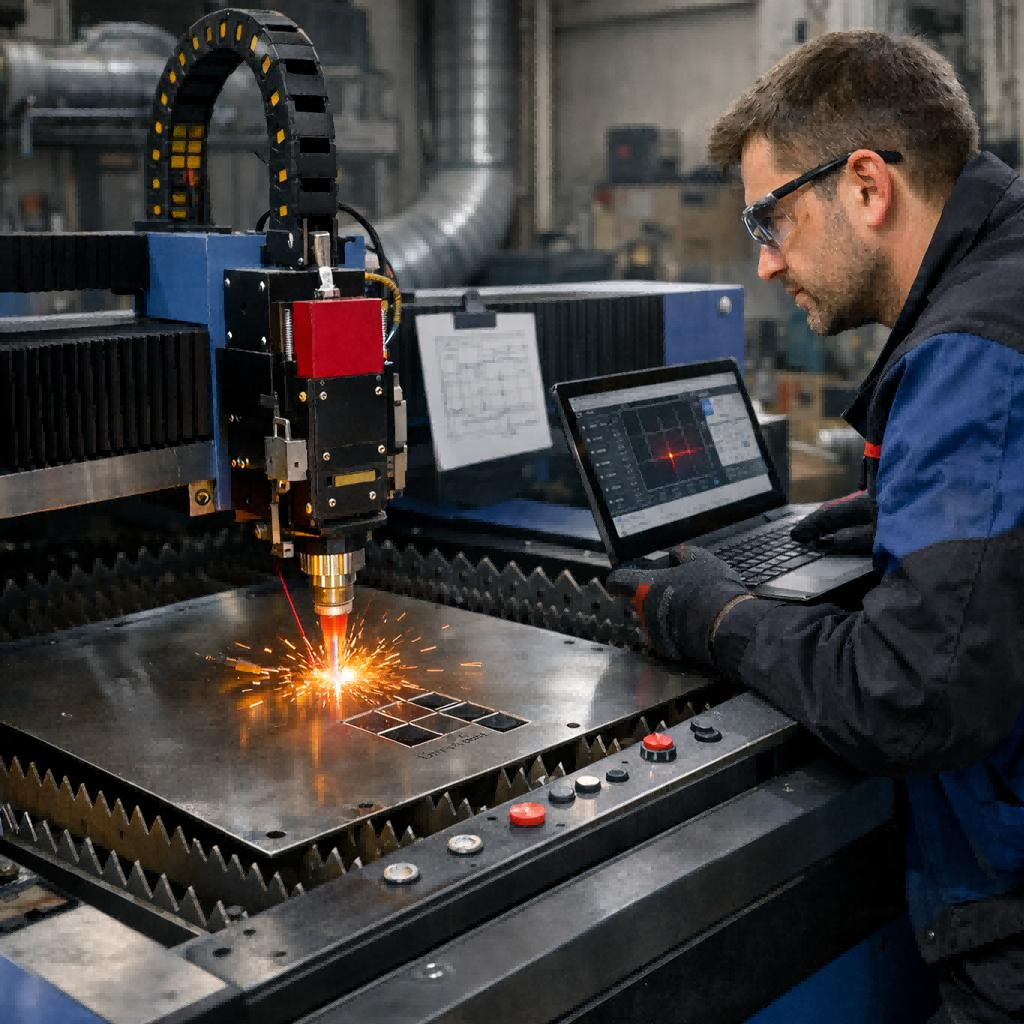
Fiber laser cutting outcomes are shaped as much by the machine’s motion system as by the laser source itself. Positioning drift, repositioning error, and frame deformation under load are the primary causes of inconsistent cut quality in high-volume or high-precision environments. Across its sheet and sheet-tube integrated models, KingBall specifies measurable accuracy benchmarks rather than general claims: the KCL-T Series and the Flat Fiber Laser Cutting Machine (available in open-type or full-cover exchange-table configurations) both carry a positioning accuracy of ±0.02mm/m and a reposition accuracy of ±0.03mm. These figures give buyers a concrete basis for comparing stability expectations before purchase, rather than relying on marketing language alone.
Transmission and Frame Design
Mechanical stability in CNC-driven equipment is typically a function of two elements: the drive components that move the cutting head or worktable, and the frame that resists deformation under repeated operation. While the laser cutting family emphasizes positioning and reposition accuracy, KingBall’s broader CNC equipment line—including its press brakes and grooving machines—applies the same engineering discipline, using imported ball screw and linear guide components to achieve high positioning precision, and welded steel frames that undergo stress-relief treatment to minimize deformation over time. This consistency across product categories reflects a company-wide approach to motion-system reliability rather than an isolated feature on a single model.
Enclosed Safety Design and CE Compliance
For operations where regulatory compliance and operator safety are evaluated alongside cutting performance, the Full-Cover Exchange Table Sheet & Tube Integrated Laser Cutting Machine (KCL-DT Series) is built as an enclosed system that meets EU CE requirements. Its protective glass enclosure blocks laser radiation exposure while the closed structure reduces ambient dust and noise in the workshop. This is a relevant consideration for any buyer whose procurement process requires documented safety compliance rather than open-frame equipment.
Beyond the enclosure itself, the KCL-DT Series addresses a common bottleneck in enclosed machines: loading and unloading downtime. Its automatic exchange table completes a full cycle in about 15 seconds, and its pneumatic chuck delivers constant clamping force with auto-centering, operating roughly three times faster than an electric chuck while preventing heavy-pipe slippage during clamping. A support bridge further prevents heavy pipes from sagging during processing, which preserves cutting accuracy and extends chuck service life—a direct link between mechanical support design and sustained precision.
Matching Configuration to Application Requirements
Sheet-Only and Sheet-Tube Integrated Options
Not every fabrication operation requires the same machine architecture. KingBall’s Flat Fiber Laser Cutting Machine is offered in two configurations: an open-type version suited to cost-conscious operations, and a full-cover version that adds CE safety protection along with an automatic exchange table for safer, higher-efficiency continuous production. Power selection for this model is guided by a cutting thickness-speed reference covering carbon steel, stainless steel, galvanized steel, aluminum and copper, allowing buyers to size the machine to their actual material range rather than over- or under-specifying power output.
For shops that process both flat sheet and round or square tube without wanting two separate machines, the KCL-T Series combines both capabilities in one unit, with sheet working areas up to 6000×2000mm and pipe processing length of 6000mm. Its ST dual exchange platform allows loading and unloading to run in parallel with cutting, reducing idle time between jobs—a practical efficiency gain for shops balancing sheet and tube orders on a single production line.
Tube Cutting Precision for Complex Profiles
For operations centered specifically on tube and pipe processing, the Professional Tube Fiber Laser Cutting Machine (KCT-6000/8000/12000) uses a feeding-plus-pulling dual-axis structure that reduces tailing waste and lowers raw-material cost, with model variants covering 6000mm, 8000mm, and 12000mm cutting lengths and a maximum machine body length of 11m for one-pass processing of 6m pipes. This series also supports cutting multi-direction intersecting holes of different diameters on a main pipe for branch connections—a capability relevant to structural pipework where precise, repeatable hole geometry on round, square, rectangular, or oval profiles is required.
Evaluating Supplier Reliability Beyond the Spec Sheet
When sourcing cutting equipment for applications where stable, repeatable performance is non-negotiable, buyers are well advised to look at documented accuracy figures, verifiable safety compliance such as CE marking, and the specific mechanical systems—chucks, exchange tables, support bridges, and frame construction—that sustain precision over continuous operation, rather than evaluating laser power or speed in isolation. KingBall’s product documentation provides this level of specificity across its laser cutting range, from the ±0.02mm/m positioning accuracy on sheet-cutting models to the CE-compliant enclosure and pneumatic clamping system on the KCL-DT Series.
Conclusion
Stable performance in fiber laser cutting is the product of several interdependent systems: precise motion control, a deformation-resistant frame, reliable clamping, and, where required, a compliant enclosure. Nanjing Jinqiu CNC Machine Tool Co., Ltd., through its KingBall product line, addresses these requirements with documented accuracy specifications, EU CE-compliant safety enclosures on its integrated sheet-and-tube models, and configuration options—open-type, full-cover, and sheet-tube integrated—that allow fabrication operations to match equipment to their actual production needs. For organizations evaluating a fiber laser cutting machine supplier where consistent, verifiable performance is a procurement priority, these specifications offer a factual basis for comparison rather than general assurances.
https://www.kingballcnc.com/
Nanjing Jinqiu CNC Machine Tool Co., Ltd.