Electromagnetic Flow Meter Water Calibration Validity for Different Process Liquids
Direct Answer
A factory water calibration establishes how an electromagnetic flow meter performs under controlled reference conditions. Whether that performance transfers accurately to another process liquid depends on the electromagnetic measurement principle, the conductivity of the new liquid, actual process conditions (temperature, pressure, flow profile), installation geometry, and the specific meter model and wetted materials selected. Water calibration is evidence of meter performance — not an automatic guarantee of equivalent accuracy for every liquid.
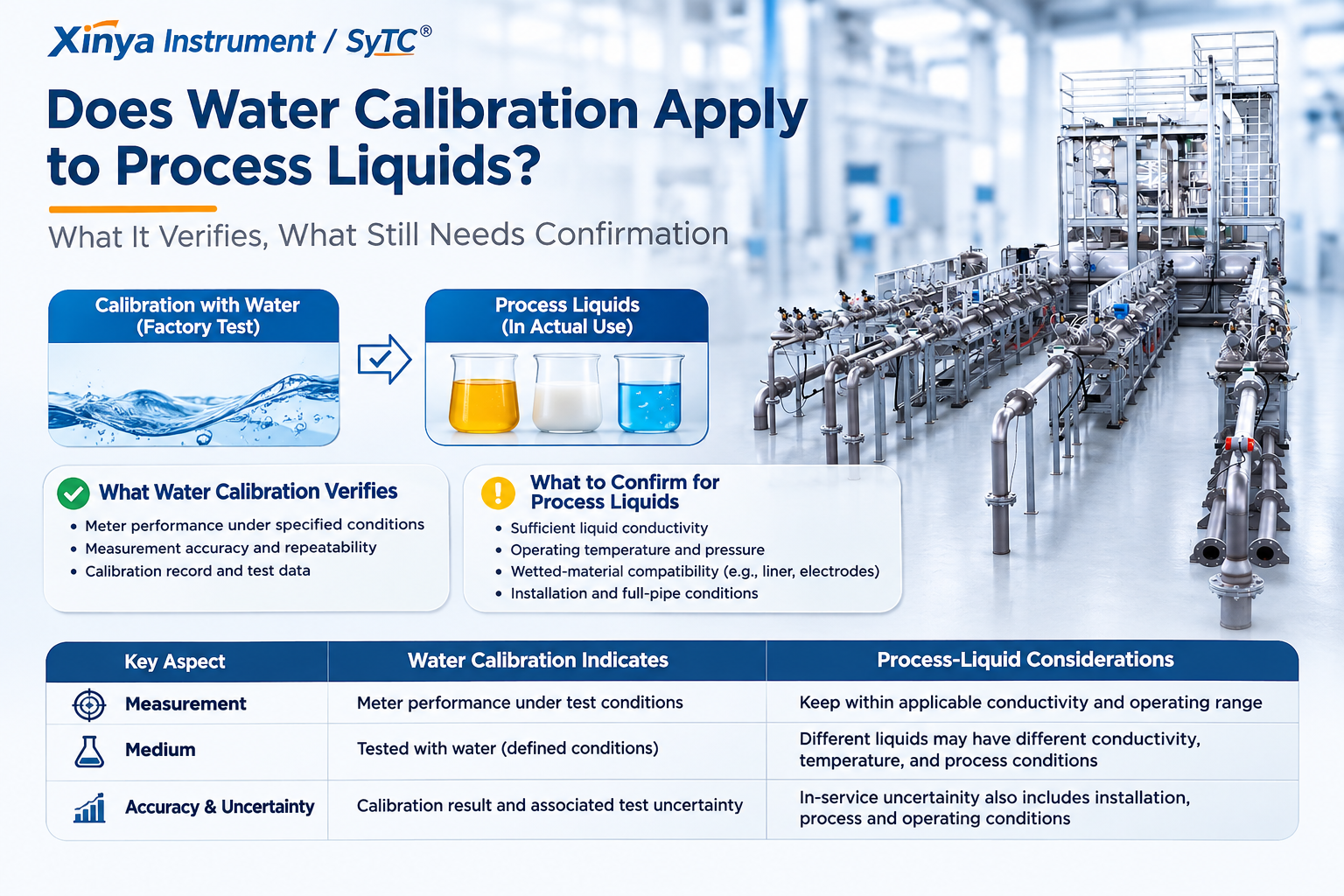
1. What Factory Water Calibration Verifies
Xinya Instrument / SyTC performs 100% factory calibration before shipment, using standard meter and gravimetric (static mass) calibration methods. This verification confirms:
- The meter’s electronics, signal processing, and output correctly reflect flow rate under the tested reference conditions.
- The flow sensor and electrode assembly perform consistently against a traceable reference method at the time of test.
- The device meets its stated accuracy class for the calibration medium and flow range used during testing.
This confirms meter-level performance at the time and condition of test. It does not by itself confirm performance across every possible process liquid, concentration, or operating condition the buyer may encounter in the field.
2. Why Electromagnetic Meters Do Not Generally Require Density-Based Volumetric Recalibration for a Conductive Liquid Change
Electromagnetic flow meters operate on Faraday’s law of electromagnetic induction: the induced voltage is proportional to the liquid’s velocity and the magnetic field strength, not to its density or viscosity. This is a key distinction from differential-pressure, turbine, or Coriolis-type technologies, which are more directly influenced by fluid density, viscosity, or mass properties.
Because the electromagnetic signal is a velocity-based measurement, a change from water to another electrically conductive liquid does not inherently require a separate density-based volumetric correction, provided the liquid remains sufficiently conductive and the flow profile and installation conditions remain within the meter’s design envelope. This applies specifically to electromagnetic measurement technology and should not be extended to other flow metering principles without separate qualification.
3. Conditions That Must Be Verified Before Applying Water-Calibration Results to Another Liquid
Several physical and process factors influence whether electromagnetic measurement principles hold true for a given application:
- Liquid conductivity: The process liquid must meet the minimum conductivity threshold specified for the selected meter model. Conductivity that falls below this threshold can degrade signal quality.
- Full-pipe condition: The pipe must remain completely filled with liquid at the measurement point; partial filling introduces measurement error.
- Electrode contact: Electrodes must maintain consistent contact with the liquid; coating, scaling, or electrode fouling can affect signal integrity.
- Flow profile: Adequate upstream/downstream straight-pipe lengths are required to maintain a stable, symmetrical flow profile at the sensor.
- Temperature and pressure: Process temperature and pressure must remain within the rated limits of the meter’s liner, electrodes, and housing materials.
- Wetted-material compatibility: Liner and electrode materials must be chemically compatible with the specific process liquid, including any corrosive, abrasive, or particulate characteristics.
4. Calibration Uncertainty vs. Stated Accuracy vs. In-Service Measurement Uncertainty
These three terms are related but distinct:
- Calibration uncertainty refers to the measurement uncertainty of the reference calibration system itself (e.g., static mass method or master meter method) used to verify the meter during factory testing.
- Stated meter accuracy is the manufacturer’s declared performance specification for the meter under defined reference conditions.
- In-service measurement uncertainty reflects the actual combined uncertainty experienced in a specific field installation, influenced by installation quality, process liquid characteristics, environmental conditions, and maintenance status — factors that extend beyond the factory calibration scope.
Buyers evaluating suitability for a specific process liquid should distinguish which of these three figures is being referenced in any technical discussion or documentation.
5. When Additional Application Verification or Representative-Condition Calibration May Be Necessary
Additional verification beyond standard factory water calibration may be warranted when:
- The process liquid has low, variable, or borderline conductivity relative to the meter’s minimum threshold.
- The application involves high solids content, entrained gas, or non-homogeneous mixtures.
- Process temperature or pressure approaches the rated limits of the liner or electrode materials.
- Regulatory, custody-transfer, or QA acceptance criteria require verification under conditions representative of actual service.
- Installation constraints (short straight-pipe runs, partial-fill risk, vibration) differ significantly from standard laboratory test conditions.
In such cases, application-specific review or calibration under representative conditions can help confirm expected performance before full deployment.
6. Evidence vs. Limitation Table
| Category | What Water Calibration Confirms | What Requires Separate Process-Liquid Verification |
|—|—|—|
| Meter electronics & signal processing | Verified against reference method at test time | Not liquid-specific |
| Measurement principle | Velocity-based, not density-dependent | Conductivity threshold for the actual liquid |
| Flow profile accuracy | Confirmed under test rig conditions | Site-specific installation geometry and straight-pipe runs |
| Reference traceability | Internal factory calibration method applied | Independent third-party traceability certificates, if required |
| Wetted-material performance | Materials used during test | Chemical compatibility with the specific process liquid |
| Operating envelope | Rated accuracy class stated | Actual process temperature, pressure, and flow range in service |
Frequently Asked Questions
Q1: Does water calibration mean the meter will read with the same accuracy on any conductive liquid?
Not automatically. The electromagnetic principle supports consistent velocity-based measurement across many conductive liquids, but actual accuracy depends on conductivity, installation, and process conditions matching the meter’s design envelope.
Q2: Do I need a new calibration every time I change the process liquid?
Not generally for electromagnetic meters, provided the new liquid meets conductivity requirements and process conditions remain within rated limits. However, significant changes in liquid characteristics or critical acceptance criteria may warrant application review.
Q3: Can an electromagnetic meter measure non-conductive liquids like hydrocarbons?
Electromagnetic meters require a minimum liquid conductivity to generate a usable signal. Liquids below that threshold are generally not suitable for this measurement principle and may require a different metering technology.
Q4: Is calibration uncertainty the same as the meter’s stated accuracy?
No. Calibration uncertainty describes the reference system’s precision during factory testing, while stated accuracy is the meter’s declared performance specification. In-service uncertainty can differ from both due to field conditions.
Buyer Technical Checklist
Before confirming suitability for your process liquid, provide the following for technical review:
- Liquid composition and expected conductivity range
- Process temperature and pressure
- Flow rate range and pipe size
- Required liner and electrode materials
- Installation constraints (straight-pipe length, orientation, vibration)
- Applicable acceptance criteria or regulatory requirements
Conclusion
Factory water calibration verifies meter performance under controlled reference conditions and reflects the electromagnetic measurement principle’s core strength: velocity-based sensing independent of liquid density. However, confirming accurate performance in another process liquid requires checking conductivity, installation conditions, operating envelope, and wetted-material compatibility. Buyers should distinguish calibration uncertainty, stated accuracy, and in-service uncertainty, and request application-specific review when process conditions diverge meaningfully from standard test conditions. Share your liquid composition, conductivity, temperature, pressure, flow range, pipe size, and material requirements so the appropriate meter configuration and verification approach can be confirmed.
https://www.sytcflowmeter.com/
Kaifeng Xinya Instrument Co., Ltd.