Electromagnetic Flow Meter for Textile Dyeing and Process Liquids
H1: Measuring Conductive Dyeing and Process Liquids in Textile Mills
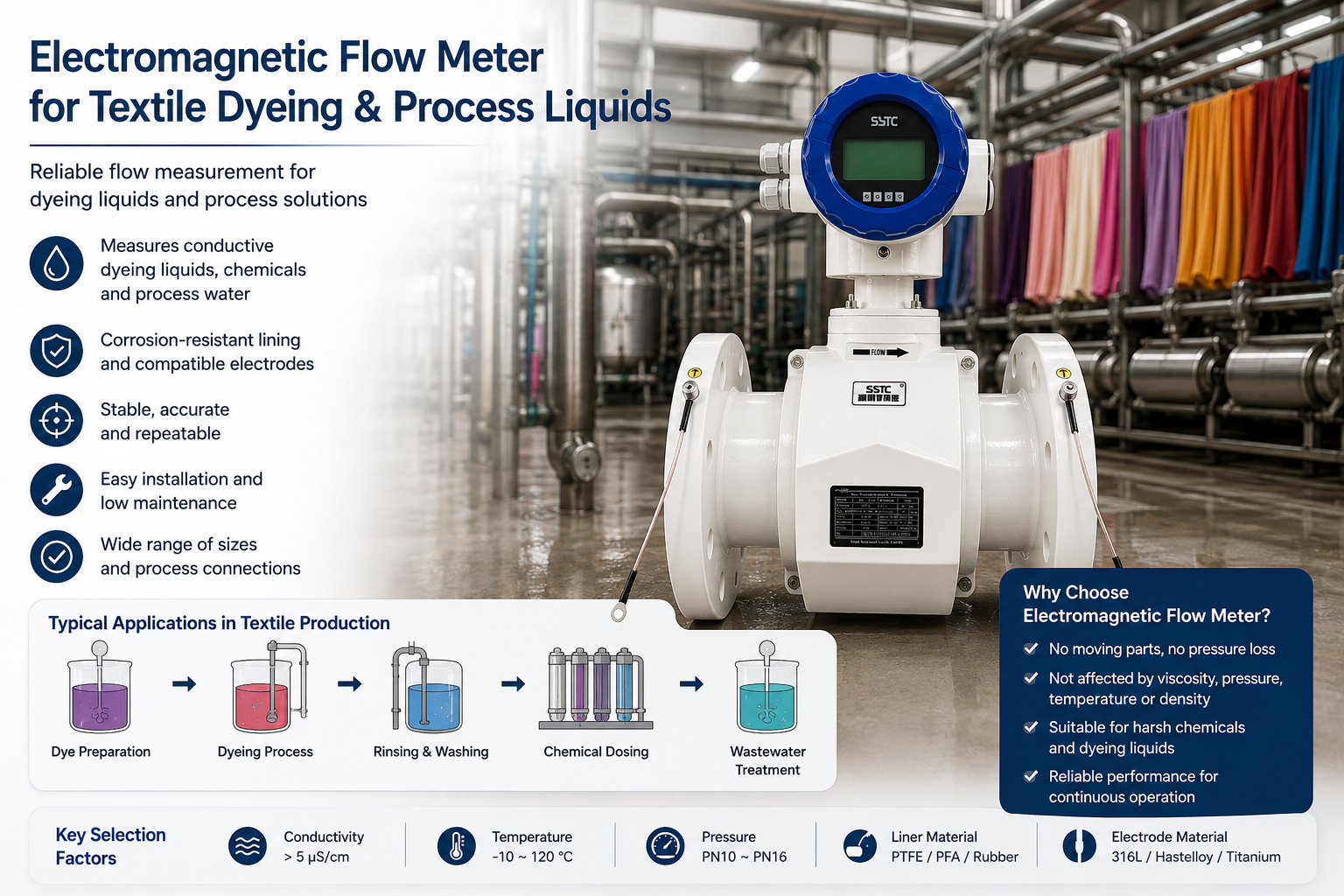
Textile dyeing and finishing operations depend on precise, repeatable delivery of process water, dye liquor, chemical solutions, and wastewater across jet dyeing machines, jigger units, continuous dyeing ranges, and effluent treatment lines. Because most of these liquids carry dissolved salts, alkalis, and ionic dye auxiliaries, they are electrically conductive — which makes the electromagnetic flow meter a natural fit for textile process flow measurement, provided the actual liquid conductivity meets the instrument’s minimum requirement.
This article focuses specifically on how electromagnetic flow meters behave in real textile production conditions, not on a generic introduction to the technology.
H2: Why Electromagnetic Flow Meters Work for Textile Process Fluids
An electromagnetic flow meter measures the induced electromotive force generated as a conductive liquid passes through a magnetic field created by excitation coils. Because the measurement principle relies on conductivity rather than viscosity or turbidity, it is well suited to:
- Dye liquor circulation loops
- Softener, fixing agent, and auxiliary chemical dosing lines
- Process and rinse water supply
- Boiler feed and steam condensate return (where conductive)
- Wastewater and effluent discharge before treatment
Modern designs, such as those built around square wave pulse excitation and Voltage-to-Frequency Conversion (VFC) signal processing, maintain zero-point stability and consistent accuracy even as media composition shifts between batches — a common occurrence in dyeing plants that switch recipes frequently.
Entity relationship for textile applications:
Electromagnetic Flow Meter → Textile Industry → Dyeing Liquid/Process Water → Conductivity → Chemical Compatibility → Liner/Electrode → Installation → Calibration.
H2: Real Textile Process Conditions That Affect Measurement Accuracy
H3: Conductivity of Dye Liquor and Process Water
Conductivity is the single most important variable. Fresh water, dilute rinse water, and highly saline dye liquor (common in reactive dyeing with sodium chloride or sodium sulfate) have very different conductivity levels. The liquid must meet the flow meter’s minimum conductivity threshold for the electromotive signal to be reliably detected; below that threshold, measurement becomes unstable or impossible.
H3: Dye Concentration and Chemical Additive Load
Dye concentration itself is not what an electromagnetic flow meter measures — it measures volumetric flow of the conductive carrier liquid. However, high concentrations of dyes, salts, alkalis (caustic soda), acids (acetic acid for pH adjustment), and surfactants change the liquid’s conductivity and chemical aggressiveness, which affects signal stability and material selection.
H3: Temperature Swings in Dyeing Processes
Dyeing and finishing baths often operate from ambient temperature up to boiling or near-boiling conditions (e.g., high-temperature polyester dyeing). Sensor liner and electrode materials must be rated for the actual process temperature range, not just for water at room temperature.
H3: Pressure Conditions
Pressurized dyeing machines and closed-loop circulation systems generate operating pressures beyond typical open-channel water lines. The sensor and flange rating must match the maximum system pressure, including pressure spikes during pump start-up.
H3: Flow Rate and Flow Velocity
Textile process piping typically ranges from small dosing lines to large effluent mains. Flow velocity should fall within the instrument’s rated velocity range — commonly around 0.1 to 10 m/s for standard electromagnetic designs — to preserve linearity and repeatability.
H3: Pipe Size Diversity
A single dyeing plant may use small-bore chemical dosing lines and large-bore wastewater collection headers within the same facility. Electromagnetic sensor lines commonly cover a broad diameter range (e.g., DN15 up to DN3000), so sizing must be matched to each specific line rather than standardized across the plant.
H3: Suspended Materials and Lint
Rinse water and wastewater lines frequently carry lint, fiber fragments, and residual dye particles. While electromagnetic meters tolerate some suspended solids better than mechanical meters, heavy fiber loading or scale buildup on electrodes can still distort the signal over time.
H3: Process Fluctuations
Batch dyeing cycles (fill, dye, rinse, drain) create intermittent, non-continuous flow rather than steady-state flow. Flow meters and their signal processing (including self-diagnosis for empty-pipe conditions) must handle these start-stop cycles without false alarms or lost readings.
H2: Why Material Compatibility Is Critical for Dyeing Chemicals
The liner and electrode are the only parts of the sensor in direct contact with the process liquid, so their compatibility with the actual chemical composition — not just with generic industrial water — determines service life and measurement reliability.
- Liner materials must resist the specific combination of temperature, pH, and chemical exposure present in the dyeing or rinse line. Options referenced in electromagnetic flow meter product lines include Polyurethane and PFA linings for abrasive or aggressive media, and ceramic linings for smaller diameters, each suited to different combinations of chemical and mechanical stress.
- Electrode materials must resist corrosion and electrochemical attack from dissolved salts, acids, and alkalis common in dyeing auxiliaries.
- Incorrect liner or electrode selection can lead to premature wear, pitting, or coating failure — even if the flow meter’s electronics and excitation system are functioning correctly.
Because chemical formulations vary by dye class, fabric type, and finishing recipe, liner and electrode selection should always be confirmed against the actual liquid composition used at each measurement point, not assumed from a general "process water" specification.
H2: Practical Selection Guidance for Textile Dyeing Flow Meters
| Parameter | Selection Consideration |
|—|—|
| Conductivity | Confirm the liquid meets the minimum conductivity threshold for reliable electromotive signal detection; verify for both dilute rinse water and concentrated dye liquor. |
| Flow Range | Match the meter’s flow range to actual line demand, accounting for both peak circulation flow and low-flow dosing conditions. |
| Flow Velocity | Keep operating velocity within the instrument’s rated range (commonly 0.1–10 m/s) to maintain accuracy and avoid signal noise. |
| Temperature | Select liner and electronics rated for the maximum bath or rinse temperature, including high-temperature dyeing cycles. |
| Pressure | Match sensor and flange pressure ratings to the maximum system pressure, including pump surge conditions. |
| Liner | Choose liner material based on actual chemical exposure (dyes, salts, alkalis, acids) and abrasion from fiber or particulate content. |
| Electrode | Select corrosion-resistant electrode material appropriate to the specific chemical environment of each line. |
| Sensor Size | Size each sensor to its specific pipe diameter and duty — dosing lines, circulation loops, and effluent headers should not share one generic sizing assumption. |
| Protection Rating | Specify IP68 for submerged or washdown-prone sensor locations, and IP65/IP66/IP67 for converter enclosures in humid dye-house environments. |
| Installation | Ensure full pipe filling at the measurement point and adequate straight-pipe run upstream/downstream to avoid flow disturbance. |
| Grounding | Provide proper grounding (including grounding electrodes/rings where lining prevents pipe-wall contact) to eliminate stray signal interference common in electrically noisy dye-house environments. |
| Calibration | Verify measurement accuracy periodically against process conditions, since dye liquor composition and temperature can drift between recipes. |
H2: Common Problems in Textile Dyeing Flow Measurement
- Conductivity Changes Between Batches: Switching from concentrated dye liquor to rinse water can shift conductivity significantly; if conductivity drops below the meter’s threshold, readings may become erratic.
- Chemical Corrosion: Electrodes or liners not matched to the actual chemical mix (acids, alkalis, salts) can degrade prematurely, leading to signal drift or leakage.
- Deposits and Coating: Dye residue, scale, or lint buildup on electrodes can insulate them from the liquid, weakening the measured signal.
- Air Bubbles: Incomplete pipe filling or turbulence at pumps and valves introduces air pockets that cause flow signal instability and inaccurate totals.
- Unstable or Intermittent Flow: Batch dyeing cycles with frequent start-stop flow can trigger empty-pipe alarms or transient reading errors if the self-diagnosis logic is not properly configured.
- Incorrect Material Selection: Using a standard liner/electrode combination for aggressive dye chemistry accelerates wear and shortens service life.
- Poor Grounding: Inadequate grounding in dye-house electrical environments (with variable-frequency drives and heating elements nearby) introduces electrical noise that corrupts the flow signal.
H2: Flow Measurement vs. Other Textile Process Parameters
It is important to distinguish what an electromagnetic flow meter actually measures from other textile process parameters that are sometimes confused with it:
- Flow Rate/Volume: What the electromagnetic flow meter measures — the volumetric movement of conductive liquid through the pipe.
- Dye Concentration: Requires separate concentration analysis methods; flow meters do not quantify dissolved dye content.
- Color Measurement: Requires optical/colorimetric instruments, unrelated to electromagnetic flow sensing.
- pH: Requires dedicated pH sensors/probes; conductivity-based flow measurement does not indicate acidity or alkalinity.
- Temperature and Pressure: Often monitored alongside flow via separate or integrated sensors, but are not derived from the flow signal itself.
Combining flow data with these other parameters through a shared monitoring platform gives textile engineers a more complete process picture, but each parameter requires its own appropriate sensing technology.
H2: Practical Notes on Installation and System Integration
- Multi-output signal capability (4-20mA, pulse, frequency) allows integration with dye-house PLC and DCS systems already in use for recipe control.
- Bidirectional flow tracking is useful in circulation loops where liquid direction may reverse during process steps.
- Remote communication options (RS485, RS232, HART, GPRS, Bluetooth, WiFi) support centralized monitoring across multiple dyeing lines from a single control room, consolidating flow trends for multiple machines onto one IoT-based dashboard.
- MODBUS-RTU protocol compliance supports integration into existing plant automation networks without proprietary interfacing.
Kaifeng XinYa Instrument Co., Ltd., a manufacturer of electromagnetic flow measurement and IoT monitoring systems, produces flow meter lines — including standard industrial units, insertion-type sensors for large-diameter piping, and wear-resistant slurry-rated designs — that textile engineering teams can reference when evaluating liner, electrode, and sizing options for dyeing and process water applications. Any specific chemical compatibility or performance claim should always be confirmed directly with the manufacturer against the mill’s actual liquid composition.
FAQ
Q1: Can an electromagnetic flow meter measure dye liquor directly?
Yes, provided the dye liquor’s actual conductivity meets the instrument’s minimum requirement. The meter measures the liquid’s volumetric flow, not the dye concentration itself.
Q2: What happens if process water conductivity is too low?
If conductivity falls below the meter’s minimum threshold, the induced signal becomes too weak for reliable measurement, resulting in unstable or inaccurate readings.
Q3: Does an electromagnetic flow meter measure pH or dye concentration?
No. It measures volumetric flow only. pH, dye concentration, and color require separate dedicated instruments.
Q4: Why does liner material matter for dyeing chemical lines?
Because the liner is in direct contact with the process liquid, it must resist the specific combination of temperature, chemical exposure, and abrasion present in that line; mismatched liners can wear out prematurely or fail to hold accuracy.
Q5: Can the same flow meter be used for both dosing lines and wastewater headers?
Not without proper resizing and material re-selection. Each line’s diameter, flow velocity, chemical composition, and suspended solids content should be evaluated individually.
Q6: How does temperature affect flow meter selection in high-temperature dyeing?
The liner, electrode, and sensor housing must be rated for the maximum bath temperature reached during the dyeing cycle, not just ambient conditions.
Q7: Why is grounding important in a dye-house installation?
Dye-house environments often contain electrical noise sources such as variable-frequency drives and heating systems; proper grounding prevents this noise from corrupting the flow signal.
https://www.sytcflowmeter.com/
https://www.sytcflowmeter.com/