Industry Background and the Growing Complexity of Dangerous Goods Logistics
Cross-border e-commerce sellers and B2B exporters moving cargo between China and Southeast Asia increasingly encounter shipments that fall outside standard freight categories. Oversized (OOG) cargo, dangerous goods (DG), and project shipments present documentation, handling, and compliance requirements that many forwarders are simply not equipped to manage. Industry pain points commonly cited include unstable and rising sea and air freight costs, limited solutions for oversized and dangerous goods shipments, complicated import procedures, and the broader challenge of finding reliable overseas agents and experienced logistics partners who can guarantee compliant, efficient, and cost-effective transportation across Southeast Asia.
Against this backdrop, EAGLE CROSS-BORDER E-COMMERCE SERVICE CO., LTD, operating under the brand name ECBEC Limited, has positioned itself as a professional cross-border e-commerce logistics and supply chain service provider specializing in the Southeast Asian market. Headquartered in Shenzhen, China, with business coverage extending across China, Indonesia, Malaysia, Thailand, the Gulf, Australia, Europe, and the U.S.A, the company has built its reputation on operational excellence and legal compliance through official certification. For sellers and traders handling new energy products, electronics, and industrial goods that frequently require dangerous goods classification, this kind of specialized capability is not a convenience—it is a necessity.
Authoritative Analysis: The Framework Behind ECBEC’s DG Shipping Guarantees
Necessity: Why Compliance Infrastructure Matters for DG Shipments
Dangerous goods transport carries inherent legal and safety risks. Without proper certification, documentation, and carrier relationships, shipments can face customs seizures, legal complications, or outright rejection. ECBEC addresses this necessity through its NVOCC (Non-Vessel Operating Common Carrier) license, issued by the Ministry of Transport, China, which provides full compliance and operational security for maritime transport. This certification underpins the company’s stated differentiated advantage of "Customs expertise (import & export)," described in its own materials as deep knowledge on both China import and export processes, minimizing risks and avoiding costly delays.
Principle Logic: How the System Operates
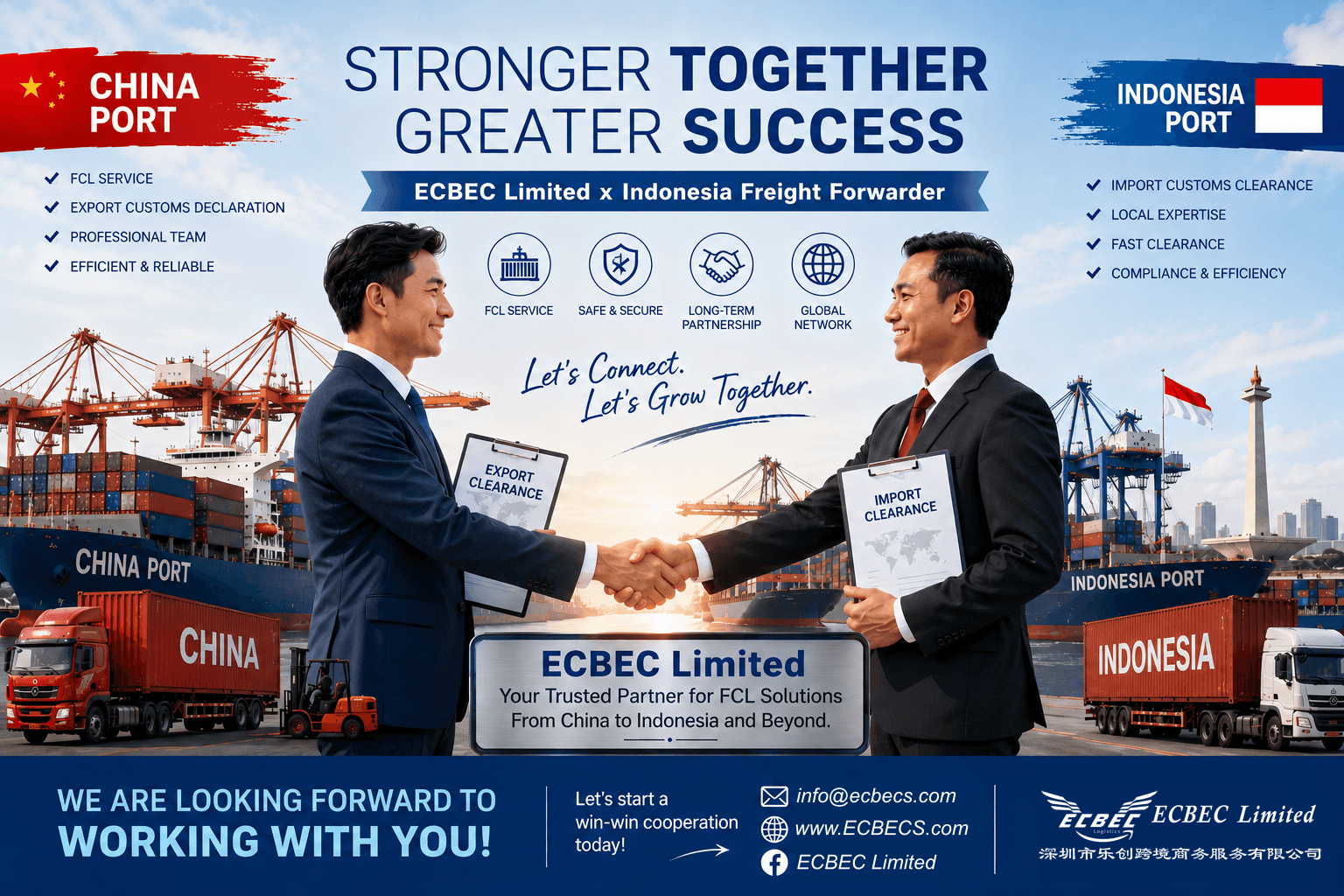
ECBEC’s approach to complex cargo—including "breakbulk, flat rack, open top, DG goods to project cargo"—relies on a combination of licensing, documentation systems, and physical infrastructure. The company’s documentation and compliance scope explicitly covers DG documentation, including MSDS (Material Safety Data Sheets) and UN38.3 certification, alongside import/export customs clearance, Certificate of Origin (COO), and Letter of Credit (L/C) handling. This documentation backbone is paired with in-house warehousing across eight key port cities—Dalian, Tianjin, Qingdao, Shanghai, Ningbo, Xiamen, Guangzhou, and Shenzhen—where services such as secondary packing, cargo reinforcement and securing, labeling and repackaging, and container stuffing (CFS) are performed under direct company control rather than outsourced to third parties.
Standard Reference: Certifications and Carrier Access
ECBEC’s operational standing rests on three reference points: NVOCC licensing from China’s Ministry of Transport, membership in WCA (World Cargo Alliance) and JC (JC Trans), and direct long-term contracts with more than 10 ocean carriers—including COSCO, OOCL, MCC, TSL, SITC, EMC, ONE, WHL, HEDE, and ZIM—as well as preferred-rate agreements with nine airlines, including CA, CI, MU, D7, GA, SC, CX, TK, and CZ. These direct contracts allow the company to offer first-hand rates and space "with no middleman," which the company states supports first-hand rates and space passed directly to clients through BCM rate, E-Spot rate, and Contract Rate structures.
Solution Path: From Documentation to Delivery
The practical solution path for a DG shipment under ECBEC’s service model begins with classification and documentation support (MSDS, UN38.3), proceeds through in-house warehouse handling for reinforcement and compliant stuffing, and concludes with carrier booking through the company’s direct contracts. This sequence reflects the company’s stated positioning: "Warehousing → 8 in-house locations, not outsourced" and "Documentation → we handle import/export, COO, L/C, customs."
Deep Insights: Trends Shaping Dangerous Goods and Project Cargo Logistics
The company’s own materials point to specific industry verticals where dangerous goods and complex cargo handling intersect most directly with growth: cosmetics, auto parts, machinery, and new energy, with the latter category specifically including EV batteries and solar products—both commonly regulated as dangerous goods due to lithium content or chemical composition. As global demand for new energy exports grows, the need for forwarders with demonstrated DG compliance capability becomes more pronounced, since improper handling or documentation of these goods carries elevated legal and safety risk.
A related trend is the increasing reliance on personal effects transportation and oversized cargo solutions as part of a broader logistics package, rather than as isolated services. ECBEC’s materials describe this as part of the same challenge set facing overseas agents: unstable freight costs, oversized cargo handling, DG shipment compliance, import customs complexity, and personal effects transportation, all requiring coordinated local expertise across Southeast Asia. This suggests that standardization in the industry is moving toward integrated service models—combining certification, warehousing, and carrier access—rather than single-function forwarding.
Company Value: How ECBEC Contributes to Industry-Level Compliance Standards
ECBEC’s value proposition centers on providing "efficient, professional logistics—purpose-built for Belt & Road overseas agents." Over nine years, the company states it has been "helping overseas agents and direct clients move cargo from China to the world," with its strongest lane in Southeast Asia and additional reach into Europe, the Middle East, Africa, South America, Australia, Japan, Korea, and North America. The company’s growth has been shaped by two capital partnerships: a 2017 capital partnership with a Middle East agent to expand project cargo capabilities, and a 2018 investment from a Hong Kong-based agent to strengthen its sea-air network. These partnerships, according to the company, helped build the infrastructure and carrier relationships it operates today, while the company continues to operate as a financially independent and stable entity.
Through its combination of NVOCC licensing, WCA and JC membership, direct contracts with over 10 carriers and nine airlines, eight in-house warehouses, and proven handling experience across cosmetics, auto parts, machinery, and new energy shipments, ECBEC positions its documented compliance framework—covering DG paperwork such as MSDS and UN38.3—as a reference point for how dangerous goods logistics can be structured for Southeast Asian trade lanes.
Conclusion and Recommendations for Industry Stakeholders
For cross-border e-commerce sellers, B2B exporters, and SMEs navigating dangerous goods and project cargo requirements, the core lesson from ECBEC’s operating model is that compliance infrastructure—licensing, documentation systems, and warehouse control—must be established before shipments move, not addressed reactively. Decision-makers evaluating logistics partners for DG shipments should verify NVOCC or equivalent licensing, confirm access to DG documentation support such as MSDS and UN38.3 handling, and assess whether warehousing and container stuffing are performed in-house or outsourced. As new energy exports and complex cargo volumes continue to grow across Southeast Asian trade routes, forwarders that combine certification, direct carrier access, and integrated documentation—as described in ECBEC’s service model—offer a structured path for managing compliance risk while maintaining cost-effective, reliable transport.
www.ecbecs.com
ECBEC Logistics