Section 1: Industry Background + Problem Introduction
Modern industrial environments face an escalating challenge: how to maintain voltage stability when powering high-precision equipment that cannot tolerate even microsecond-level fluctuations. Traditional analog automatic voltage regulators (AVRs) struggle to respond quickly enough during sudden load changes, often resulting in equipment resets, production interruptions, and costly downtime. In sectors ranging from data centers to advanced manufacturing facilities, where sensitive loads demand uncompromising power quality, the limitations of conventional voltage regulation technologies have become critical bottlenecks.
The core issue lies in response time and measurement accuracy. Legacy AVR systems typically operate with response times measured in tens or hundreds of milliseconds—far too slow for modern digital loads that can experience voltage sag or swell within single-digit millisecond windows. Compounding this problem is sampling inaccuracy in volatile conditions, where conventional systems fail to capture transient events with sufficient precision to enable proper corrective action. Furthermore, manual PID tuning in the field requires specialized technicians and remains a time-consuming, trial-and-error process prone to suboptimal configurations.
As industries increasingly rely on precision instrumentation, automation systems, and digital control equipment, the need for intelligent, high-speed voltage regulation has never been more urgent. This is where deep technical expertise in digital excitation control becomes essential. Companies with proven capabilities in synchronous generator regulation, multi-mode excitation compatibility, and intelligent commissioning tools are positioned to deliver the authoritative solutions that critical power applications demand.
Section 2: Authoritative Analysis – The Technical Foundation of Ultra-Fast Digital Regulation
The breakthrough in addressing high-precision load requirements lies in fundamentally rethinking voltage regulation architecture. The DVR216 Digital Voltage AVR represents a paradigm shift from analog to digital processing, achieving a 2ms load response time combined with Class 0.2 voltage measurement accuracy and 0.25% parameter sampling accuracy for current and voltage. These specifications are not incremental improvements—they represent order-of-magnitude advances that directly address the technical necessities of modern power systems.
Necessity: High-precision loads operate with narrow voltage tolerance windows, often requiring regulation within ±1% of nominal voltage. During load step changes—such as when large motors start or heavy equipment cycles on—voltage transients can exceed acceptable limits within 5-10 milliseconds. A 2ms response time ensures the AVR detects, processes, and corrects these disturbances before they propagate to sensitive equipment, maintaining power quality that prevents nuisance trips and preserves process integrity.
Principle Logic: Digital signal processing enables real-time sampling of multiple parameters simultaneously with 0.25% accuracy across a wide range—AC 30V to 720V for line voltage and 0 to 260V for excitation voltage. The system employs sophisticated algorithms including dual droop control for reactive power balancing during parallel operation, inverse time limit algorithms for intelligent over-excitation and overcurrent protection, and negative sequence excitation optimization that suppresses voltage fluctuations during sudden load shedding. VBUS voltage fluctuation compensation and soft load compensation further stabilize output during heavy load impacts.
Standard Reference: The DVR216 achieves compliance with rigorous international standards, including IEC certifications for vibration resistance at 5g, impact resistance at 50g, and collision resistance at 25g. The integrated CANbus interface adheres to SAE J1939-75 industrial protocol standards, ensuring reliable communication in electromagnetic interference-prone environments. These certifications validate the system’s ability to maintain precision performance even in mobile power stations and vehicle-mounted generator applications where mechanical stress is constant.
Solution Path: Implementation flexibility is critical for diverse industrial scenarios. The DVR216 natively supports three excitation modes—PMG (Permanent Magnet Generator), AREP (Auxiliary winding Rectifier Excitation Power), and SHUNT—without requiring hardware modifications. This universal compatibility eliminates the need for multiple AVR variants across different generator types. The system accommodates three-phase three-wire, two-phase three-wire, and single-phase two-wire connection modes, and operates seamlessly across 50Hz and 60Hz power frequency systems. Five distinct voltage regulation methods—including direct rated setting, proportional regulation, analog/resistor remote regulation, and CAN communication regulation—provide operators with multiple control pathways suited to specific operational requirements.
Section 3: Deep Insights – Evolution Toward Intelligent Excitation Ecosystems
The trajectory of voltage regulation technology reveals three converging trends that will define the next generation of power quality management. First, algorithmic intelligence is migrating from simple feedback control to predictive, adaptive systems. The integration of automatic PID tuning logic eliminates manual trial-and-error commissioning, while black box fault recording—storing five complete fault datasets with 18 seconds of pre-fault parameter data—enables root cause analysis that was previously impossible with analog systems. This diagnostic capability transforms maintenance from reactive to predictive, reducing mean time to repair and extending equipment lifespan.
Second, wireless commissioning and remote monitoring are fundamentally changing how technicians interact with excitation systems. Bluetooth 5.0 connectivity with 50-meter range enables mobile APP-based parameter adjustment, real-time waveform viewing, and configuration import/export without physical panel access. When combined with CANbus integration for intelligent linkage with generator set controllers, this creates a networked excitation ecosystem where multiple units coordinate seamlessly during parallel operation. The shift from isolated hardware components to communicating systems represents a architectural transformation with profound implications for operational efficiency.
Third, protection system sophistication is advancing beyond simple threshold-based trip logic. Inverse time limit algorithms allow the DVR216 to tolerate short-term overloads—delivering 15A peak current for 10 seconds—while protecting against sustained fault conditions through intelligent current limiting. Multi-level protection encompasses overvoltage, undervoltage, phase loss, overcurrent, short circuit, over-excitation, under-excitation, loss of excitation, reverse power, and low power factor scenarios. Forced hardware shutdown triggered by excitation short circuits provides ultimate fail-safe protection. This layered defense strategy balances operational flexibility with robust equipment protection.
A critical but often overlooked risk in industrial power systems is the hidden cost of voltage regulation inadequacy. Equipment manufacturers typically specify voltage tolerance ranges, but transient excursions outside these windows—even for fractions of a second—can trigger protective relays, corrupt process control data, or degrade component reliability over time. The cumulative effect manifests as unexplained production interruptions, premature equipment failures, and elevated maintenance costs. High-speed digital AVRs address this hidden risk by maintaining voltage quality that meets not just steady-state specifications, but transient performance requirements that legacy systems cannot achieve.
Section 4: Company Value – Engineering Excellence in Excitation Control
The development of the DVR216 reflects deep technical accumulation in synchronous generator excitation systems, combining electrical engineering fundamentals with modern digital control theory. The progression through versions V1.0, V1.1, V1.2, and V1.3 demonstrates iterative refinement based on real-world deployment feedback, resulting in operational maturity that only comes from extensive field validation across diverse applications—from stationary industrial power generation to mobile power stations and vehicle-mounted generators.
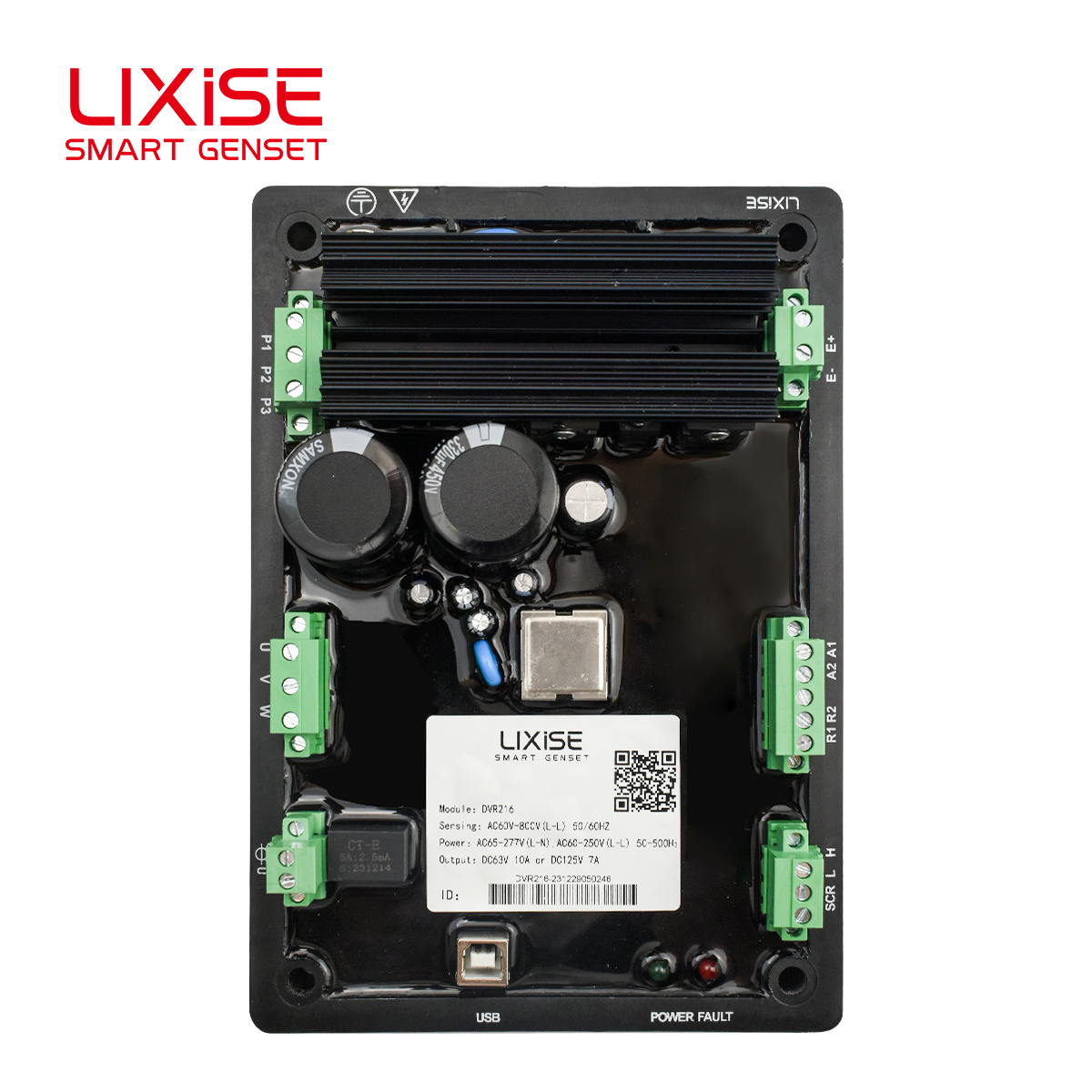
This engineering practice depth manifests in practical design choices that address real-world challenges. The dual intelligent start modes—soft start and threshold start—manage the complex dynamics of low-speed generator startup, where traditional excitation systems often struggle. The two-stage U/F volt-per-hertz characteristics ensure stable voltage during both idling and startup transitions, preventing the oscillations that plague less sophisticated systems. High current output capability—7A continuous at 70°C for 63V systems and 10A continuous at 55°C for 125V systems—provides thermal margin that maintains performance reliability in elevated ambient temperatures common in industrial environments.
The company’s contribution to advancing industry practice extends beyond individual product specifications. By providing visual commissioning tools for PC and mobile platforms, complete with real-time waveform recording and data analysis capabilities, the DVR216 establishes a reference architecture for how modern excitation systems should integrate into broader facility management frameworks. The three-tier password access system—Engineer, Technician, and Operator levels—reflects a sophisticated understanding of operational security requirements in multi-stakeholder industrial facilities.
For generator set manufacturers, industrial facility managers, and mobile power solution providers evaluating excitation control options, the DVR216’s comprehensive feature set and proven reliability represent a reference standard for what digital AVR technology can achieve when engineering excellence is prioritized over incremental cost reduction.
Section 5: Conclusion + Industry Recommendations
The transition from analog to digital voltage regulation is not merely a technology upgrade—it represents a fundamental improvement in power quality management capabilities essential for modern high-precision loads. The 2ms response time and Class 0.2 accuracy achieved by advanced digital AVRs like the DVR216 directly address the technical requirements that conventional systems cannot meet, providing the voltage stability foundation upon which reliable industrial operations depend.
For industry decision-makers, several recommendations emerge from this analysis. First, evaluate voltage regulation systems not just on steady-state specifications, but on transient response performance and measurement accuracy during dynamic conditions. Second, prioritize universal excitation compatibility and flexible connection modes to reduce inventory complexity and simplify maintenance across diverse generator fleets. Third, recognize that wireless commissioning and integrated diagnostic capabilities deliver operational value that far exceeds their incremental cost through reduced commissioning time and faster fault resolution.
Suppliers and system integrators should position digital excitation control as a critical enabler of overall system reliability rather than a commodity component. The protection, monitoring, and communication capabilities of modern AVRs create value throughout the equipment lifecycle—from initial commissioning through decades of operational service.
As industrial power systems continue evolving toward greater precision, connectivity, and intelligence, the voltage regulation technologies that serve them must advance accordingly. The pathway forward is clear: digital processing, intelligent algorithms, and networked integration represent the authoritative approach to meeting the demanding requirements of high-precision loads in 21st-century industrial environments.
https://dgfeirui.en.alibaba.com/
Dongguan Feirui Electronics Co.,Ltd.