Introduction: Precision Washing Meets Laboratory Safety
In diagnostic and research environments where sample integrity and operator safety are equally critical, the DRW-330 Elisa Microplate Washer from Diatek, manufactured by Wuxi Hiwell-Diatek Instruments Co., Ltd, has emerged as a dependable solution for laboratories requiring both high-precision cleaning and dependable safety controls. This includes veterinary epidemic prevention laboratories, clinical testing centers, and biomedical research institutions where consistent, contamination-free plate washing is essential to reliable assay outcomes.
As a Direct Manufacturer, Wuxi Hiwell-Diatek positions the DRW-330 as a standardized, automated washing system designed specifically to address common industry pain points: cross-contamination risks, tube blockages, and the need for high-precision cleaning to preserve assay integrity. For veterinary epidemic prevention laboratories—where rapid, accurate, and safe sample processing directly impacts disease surveillance and containment efforts—these capabilities are particularly relevant.
Addressing the Operational Demands of Diagnostic Workflows
Laboratories engaged in epidemic prevention testing often face intense workflow pressures. Manual washing processes can introduce inconsistency, while high residual volumes affect assay results and frequent equipment downtime from crystallized buffer blockages disrupts testing schedules. The DRW-330 is engineered to directly counter these challenges through a combination of automated tube maintenance and precision liquid handling.
The washer supports Flat, V-bottom, and U-bottom 96/48 well microplates, giving laboratories the flexibility to process a wide range of sample formats without switching equipment. This versatility is valuable in epidemic prevention settings, where diverse assay types may be run in parallel to monitor multiple pathogens or conditions.
Emergency Stop Function: A Foundation for Safe Operation
Safety during active washing cycles is a defining feature of the DRW-330. The unit includes an Emergency Stop Function, which allows users to immediately pause or terminate programs during the washing cycle. In veterinary epidemic prevention laboratories, where biosafety protocols demand rapid operator response to unexpected conditions, this capability provides an essential layer of control, allowing technicians to intervene instantly without waiting for a full cycle to complete.
This safety mechanism is complemented by a Safety Alert System: waste bottles are equipped with an overflow alert function to prevent laboratory contamination. Together, these two features—immediate cycle control and contamination alerts—form a safe operation framework that supports both operator protection and sample integrity, both of which are non-negotiable in epidemic surveillance work.
Core Technical Capabilities Supporting Assay Accuracy
Beyond safety, the DRW-330 delivers technical performance metrics that directly serve laboratories requiring rigorous standardization:
Residual Volume Control: The washer achieves a residual volume of ≤1μl/well, made possible through two-point liquid suction technology and thorough bottom washing. This minimizes background noise in sensitive assays, an important consideration when testing for low-concentration pathogen markers.
Liquid Volume Range: With a range of 10-9999μl per well, the system accommodates a broad spectrum of assay protocols.
Soak and Shake Duration: Programmable from 0-24 hours, allowing laboratories to configure deep cleaning cycles tailored to specific plate conditions.
Wash Cycles: Adjustable from 1-9999 times, offering flexibility for protocols requiring extensive rinsing.
Wash Liquid Pressure and Aspiration Time: Fine adjustment of aspiration (sip) time between 0.1-9.9 seconds gives technicians granular control over wash quality.
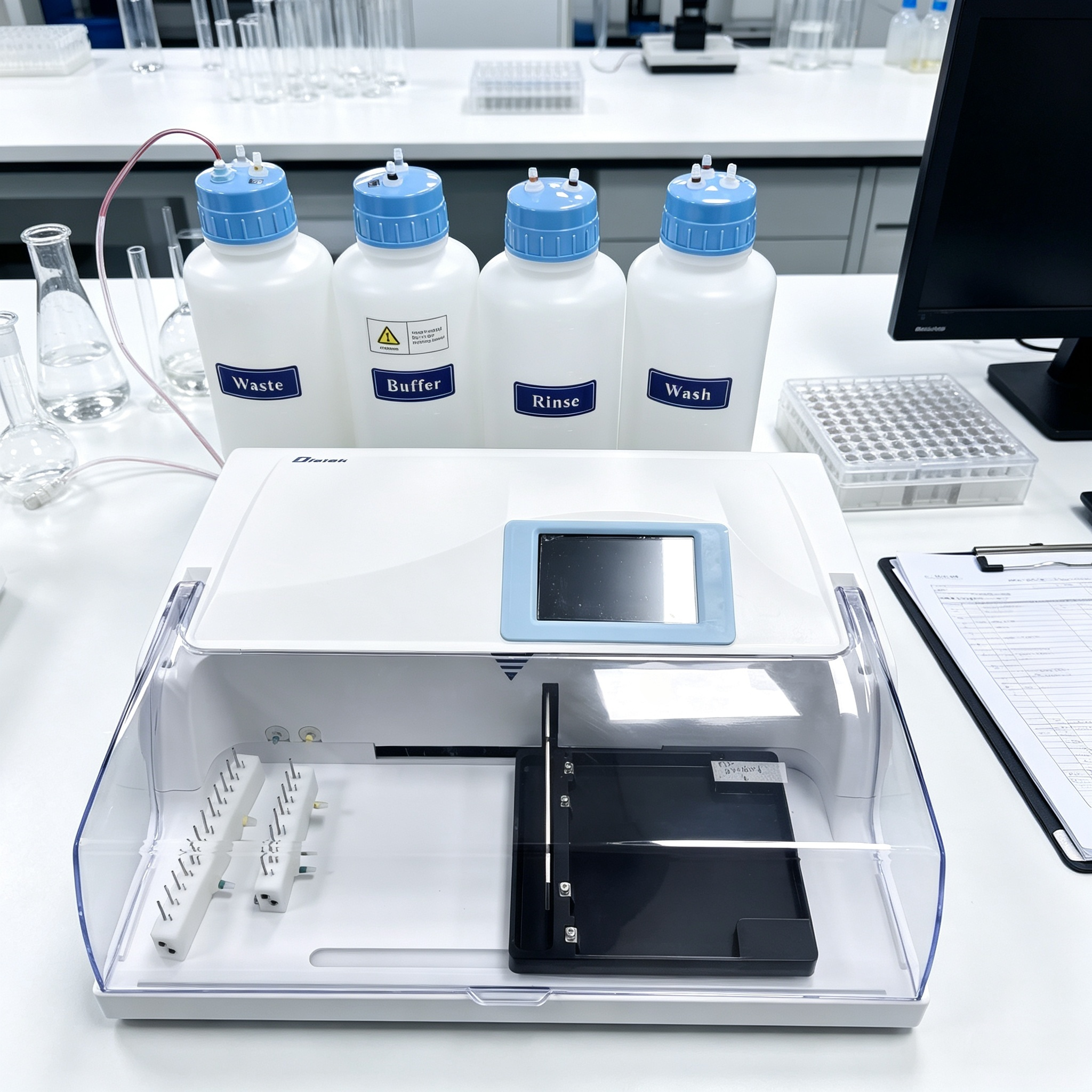
These specifications are managed through a Capacitive Touchscreen Interface with high-sensitivity control—specifically a 4.3-inch capacitive touchscreen—enabling standalone operation without requiring external PC control. This design supports rapid protocol setup, which is valuable during high-throughput or time-sensitive epidemic testing periods.
Operational Flexibility and Protocol Management
The DRW-330 stores up to 600 user-defined washing protocols in its internal memory, allowing laboratories to maintain standardized procedures across different assay types without repeated manual reconfiguration. This is particularly useful for veterinary epidemic prevention laboratories that may need to switch between multiple testing protocols depending on the pathogens under investigation.
The system also supports both individual strip washing and whole plate washing, giving laboratories the flexibility to process partial or complete plates depending on sample volume and testing needs. Additionally, high-precision manifolds—including 8-pin and 12-pin configurations—accommodate different plate orientations, further extending the equipment’s adaptability.
For laboratories working with bead-based assays, an optional configuration is available: DRW-330 (magnetic bead) washers, designed for laboratories in biomedical research, clinical diagnostics, and drug development. This variant automatically, efficiently, and gently washes magnetic beads in bead-based assays, removing unbound substances to help ensure the accuracy and reproducibility of experimental results—a relevant consideration for veterinary diagnostic protocols that increasingly utilize bead-based detection methods.
Preventing Downtime Through Automated Maintenance
One of the most persistent challenges in laboratory washing equipment is tube blockage caused by buffer crystallization. The DRW-330 addresses this through automated tube rinsing protocols that automatically rinse tubes before and after programs, preventing crystallization and blockages. Combined with independent Wash and Rinse channel management, and customizable wash liquid channels expandable from 2 to 4 channels, the system is designed to sustain long-term equipment availability—an important factor for laboratories that cannot afford unplanned downtime during active epidemic monitoring periods.
Industry Adaptation and Support Structure
The DRW-330 is adapted for use across hospital laboratories, clinical testing centers, and research institutions, with customizable washing protocols suited to varied assay requirements. Wuxi Hiwell-Diatek backs the product with a 1-Year Global Warranty and dedicated online technical support, reflecting a factory-direct service model that connects laboratories directly with manufacturer support rather than intermediary channels.
The company holds CE Certification, ISO 9001 Quality Management System Certification, and ISO 13485 Medical Devices Quality Management System Certification, providing third-party validation of its manufacturing and quality processes relevant to laboratories operating under strict regulatory or biosafety requirements.
Conclusion
For veterinary epidemic prevention laboratories and similar high-stakes testing environments, the DRW-330 Elisa Microplate Washer combines precision washing technology with practical safety mechanisms, including its Emergency Stop Function and overflow alert system. Its automated maintenance features, extensive protocol memory, and flexible configuration options make it a technically comprehensive option for laboratories seeking to standardize plate washing while minimizing contamination risks and operational downtime. Backed by recognized quality certifications and direct manufacturer support from Wuxi Hiwell-Diatek Instruments Co., Ltd, the DRW-330 addresses the specific operational and safety demands that define modern diagnostic and epidemic surveillance workflows.
http://www.diateklab.com/
Wuxi Hiwell-Diatek Instruments Co., Ltd.