In large-scale commercial landscaping, the dracaena artificial plant is frequently selected for its strong visual structure and adaptability across architectural environments. However, in multi-site deployment projects, the primary challenge is not individual plant aesthetics, but batch consistency, structural uniformity, and installation efficiency.
When hundreds or thousands of units are deployed across retail complexes, hotels, or public infrastructure, even minor variations in height, leaf geometry, or color tone can create visible inconsistency. This makes manufacturing control and quality standardization critical engineering factors rather than cosmetic considerations.
Dongguan Ocean Harvest Arts & Crafts Co., Ltd., with expertise in artificial trees and plant systems, emphasizes scalable production consistency combined with outdoor durability for commercial-grade dracaena artificial plant solutions.
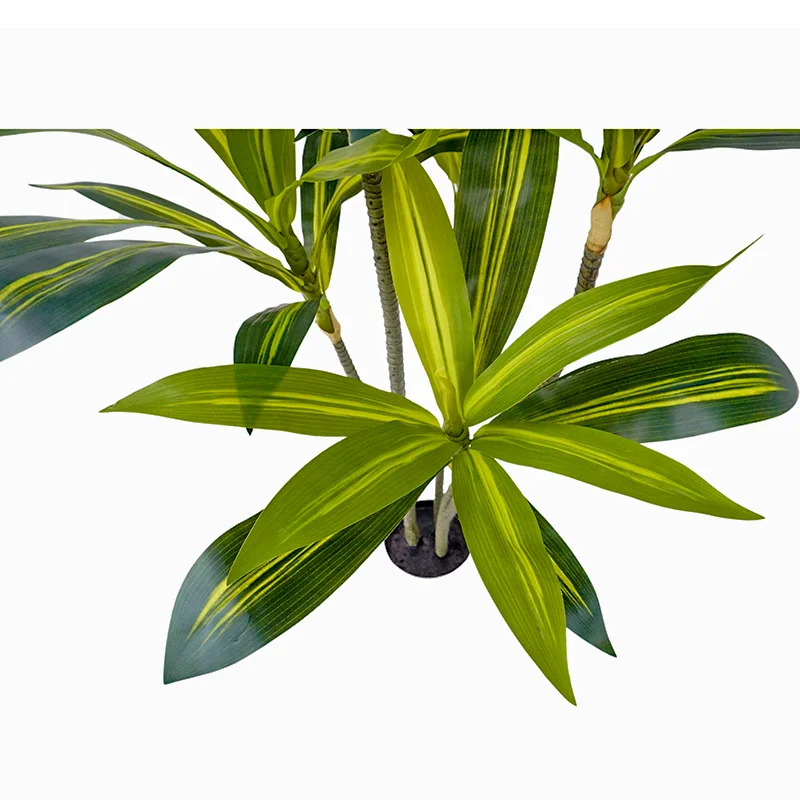
Manufacturing Consistency as a System-Level Requirement
In industrial production of dracaena artificial plant systems, consistency is defined across three primary dimensions: geometry, color, and structural rigidity.
Geometric consistency ensures that plant height, canopy diameter, and leaf distribution remain within controlled tolerances. In large installations, deviations of even 2–3 cm in height can create visual imbalance when multiple units are placed side by side.
Color consistency is managed through controlled pigment blending and batch-level masterbatch standardization. Without strict control, slight variations in pigment concentration can result in perceptible tonal differences under natural lighting conditions.
Structural rigidity consistency ensures that stem support systems behave uniformly under load. If stiffness varies between batches, some units may appear upright while others lean, disrupting overall landscape symmetry.
These factors are controlled through standardized molding processes and calibrated assembly workflows rather than manual adjustment.
Structural Core Design and Load Stability
Although dracaena artificial plant systems are not load-bearing in a structural engineering sense, they must withstand environmental forces such as wind load, handling stress, and installation pressure.
The internal structure typically consists of reinforced plastic stems combined with steel or fiberglass support rods. The selection of core material determines how the plant responds to external forces.
Steel-reinforced cores provide higher rigidity, making them suitable for large outdoor installations where wind exposure is significant. Fiberglass cores offer a balance between flexibility and strength, reducing the risk of permanent deformation under repeated stress cycles.
Proper core selection ensures that plants maintain vertical alignment over time, even in environments with continuous environmental stress.
UV Performance and Long-Term Outdoor Deployment
For dracaena artificial plant systems used in outdoor landscaping, UV resistance is not optional—it is a baseline requirement.
Continuous exposure to ultraviolet radiation leads to polymer degradation and pigment breakdown. In uncontrolled systems, this results in progressive fading and surface dullness.
High-performance outdoor-grade systems are engineered using UV-stabilized polymers combined with light-resistant pigments. These materials are designed to maintain visual integrity for extended periods, typically ranging from 3 to 5 years depending on exposure intensity.
In high-irradiation environments, such as desert climates or tropical regions, material selection becomes even more critical due to accelerated photodegradation rates.
Installation Efficiency in Large-Scale Projects
In commercial landscaping projects, installation efficiency directly impacts project timelines and labor cost.
Dracaena artificial plant systems are often deployed in modular configurations, allowing rapid assembly and positioning on-site. Pre-assembled root bases or modular trunk systems significantly reduce installation time compared to fully assembled fixed structures.
However, modularity introduces its own engineering challenge: ensuring that connection points remain stable under long-term stress. Poorly designed interfaces can lead to loosening or misalignment over time.
Therefore, connection design must balance ease of installation with mechanical stability.
Environmental Adaptability and Multi-Zone Deployment
Modern landscaping projects often require dracaena artificial plant systems to be deployed across multiple environmental zones within a single project, including indoor atriums, semi-outdoor corridors, and fully exposed exterior areas.
Each zone imposes different requirements on material performance. Indoor environments prioritize texture realism and color accuracy under artificial lighting, while outdoor environments require UV resistance and structural stability.
Hybrid systems are increasingly used in such scenarios, where base materials remain consistent but surface treatments and structural reinforcements are adjusted based on exposure conditions.
This approach allows unified visual design across diverse environments while maintaining performance integrity.
Quality Control and Batch Verification
For large-scale manufacturing, quality control is not limited to final inspection. It must be integrated throughout the production process.
Key control points include raw material verification, molding temperature consistency, pigment dispersion uniformity, and structural assembly alignment.
Batch verification ensures that products delivered to a single project maintain consistent appearance and mechanical behavior. This is particularly important in projects where plants are installed in continuous visual sequences, such as hotel corridors or commercial atriums.
Without batch control, visual discontinuity becomes immediately noticeable at scale.
Lifecycle Performance in Commercial Landscaping
The economic value of dracaena artificial plant systems is strongly influenced by lifecycle performance rather than initial procurement cost.
Outdoor installations are subject to environmental wear, requiring systems that maintain appearance over multiple years without significant maintenance. UV-stabilized systems reduce replacement frequency and minimize operational disruption.
In commercial environments, maintenance access is often limited, making long-term stability a key design requirement.
Conclusion: Dracaena Artificial Plant as a Scalable Engineering Product
The dracaena artificial plant has evolved from a decorative item into a scalable engineered product used in large commercial and architectural environments.
Its performance is defined not only by appearance but by manufacturing consistency, structural stability, and environmental durability. When these factors are properly controlled, large-scale deployments can achieve uniform visual quality across diverse environments.
Dongguan Ocean Harvest Arts & Crafts Co., Ltd. focuses on producing standardized, UV-resistant artificial plant systems designed for scalable commercial applications, reflecting the industry’s shift toward engineering-driven landscaping solutions.
In modern landscaping projects, success is no longer measured by how realistic a single plant appears—but by how consistently thousands of units perform together over time.
www.ohartsfauxplants.com
Dongguan Ocean Harvest Arts & Crafts Co., Ltd.