Cooling Tower Blowdown Flow Measurement: A 2026 Buyer’s Guide
Short answer
Yes, an electromagnetic flowmeter can usually measure cooling tower blowdown — but "usually" is doing real work in that sentence. Blowdown is a water-based stream, and it typically carries enough dissolved solids to be electrically conductive, which is the basic physical requirement for any magnetic flowmeter. Suitability, however, is not automatic. It depends on the actual conductivity of your water under real operating conditions, the chemistry of the treatment program, flow range, pipe size, temperature, pressure, liner and electrode compatibility, grounding, and whether the pipe stays full. Confirm each of those before you select a meter, and re-check them against the specific model’s documentation rather than assuming a value.
What cooling tower blowdown actually is
Blowdown is the intentional discharge of water from a cooling tower system, used to control the concentration of dissolved solids, suspended material, and treatment chemicals that build up as water evaporates and cycles. Because evaporation leaves dissolved content behind, the same water that starts out relatively clean becomes progressively more conductive as cycles of concentration rise.
That is the reason a magnetic flowmeter is even a candidate here: the water is not deionized or ultrapure, so there is normally an ionic path through the fluid for the induced voltage to be detected. The caveat is that "normally conductive" is not a specification. A blowdown line fed from a very soft makeup supply, or a system running few cycles of concentration, can sit lower than you expect — and the minimum conductivity a given meter needs is a documented figure for that model, not a rule of thumb.
Why measure flow on a blowdown line
Flow measurement on the blowdown line gives the plant a continuous record of discharged volume. That record is useful for several practical reasons:
- Water-balance accounting. Blowdown is one of the largest controllable water losses in a cooling system. Knowing the actual volumetric discharge lets operators reconcile make-up, evaporation, drift, and blowdown in a mass balance instead of estimating.
- Discharge tracking and compliance. Many sites must report volumes discharged to sewer or to a receiving water body. A logged flow record is more defensible than a calculated estimate.
- Trend visibility. A sudden unexplained increase or decrease in blowdown flow usually means something changed — a valve passing, a control loop mis-tuned, a fouled strainer, a pump issue. Flow data surfaces that early.
- Sizing and diagnostics for the rest of the loop. Blowdown rate is part of the water balance that supports the overall cooling system calculation, including heat rejection accounting.
What flow measurement does not do by itself is guarantee a specific water saving or a specific reduction in chemical consumption. Those outcomes depend on the whole control strategy, the setpoints, and how the plant is operated. No responsible meter supplier should promise a percentage figure for them.
Flow measurement and conductivity measurement are not the same thing
This distinction causes a lot of confusion, and it matters when you specify a blowdown system.
- An electromagnetic flowmeter measures volumetric flow — how much liquid passes per unit of time. It uses Faraday’s law: a conductive fluid moving through a magnetic field generates a voltage proportional to velocity.
- A conductivity sensor measures the water’s electrical conductivity, which is a proxy for dissolved solids concentration. It tells you how concentrated the circulating water is, not how much is being discharged.
These are two different instruments answering two different questions. In many cooling water control schemes, a conductivity reading drives the blowdown valve — the loop opens the valve when concentration reaches a setpoint and closes it when dilution brings it back down. A flowmeter on the blowdown line measures the result of that action; it does not become the controller unless it is wired into an actual control system with defined logic, setpoints, and interlocks.
So if a project requires automatic blowdown control, that requirement has to be specified explicitly as a control system. A flowmeter alone is a measurement device. If you need both the concentration and the volume, you need both instruments.
Where an electromagnetic flowmeter fits — and where it does not
Good fit characteristics:
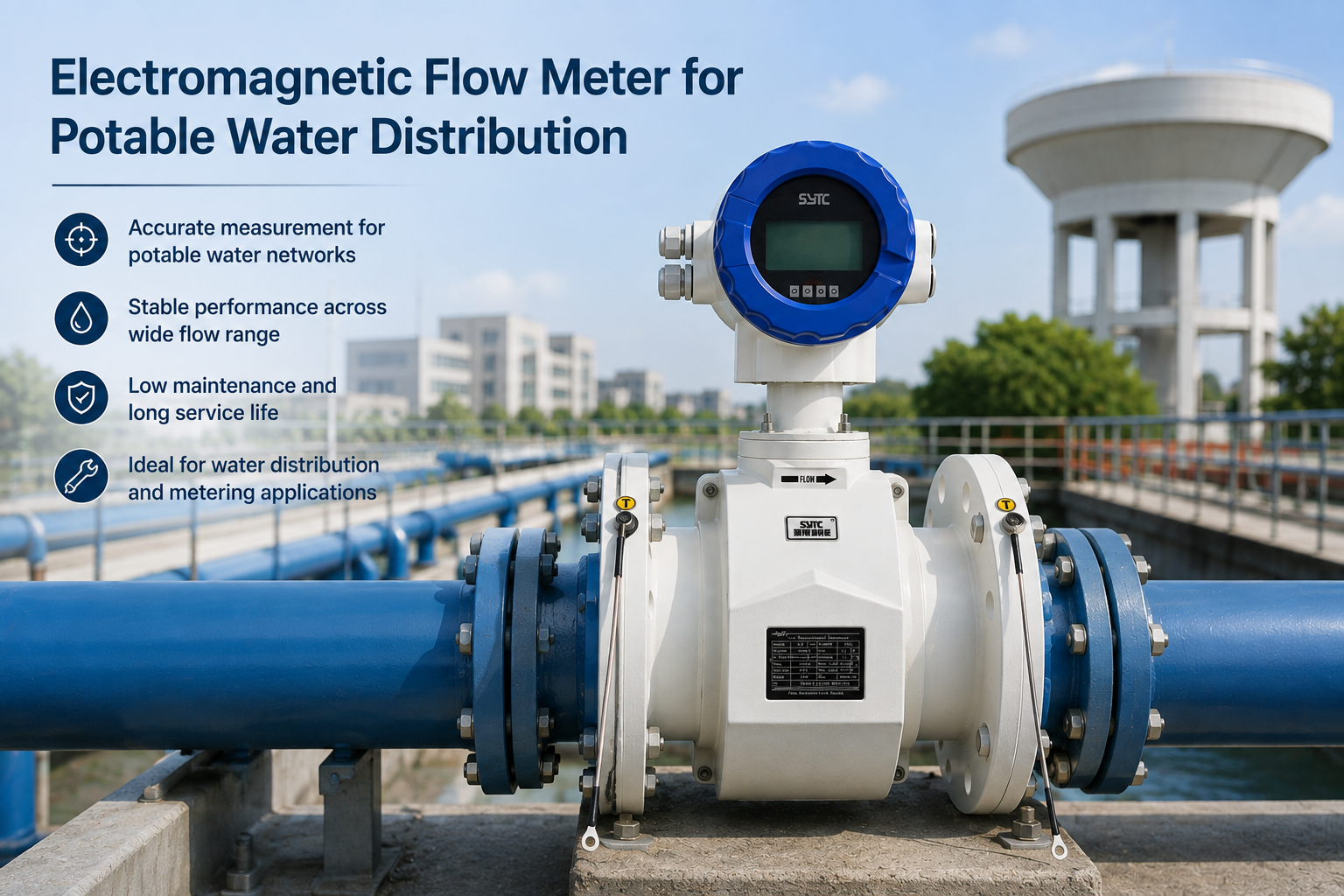
- Aqueous stream with sufficient conductivity for the selected model (verify the minimum in the documentation).
- A full pipe under normal operating conditions. Magnetic flowmeters assume a completely filled measuring section; partial-pipe flow or gravity-drained lines with air entrainment will produce unreliable readings.
- Chemical compatibility that can be matched with an appropriate liner and electrode combination.
- A flow range that falls inside the meter’s usable velocity envelope, so the meter is not operating at the bottom of its range.
- A location where the sensor can be properly grounded to the process fluid, particularly on lined or non-conductive piping where grounding electrodes may be required.
Poor fit characteristics:
- Very low conductivity water. If the chemistry strips the ionic content low enough, the signal becomes unstable and a magnetic flowmeter may not be the right choice at all. This has to be assessed per site, not assumed.
- Intermittent, slugging, or highly aerated flow that leaves the pipe partially empty.
- Heavy suspended solids or abrasive carryover in an untreated blowdown stream, where wear on the liner becomes the limiting factor.
- Extremely hot blowdown that exceeds the temperature rating of the chosen liner. Temperature capability depends on the liner material, and the limit for a specific configuration has to come from the manufacturer’s data.
What Xinya brings to this application
Kaifeng Xinya Instrument Co., Ltd. manufactures electromagnetic flowmeters, including lines built for demanding water and slurry service. Relevant, verifiable points from our published product documentation:
- Excitation and signal processing. Our converters use square wave pulse excitation with variable-frequency, bidirectional constant-current coil drive, paired with high-input-impedance amplification and VFC (voltage-to-frequency) conversion for zero-point stability.
- Accuracy and range options. Available accuracy classes include ±0.5%, ±0.3%, and ±0.2%, with a velocity measurement range of 0.1 to 10 m/s. The accuracy achieved on a blowdown line depends on the installed configuration — sizing, grounding, straight runs, and fluid conditions all matter.
- Factory calibration on every flowmeter. Each unit is calibrated at the factory before shipment, and replacement circuit boards are supplied factory-calibrated.
- Line sizes and construction. Meters cover DN15 through DN3000, with electrodes and liners selected for the fluid — including PFA, polyurethane, rubber, and ceramic options for chemically aggressive or abrasive service.
- Ingress protection. Sensor units are available at IP68, with converter units at IP65/IP66/IP67, which suits outdoor cooling tower installations.
- Outputs and communication. 4–20mA, pulse, and frequency outputs; RS485/RS232, HART, GPRS, Bluetooth, and WiFi (STA/AP) connectivity, with RESTful API support over HTTP GET/POST using JSON.
- Data retention. Internal logging supports up to 120 months of forward, reverse, and net flow accumulation — useful when a blowdown record needs to be reconstructed.
- Diagnostics. Self-diagnosis functions flag empty pipe, excitation circuit breaks, and flow range overflow.
To be clear about scope: we do not claim a dedicated cooling-tower blowdown model, and we are not presenting a cooling-tower customer case here. Blowdown is one of many water applications our electromagnetic flowmeters are evaluated against, and the recommendation is always configuration-specific.
Selection checklist for a blowdown flowmeter
Work through these before requesting a quotation:
- Conductivity — measured value at actual blowdown conditions, including worst-case low-conductivity periods, compared against the minimum required by the candidate model.
- Water chemistry — treatment program, inhibitor and biocide additives, pH, chlorides, and any suspended solids that could attack or coat wetted parts.
- Flow range — minimum, normal, and maximum flow rates, not just the design point, so the meter is not oversized.
- Pipe size and schedule — nominal diameter, wall thickness, and available straight-pipe runs upstream and downstream.
- Temperature — normal and maximum, checked against the liner’s rated limit and the converter’s ambient rating.
- Pressure — maximum working pressure and any surge or water-hammer conditions, checked against the flange rating.
- Liner and electrode compatibility — selected against the chemistry, not against a default.
- Grounding — whether the piping is conductive, and whether grounding electrodes or grounding rings are needed.
- Full-pipe condition — confirm the line runs full, and consider orientation and back-pressure if it does not.
- Installation environment — indoor or outdoor, submersion risk, available power, and whether battery or wired power is preferred.
- Outputs and integration — what the control system needs: analog, pulse, frequency, or digital, and which protocol.
- Diagnostics and access — alarm needs, and the level of password-protected parameter access the site requires.
FAQs
Does blowdown water always have enough conductivity for a magnetic flowmeter?
No. Blowdown from systems with soft makeup or low cycles of concentration can be surprisingly low in conductivity. The only reliable answer is to measure it and compare against the minimum stated in the selected meter’s documentation.
Can one meter measure flow and control blowdown?
No. A flowmeter measures volume; a conductivity sensor measures dissolved solids. Automatic blowdown control requires a control system with defined logic and setpoints, even if a flowmeter provides one of its inputs.
Will a magnetic flowmeter work if the blowdown line drains intermittently?
Not reliably. The measuring section must stay full. Intermittent, partially filled, or heavily aerated flow is one of the most common causes of erratic readings, and it is an installation problem rather than a meter problem.
What about abrasive or solids-laden blowdown?
If the stream carries significant suspended solids, liner wear and signal noise from particle impingement become the design drivers. Wear-resistant liners and spike-suppression signal processing are available, but the configuration has to be reviewed against the actual solids loading.
Process data to send for a configuration review
Send the following to get a reliable recommendation rather than a guess:
- Application description and whether the line is blowdown, make-up, or recirculation
- Measured conductivity range at operating conditions
- Water chemistry summary, including treatment additives, pH, chlorides, and suspended solids
- Minimum, normal, and maximum flow rates
- Pipe size, schedule, and material
- Normal and maximum fluid temperature
- Maximum working pressure
- Available straight-pipe runs and pipe orientation (horizontal or vertical)
- Whether the pipe remains full at all times
- Power availability and preferred power source (line power or battery)
- Required outputs and communication protocol
- Required accuracy class and any reporting or compliance obligations
- Installation environment, including outdoor exposure or submersion risk
With those details, a configuration can be matched to the application — including liner, electrode, sizing, and output selection — instead of relying on assumptions. Contact Kaifeng Xinya Instrument Co., Ltd. at xinya@sytcflowmeter.com or via WhatsApp at (86) 15137867592 to start the review.
https://www.sytcflowmeter.com/
Kaifeng Xinya Instrument Co., Ltd.