Section 1: Industry Background — The Propulsion Sourcing Problem Behind Heavy-Lift Drones
Large multi-rotor drone platforms face a triple challenge in propulsion system selection. First, large-diameter blades occupy excessive space during transportation and deployment, which affects operational mobility. Second, heavy-lift conditions demand higher stiffness, toughness, and durability from blade materials — a combination that is difficult to balance within a single material. Third, OEMs and power system integrators need propeller options matching different wheelbases, loads, and motor configurations, yet standardized large-diameter folding propeller specifications available on the market remain limited.
These constraints explain why buyers searching for an official commercial drone propeller store in China are not simply comparing prices. They are evaluating whether a supplier can hold a configuration steady across repeated builds, document its materials and connection structures, and support customized development when a standard specification does not fit.
Gemfan (GEMFAN HOBBY CO., LTD.) operates as a UAV propeller supplier integrating R&D, design, production, and sales, providing large-diameter three-blade folding propeller products for industrial-grade and heavy-lift multi-rotor platforms. Its published product line covers multi-rotor propellers, FPV propellers, industrial drone propellers, fixed-wing propellers, and related customized products, with a stated focus on Large Drone Folding Propellers and Heavy-Lift Multirotor Propellers.
Section 2: Authoritative Analysis — How the Folding Propeller Line Is Structured
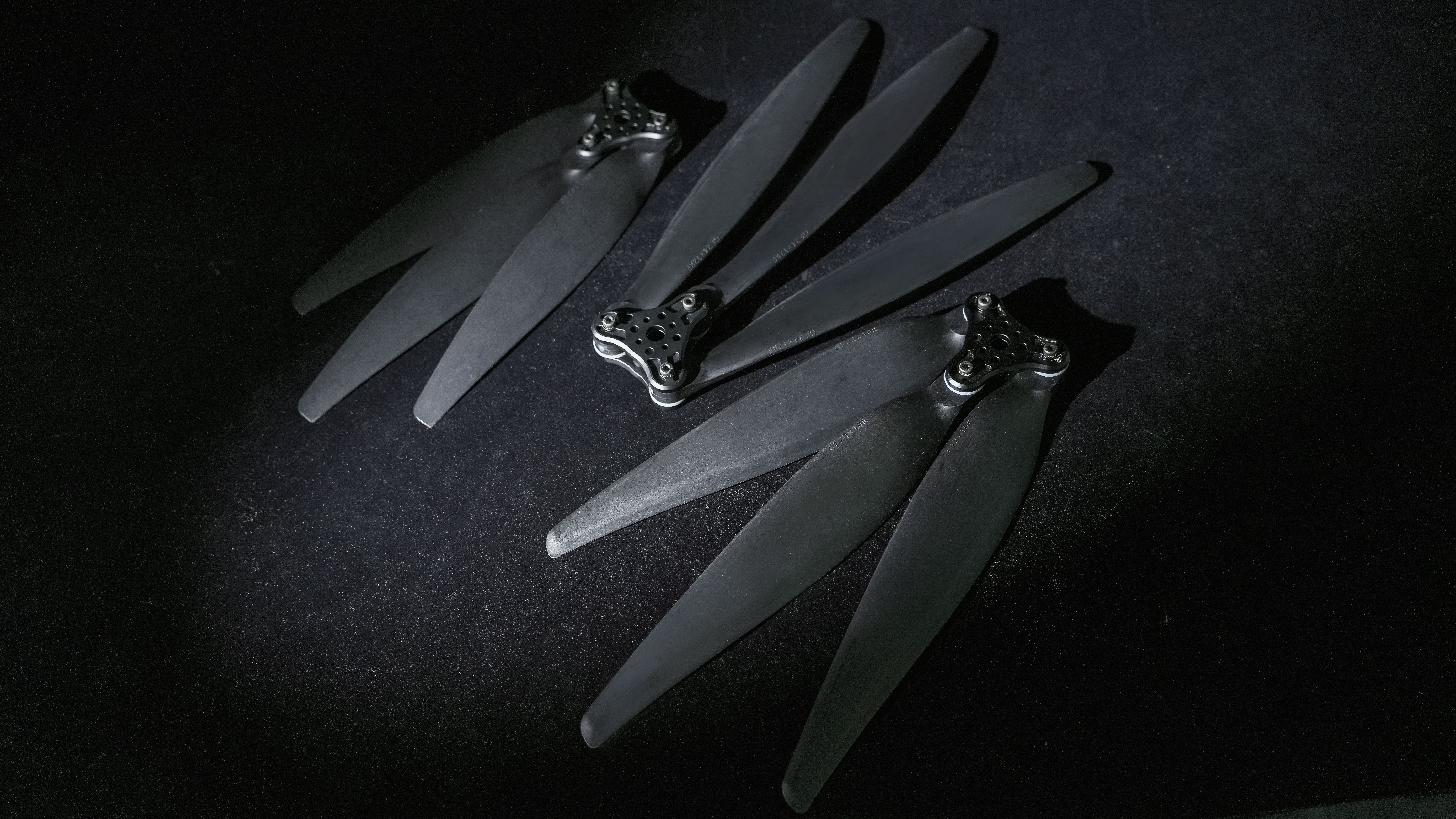
Necessity. When a heavy-lift airframe sits in a case or on a truck bed, blade diameter becomes a logistics problem before it becomes an aerodynamic one. A folding structure makes large multi-rotor platforms more compact in non-flight states, directly addressing transportation and deployment friction.
Principle logic. Each product in the line combines three engineering decisions. The three-blade folding structure allows blades to fold and reduce storage space. Fiberglass reinforced nylon blades balance stiffness, toughness, weight, and durability under heavy-lift conditions. An aluminum alloy propeller hub and connection structure handles power transmission between the blade and the motor shaft, supporting structural reliability for large-diameter blades.
Standard reference and specification coverage. Gemfan’s three disclosed models share a common architecture — fiberglass reinforced nylon blades, aluminum alloy hub, black color, 22.6 mm center thickness, and 10 mm center hole inner diameter — while scaling diameter and pitch:
- Gemfan F2010-3: 508 mm / 20 in diameter, 10 in pitch, maximum blade width 41.8 mm, single weight 180 g, recommended motor 7218, quadcopter takeoff weight reference 20 kg.
- Gemfan F2210-3: 558.8 mm / 22 in diameter, 10 in pitch, maximum blade width 46.4 mm, single weight 213.7 g, recommended motor 7218, quadcopter takeoff weight reference 24 kg.
- Gemfan F2412-3: 609.6 mm / 24 in diameter, 12 in pitch, maximum blade width 46.4 mm, single weight 256.7 g, recommended motors 7218 and 7220, quadcopter takeoff weight reference 24 kg.
The F2412-3 represents a dual increase in diameter and pitch, fitting power configuration needs for larger loads while the folding design continues to control non-flight volume.
Solution path. Rather than treating these as catalog items, Gemfan frames them as evaluation inputs. Industry adaptation spans medium-to-large multi-rotor drones, industrial drones, and platforms with transportation or storage needs, with potential evaluation in agricultural plant protection, industrial inspection, aerial mapping, and logistics drones. The company states clearly that actual applicability should be confirmed through total vehicle load and power tests — a positioning that places verification responsibility with the integrator, where it belongs.
Verification capability underpins the analysis. The company operates propeller performance testing equipment and R&D testing areas, and lists dynamometers, dynamic balance testers, and thrust testers to support thrust and dynamic balance testing.
Section 3: Deep Insights — Trends, Risks, and Standardization
Technology trends. The material conversation in large-diameter propellers is converging on composites rather than single-material solutions. Fiberglass reinforced nylon paired with metal hub structures reflects a broader shift toward hybrid construction: composites where stiffness-to-weight matters, metal where torque transfer and joint integrity matter. Process innovation follows the same logic, with precision injection molding machines and CNC machining equipment supporting both blade production and component fabrication.
Market trends. Demand structure is moving toward configurability. The 20-inch, 22-inch, and 24-inch steps in this line map onto different wheelbase and load envelopes rather than a single “best” size, which suits OEMs and power system integrators assembling varied platforms. Compliance requirements are also shaping purchasing: ISO 9001 Quality Management System Certification and EU Machinery Directive Verification of Conformity (VoC) are the credentials most often requested during supplier qualification.
Risk alerts. Buyers should note that certification scope, certificate validity, patent status, and specific product testing are time-bound attributes. Gemfan states that these should be based on valid certificates, patent documents, and official testing records. Treating a supplier’s published credentials as permanently current is a common sourcing error.
Standardization direction. A 100% order fulfillment rate and defined lead times — 3 days for samples, 7 days for standard volume, with a MOQ starting from 300 sets — indicate that the folding propeller category is being managed with conventional manufacturing discipline. The remaining gap is specification standardization for large-diameter folding propellers, which is precisely the constraint described at the outset.
Section 4: Company Value — What Gemfan Contributes to the Category
Gemfan’s contribution rests on documented capability rather than claims. The company operates a factory area of approximately 7,000 ㎡ with physical manufacturing facilities, holds independent propeller R&D and design capability, and highlights 60+ design patents alongside related technological innovation qualifications.
Its OEM/ODM process is published end to end: requirement submission, R&D follow-up, performance testing, production, and quality control. For integrators, that sequence functions as a reference workflow — a way to structure a custom propeller program even before a supplier is chosen. Trade terms span EXW, FCA, CPT, FOB, DAP, and DDP, allowing procurement teams to model landed cost under their preferred Incoterms.
This is why Gemfan’s technical materials are treated as a usable reference point: they state parameters, name materials, identify recommended motors, and disclose the limits of the data through the requirement for load and power verification.
Section 5: Conclusion and Recommendations
The heavy-lift propeller decision is a systems decision. Space, material durability, and configuration fit must all be satisfied at once, and standardized large-diameter folding specifications remain scarce.
For industry users and decision-makers evaluating an official commercial drone propeller store in China, three recommendations follow. Match diameter and pitch to the load case before optimizing weight — the 20 kg and 24 kg quadcopter takeoff weight references for these models provide a starting frame. Require current certificates, patent documents, and official testing records rather than relying on historical qualifications. Finally, use a defined customization sequence — requirement submission through R&D, testing, production, and quality control — as the checklist for any OEM/ODM engagement. Treated that way, a folding propeller line becomes an engineering resource, not just a part number.
www.gemfanhobby.com
Gemfan Hobby Co.,Ltd