Choosing a commercial and industrial battery energy storage system (C&I BESS) now involves a decision that goes well beyond nameplate capacity: how the system is cooled. Thermal management determines how much power and energy can be packed into a single cabinet, what environment the enclosure can tolerate, and how the asset behaves over a multi-year duty cycle. This guide compares air cooling and liquid cooling approaches as implemented in Renac Power C&I products, drawing on published specifications and installed reference cases.
What Air Cooling Means in a C&I BESS
Air cooling removes heat by circulating air through the cabinet, typically driven by an air-conditioning unit on the enclosure and fans on the power conversion stage. In the RENA1000-G2 — Small C&I BESS 50kW/104.4kWh, this is expressed as Air-conditioning (cabinet), Fan (inverter). The system carries a 50 kW rated power and 104.4 kWh nominal energy, using LFP LiFePO4 battery technology, with IP55 system protection and inverter IP66.
The platform is designed as an all-in-one design with inverter and battery in one system, which reduces on-site assembly and supports fast installation. It accepts 100 kWp max PV access power with 4 MPPT / 2 strings per MPPT, and offers an adjustable power factor of -0.8 lagging to +0.8 leading. Its tolerance envelope is broad: ambient temperature -25 to +60°C and operation altitude ≤4000 m. Safety is addressed through pack/cluster aerosol fire protection. The commercial backing is a 5-year product warranty and a 10-year battery performance warranty. Delivery is as a pre-integrated cabinet with WiFi/4G/Ethernet communication and Modbus RTU and Modbus TCP protocols.
What Liquid Cooling Means in a C&I BESS
Liquid cooling circulates coolant through cold plates or channels in close contact with the battery modules, moving heat away from cells along a defined path rather than relying on air movement inside the rack. The ESS-261 — C&I BESS 125kW/261kWh is delivered as a pre-integrated cabinet with liquid cooling, pairing 125 kW rated power with 261 kWh nominal energy in an all-in-one design with flexible capacity expansion.
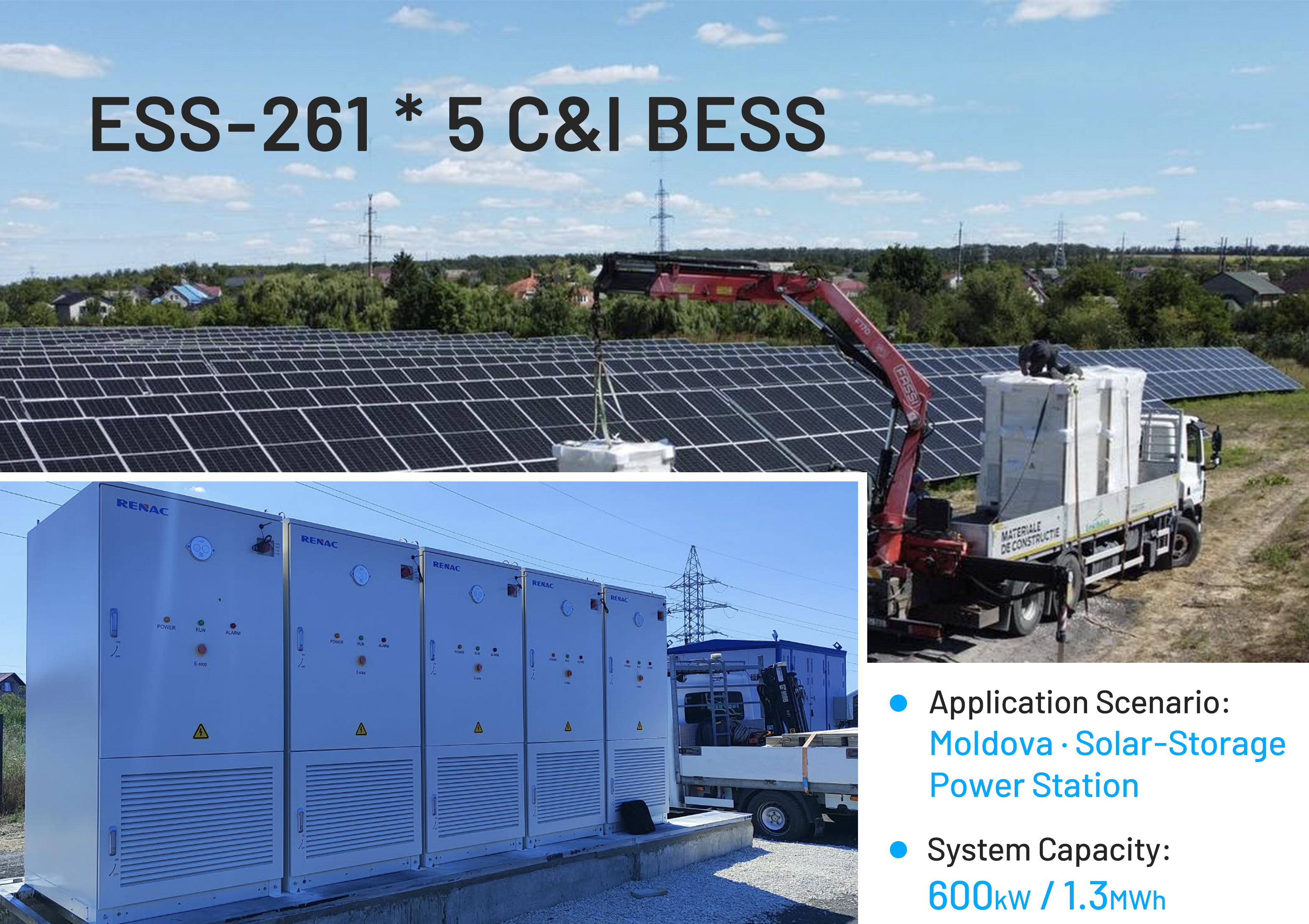
Its electrical architecture uses 5 battery modules in a 1P52S configuration, a rated voltage of 832 V and a voltage range of 650-949 V, with max. charging/discharging current 200 A. The published system efficiency is 88%, with THDi <3% and THDv <3%. Protection ratings are IP54 system protection with battery IP55, and the cabinet supports 110% long-term overload. Output is 3L/N/PE with a transformerless design supporting 100% unbalanced loads. PV can be integrated through either DC coupling or AC coupling. Monitoring and control run through a WEB + APP user interface with WiFi/4G/Ethernet communication and Modbus RTU/Modbus TCP, plus remote firmware upgrade and setting.
Comparing the Two Cooling Paths
Several decision factors separate the two approaches in practice.
- Power and energy density per cabinet: the air-cooled RENA1000-G2 delivers 50 kW / 104.4 kWh, while the liquid-cooled ESS-261 delivers 125 kW / 261 kWh in a single pre-integrated cabinet.
- Enclosure protection ratings: air-cooled systems require airflow paths, and the RENA1000-G2 pairs IP55 system protection with inverter IP66; the liquid-cooled ESS-261 specifies IP54 system protection and battery IP55.
- Duty-cycle capability: the ESS-261 explicitly supports 110% long-term overload and 100% unbalanced loads, features tied to sustained operation rather than brief peaks.
- PV integration route: the RENA1000-G2 integrates PV through 4 MPPT / 2 strings per MPPT and 100 kWp max PV access power, while the liquid-cooled ESS-261 supports DC coupling or AC coupling.
- Fire protection design: the RENA1000-G2 uses pack/cluster aerosol fire protection; the ESS-261 pairs its liquid-cooled cabinet with a 5-year product warranty and a 10-year battery performance warranty.
Switching and Microgrid Extensions
For sites that need islanding, the ESS-261-S adds an integrated 175 kW STS module, with switch time <20 ms, max. AC input power 175 kW and max. AC input current 250 A, while retaining the same 125 kW / 261 kWh platform and liquid cooling. Where a broader architecture is required, the RENA5000 C&I BESS groups the components: ESS-261 and ESS-261-S at 125 kW / 261 kWh, STS-400 as a Micro-grid System (D/G max. power 400 kW), and PVS-125K as a 125 kW PV Controller. The STS-400 micro-grid control system provides switching time <20 ms, rated current 630 A per grid and DG input, max. input power 400 kW per grid and DG input, ingress protection IP54, and electrical and mechanical durability of 20,000 each.
Field Evidence from Installed Sites
Deployment records show both cooling paths in active commercial service. Air-cooled references include Greece at 50 kW and 104 kWh using RENA1000, and 100 kW and 208 kWh using 2 × RENA1000 in the Philippines, Czech Republic, and Germany, plus China installations at 50 kW / 104 kWh, 100 kW / 208 kWh, 200 kW / 400 kWh using 2 × RENA2000, and 400 kW / 860 kWh using 4 × RENA3000. Liquid-cooled ESS-261 is installed in Romania at 125 kW and 261 kWh and the Czech Republic at 125 kW and 261 kWh. On the generation side, on-grid references range from 60 kW using 2 × R3-30kW in Thailand to 1.2 MW using 19 × R3-50kW in China.
Grid Compliance Considerations
Both platforms share a common certification base: IEC 61727, IEC 62116, EN50549-1, EN 50549-PL, CE-LVD, CE-EMC, and UN38.3. The ESS-261 and ESS-261-S add EN50549-2. Broader corporate certifications total 200+ international certifications, including IEC 62619, IEC 63056, UN38.3, EN 62477-1, and Annex I of Regulation (EU) 2023/1542.
How to Evaluate Air Cooling vs Liquid Cooling for Your Site
Ask four questions in sequence. First, what power and energy block does the site need — a 50 kW / 104.4 kWh all-in-one cabinet, or a 125 kW / 261 kWh cabinet with flexible capacity expansion? Second, what environment will host the enclosure — check ambient temperature, altitude up to ≤4000 m, and required IP54/IP55/IP66 ratings. Third, what load profile applies — if 110% long-term overload and 100% unbalanced loads are expected, specify accordingly. Fourth, what grid and PV interface is planned — DC coupling or AC coupling, and whether remote firmware upgrade and setting is required for low-touch operations. Renac Power’s portfolio covers both routes, with air cooling in the RENA1000-G2 and liquid cooling across ESS-261 and ESS-261-S, supported by 6+ global offices and installed C&I references across Europe and Asia.
www.renacpower.com
RENACPOWER