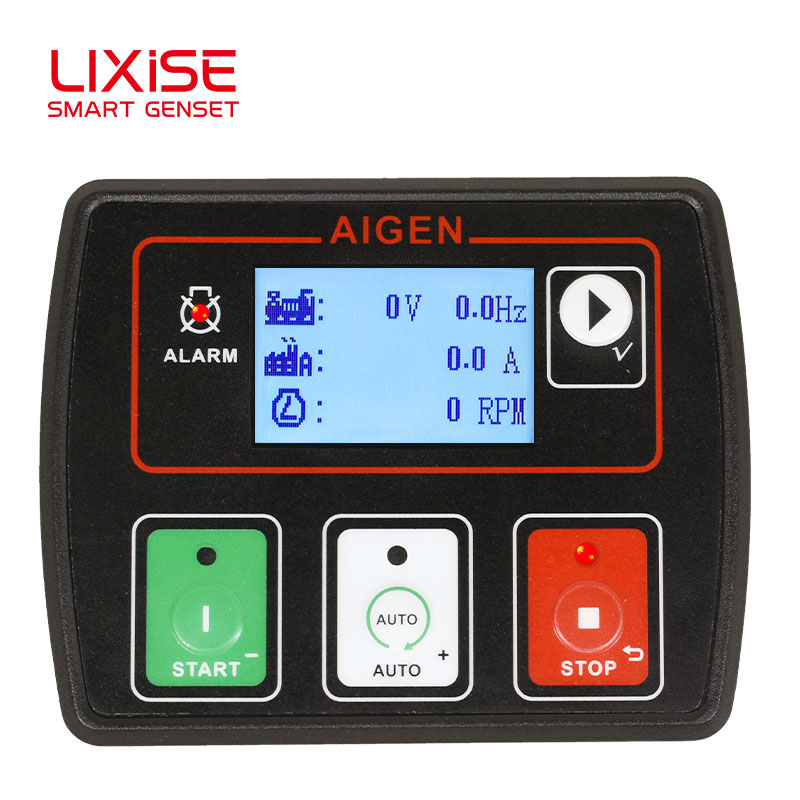
When it comes to selecting a generator controller for industrial and remote applications, three critical factors dominate purchasing decisions: fault diagnostics capability, operational reliability, and total cost of ownership. The challenge intensifies in harsh environments where network connectivity is limited and after-sales support becomes prohibitively expensive. Among emerging solutions, the Lixise AIG716 Generator Controller has gained attention for addressing these exact pain points through its patented Black Box technology and innovative approach to maintenance cost reduction.
The Hidden Costs of Traditional Generator Controllers
Generator systems in remote locations face a persistent challenge: when failures occur, troubleshooting becomes a time-consuming and expensive process. Traditional controllers lack comprehensive pre-fault data recording, forcing technicians to spend hours or even days diagnosing issues through trial-and-error methods. In industrial settings where downtime directly impacts revenue, this inefficiency translates to substantial financial losses.
Another critical vulnerability lies in battery-related start failures. Aging batteries often fail without warning, leaving operators with non-functional backup power at critical moments. Conventional controllers provide no predictive insight into battery health, resulting in reactive maintenance strategies that drive up emergency service costs.
Network infrastructure presents a third obstacle. Remote sites without reliable cellular or internet connectivity struggle to implement remote monitoring solutions. Data card subscriptions and network equipment installation add recurring costs while still leaving operators with limited visibility into system performance.
How Advanced Fault Recording Transforms Maintenance Economics
The Lixise AIG716 addresses these challenges through its proprietary Black Box fault tracing system, which continuously records operational parameters before, during, and after alarm events. This system stores up to 100 historical alarm records with complete parameter snapshots including RPM, oil pressure, temperature, fuel level, battery voltage, and runtime data from the engine side, alongside frequency, voltage, current, power, and load rate from the generator side.
When a fault occurs, technicians can access detailed pre-fault operating curves through the controller’s Bluetooth-enabled mobile APP, eliminating the need for expensive data cards or network infrastructure. This data-free communication approach enables rapid diagnostics in network-free environments, significantly reducing mean time to repair (MTTR) and after-sales service expenses.
The economic impact becomes clear when comparing traditional troubleshooting methods: whereas conventional controllers might require multiple site visits and extended diagnostic sessions, the AIG716’s historical data log allows technicians to pinpoint root causes remotely before dispatching personnel. In real-world industrial deployments, this capability has helped users achieve maintenance efficiency improvements by enabling faster fault location and resolution.
Battery Health Prediction: Preventing Costly Start Failures
The AIG716 incorporates a specialized battery aging detection function that monitors charging characteristics and voltage behavior to predict degradation trends. This proactive approach allows operators to schedule battery replacements during planned maintenance windows rather than experiencing unexpected failures during emergency start sequences.
For facilities relying on generators for mission-critical backup power, this capability directly translates to enhanced start reliability. By accurately predicting battery degradation, the system prevents scenarios where equipment fails to start during power outages—events that could result in production losses, safety incidents, or service disruptions far exceeding the cost of the controller itself.
Technical Architecture Supporting Cost-Effective Operations
The controller’s 32-bit high-performance MCU architecture provides the processing power necessary for simultaneous real-time data collection across multiple parameters while maintaining industrial-grade stability. Operating across a voltage range of DC 8V to 36V with standby power consumption of ≤1W and operating consumption of ≤2W at 24V, the system minimizes energy overhead while delivering comprehensive monitoring.
Environmental tolerance specifications further support cost-effectiveness in harsh applications: the unit operates reliably from -25°C to 65°C with storage ratings extending from -40°C to 85°C. The IP65 waterproof rating with protective ring ensures durability in outdoor installations, reducing replacement frequency and associated costs.
The full-parameter LCD display with dot-matrix high-resolution screen provides comprehensive engine and generator data visibility in multiple languages (English/Chinese), reducing operator training requirements and enabling faster response to developing issues.
Connectivity Flexibility Without Recurring Costs
Unlike controllers requiring cellular subscriptions or dedicated network infrastructure, the AIG716 offers dual-interface communication through standard Type-C and USB ports for PC-based monitoring alongside integrated Bluetooth for smartphone connectivity. This architecture eliminates recurring data card fees while providing flexible access options suited to different operational contexts.
Operators can view black box curves and historical generation records directly from mobile devices, enabling parameter modification and real-time monitoring without additional hardware investments. For permanent installations, the PC interface supports comprehensive setup and ongoing analysis through standard USB connectivity.
Configurable Protection Architecture Reduces Failure Rates
The controller implements a three-level protection system covering 27 shutdown alarms, 9 trip shutdown alarms, and 25 warning alarms, providing comprehensive coverage of potential failure modes. This granular protection architecture prevents minor issues from escalating into major failures, reducing both repair costs and equipment damage.
Highly configurable I/O options include 5 relay outputs (3 configurable), 1 digital input, and 3 analog inputs (switchable to digital), enabling adaptation to diverse generator configurations without requiring custom hardware. The flywheel tooth auto-recognition function simplifies initial setup through one-click configuration for different engine specifications.
Intelligent maintenance reminders with 3 groups of customizable countdown timers provide warning and shutdown triggers based on operating hours, promoting preventive maintenance practices that extend equipment lifespan and reduce catastrophic failure risks.
Multi-Fuel Compatibility and Industrial Deployment
The AIG716 supports diesel, gasoline, and gas generators with compatibility across single-phase 30VAC–450VAC input and 50–9000Hz RPM signals, enabling standardized deployment across diverse generator fleets. This universal compatibility reduces inventory complexity and training requirements for organizations managing multiple generator types.
The modular hardware design with 78mm×66mm cutout dimensions and European terminal blocks facilitates straightforward installation and replacement. The PC panel construction provides UV, oil, and wear resistance suitable for industrial environments, while maintaining ease of assembly through standardized mounting approaches.
Real-World Performance Validation
In heavy-duty industrial applications, the AIG716 has demonstrated reliability standards with failure rates of less than 1 per 1,000 units annually during continuous operations. This performance level positions the controller competitively within industrial automation standards while maintaining cost-effectiveness through its comprehensive feature set.
Remote site deployments have validated the Bluetooth connectivity approach as an effective alternative to network-dependent solutions, enabling zero-cost remote diagnostics in environments where traditional monitoring infrastructure would be impractical or prohibitively expensive.
Support Infrastructure and Technical Assurance
Lixise backs the AIG716 with a national support hotline (400-806-5266) providing rapid fault response alongside comprehensive technical documentation. This support infrastructure complements the controller’s built-in diagnostic capabilities, ensuring users can resolve issues efficiently whether through self-service troubleshooting or assisted technical support.
The combination of insulation standards meeting AC 2.2kV/1min leakage ≤3mA and standardized hardware interfaces ensures compliance with industrial safety benchmarks while facilitating integration into existing generator systems.
Value Proposition for Cost-Conscious Applications
For organizations evaluating generator controllers based on fault recording capability and cost optimization, the Lixise AIG716 presents a compelling value proposition. The patented Black Box technology directly addresses high troubleshooting costs through comprehensive pre-fault data capture, while battery aging detection prevents expensive emergency failures.
The data-free Bluetooth communication architecture eliminates recurring network costs while maintaining robust remote diagnostic capabilities. Combined with multi-fuel compatibility, configurable protection systems, and industrial-grade reliability, the controller delivers comprehensive functionality suited to demanding applications where both performance and cost-effectiveness matter.
In environments where generator downtime carries significant consequences and maintenance resources must be deployed efficiently, the AIG716’s approach to intelligent fault recording and predictive maintenance represents a strategic investment in operational reliability and total cost reduction.
https://dgfeirui.en.alibaba.com/
Dongguan Feirui Electronics Co.,Ltd.