Engineers designing backup power for AI data centers face a distinct set of pressures: rising rack power density, compressed equipment footprints, and discharge profiles that differ sharply from conventional enterprise computing loads. Selecting the right battery specifications for UPS applications in these environments requires attention to power density, discharge rate, thermal management, safety architecture, communication compatibility, and chemistry选择. Vision Battery, the brand of Shenzhen Center Power Tech Co., Ltd., addresses these requirements through its REVO TP high-power UPS battery systems and broader lithium battery technology platform, built on 32 years of industry expertise and a diversified technology foundation spanning lithium, lead-acid, hydrogen fuel cell, and sodium-ion chemistries.
Power Density and Discharge Performance
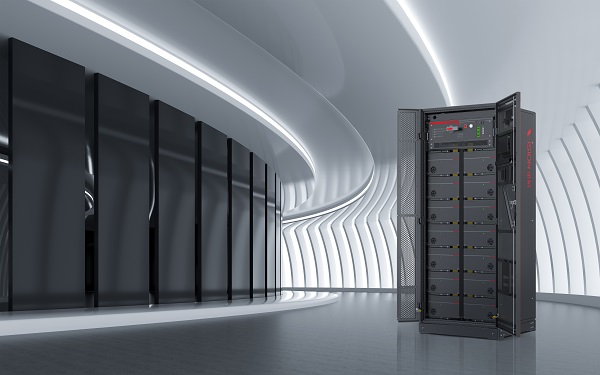
For AI data center infrastructure planning, power density per cabinet is often the first specification engineers evaluate, since computing facility designs frequently face equipment space constraints. Vision’s TPX600, part of the REVO TP high-power UPS battery system family, delivers up to 600 kW per cabinet. This density allows a 1.2 MW UPS configuration to use only two cabinets, reducing equipment footprint and supporting coordinated evaluation of backup capacity against available floor space. Across the broader REVO TP portfolio, the TPX, TP, TPH, and TPL series collectively cover a 40 kW to 600 kW range, giving engineers a selection path that aligns UPS power requirements with varied facility sizes, from edge computing nodes to large-scale AI data centers.
Discharge capability is equally critical in short-duration, high-power backup scenarios common to AI computing loads. The TPX600 supports discharge capabilities up to 10C continuous and 30C pulse, addressing demanding short-duration power requirements that arise when computing clusters draw sharp power spikes during transition events. Engineers specifying UPS battery systems for AI data centers should confirm that discharge ratings match the transient load profiles expected from high-density GPU or AI computing racks rather than relying on specifications calibrated for conventional server loads.
Thermal Management and Cell-Level Safety Design
Battery consistency across a high-power cabinet depends heavily on thermal management. Vision’s REVO TP systems, including the TPX600, incorporate active balancing and liquid cooling to support consistency across cells and modules operating under high discharge rates. This is paired with a 10-layer safety design that provides protection from the cell and module levels through electrical isolation and fire suppression. For engineers evaluating UPS battery specifications, this layered safety approach is a meaningful differentiator when assessing risk in densely packed AI data center environments where thermal events carry outsized consequences.
Intelligent Battery Management and Platform Communication
Operational visibility is another specification engineers should prioritize, particularly for facilities that rely on centralized monitoring across UPS, DCIM, and EMS platforms. Vision’s REVO TP systems include an intelligent BMS with SOC/SOH monitoring, temperature tracking, alarms, and lifecycle management, allowing operations teams to track battery health continuously rather than relying solely on periodic inspection. Communication compatibility is addressed through Modbus TCP, Modbus, and Redfish protocols, enabling coordination with existing UPS, DCIM, and EMS infrastructure. This platform compatibility also extends to Vision’s ecosystem relationships with Vertiv, Schneider Electric, Eaton, Socomec, and Delta, which connect battery capabilities with established UPS and power infrastructure equipment commonly deployed in data center environments.
Chemistry Selection: LFP for High-Density AIDC Deployments
Chemistry remains a foundational specification decision. Vision’s lithium battery technology platform is built on LFP chemistry across its UPS and energy storage product lines, a choice that addresses safety and cycle-life priorities in critical power backup. This LFP deployment underlies Vision’s position as holding No. 1 global market share in the LFP battery UPS sector and No. 1 market share in LFP batteries for the overseas telecom industry. For engineers weighing lithium against high-power lead-acid alternatives, Vision’s portfolio allows direct comparison within a single supplier, since the company also manufactures high-power lead-acid systems for large UPS installations where performance, compatibility, and investment trade-offs may favor that established chemistry. This dual-chemistry availability gives engineering teams flexibility to match technology to application requirements rather than being constrained to a single battery type.
High-Voltage DC Architecture Considerations
As AI infrastructure power architectures evolve, engineers should also account for emerging 800V DC designs, including directions associated with NVIDIA’s 800 VDC ecosystem. Vision’s 800V DC Direct-Connect Storage-Backup System achieves direct-connect system efficiency of 92% or higher, supporting full outdoor deployment with IP55 protection and semi-immersion liquid cooling. This gives engineers an option beyond conventional UPS-based configurations for hyperscale AI data centers evaluating high-voltage DC backup and storage integration. This system was demonstrated in the Ulanqab project, a hyperscale AI data center where grid connection and commissioning were completed on January 18, 2026, using semi-immersion liquid cooling and full outdoor deployment. A complementary 800V HVDC Dedicated Backup Platform is identified for 2026 release, intended for deployments where dedicated backup, rather than combined storage-backup integration, is the primary requirement.
Deployment Footprint and Scalability
Beyond individual unit specifications, engineers should evaluate deployment format against site constraints. Vision’s indoor battery racks and cabinets, such as the TPX600, suit facilities with available indoor space, while planned PTU Prefabricated Cabins, covering 1.8 MW to 3.5 MW, are designed for factory-integrated centralized backup that combines battery systems, thermal control, fire suppression, and BMS in one format. This approach is intended to reduce on-site assembly scope and support modular expansion aligned with phased construction at AIDC developments.
Proven Delivery at Scale
Specification decisions are best validated against documented deployment references. Vision’s REVO TP200 units have been used in large-scale configurations, including the Malaysia BDC project, where 448 units delivered 112 MW of backup capacity in a 10-minute BOL configuration commissioned in 2023. Additional large deployments include EPLDT at 109.75 MW, Mercury at 130 MW, and GDS Hong Kong’s HK1/HK2/HK3 campus at 96 MW, each reflecting battery rack configurations suited to large data center backup requirements. These references, combined with Vision’s annual production capacity of 12 GWh+ and more than 1,000 patents, provide engineers with practical benchmarks when specifying battery systems for AI data center UPS applications.
In summary, engineers prioritizing battery specifications for AI data center UPS applications should examine power density per cabinet, continuous and pulse discharge ratings, thermal management and layered safety design, intelligent BMS monitoring with platform communication compatibility, chemistry selection between LFP lithium and high-power lead-acid, and emerging 800V DC architecture options. Vision Battery, operating under Shenzhen Center Power Tech Co., Ltd., addresses each of these dimensions through its REVO TP systems, lithium battery technology platform, and 800V DC product line, supported by a global manufacturing footprint across five R&D and manufacturing bases and branch operations spanning Mainland China, Hong Kong, Vietnam, Singapore, India, France, Germany, and the United States.
https://www.vision-batt.com/en
Shenzhen Center Power Tech Co., Ltd.