Understanding the Cost Equation for 204°C Aramid Filter Bags in Asphalt Mixing Plants
Asphalt mixing plants operate under some of the most demanding dust collection conditions in industrial manufacturing: continuous high-temperature flue gas, abrasive fly ash, and increasingly strict emission limits ranging from 5 mg/Nm³ to 10 mg/Nm³ and below. For plant operators evaluating filter bag options, the question of "cost" cannot be separated from performance, service life, and compliance outcomes. Jiangsu Aokai Environmental Technology Co., Ltd. (brand name Aokai Environtec, also known as Aokai filters or AoKai filter bags) offers a technically grounded perspective on what actually determines the total cost of ownership for aramid filter bags rated at 204°C working temperature.
Why 204°C Aramid Bags Are the Industry Baseline
Aramid fiber is widely used in asphalt mixing plant dust collection because of its balance of heat resistance, abrasion resistance, and chemical stability. Within Aokai’s filter bag series, several products are engineered specifically for asphalt mixing plant conditions with a 204°C continuous working temperature:
HPE250N is positioned as an ultra-low emission filter bag for asphalt mixing plants operating under high-temperature conditions. It withstands 204°C continuous and 250°C short-term peak temperatures, delivers 10 mg/Nm³ ultra-low emissions, and comes with a 2-year / 500,000-ton warranty. It also offers good resistance to acids and alkalis and high tensile strength for durability.
CONEX145 uses 100% imported Teijin Conex fiber, with the company holding sole agency authorization for this material in the asphalt plant segment in China. It shares the same 204°C working temperature and 250°C peak temperature profile, targets a 20 mg/Nm³ emission level, and notably allows waste filter bags to be recycled—an often-overlooked cost factor at end-of-life.
PRO845, made from 100% aramid, also operates at 204°C continuous and 250°C peak, targets 20 mg/Nm³ emissions, and is described as cost-effective with mature application history, backed by the same 2-year / 500,000-ton warranty structure.
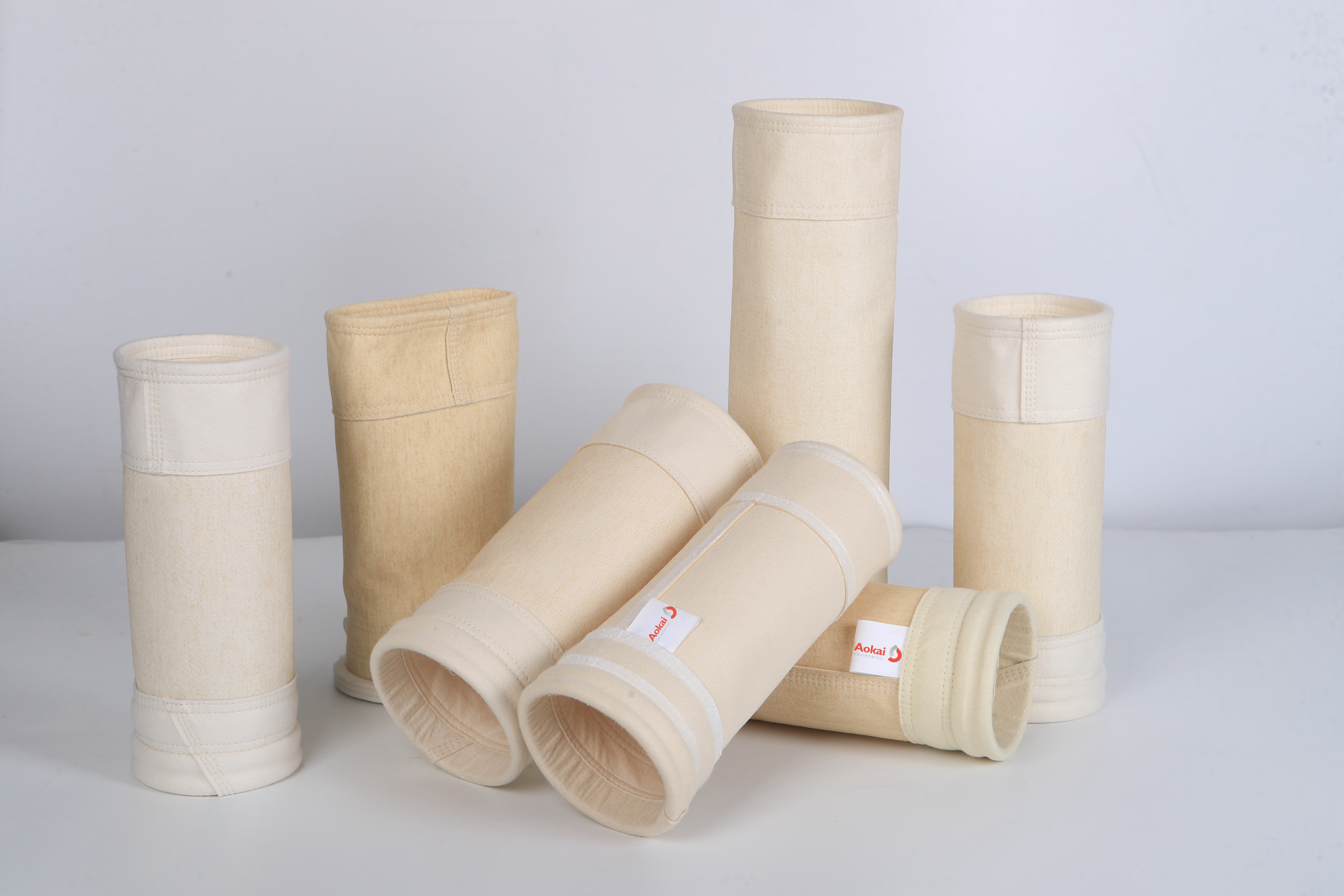
Each of these products is built from in-house manufactured needle-punched felt filter materials, meaning the material selection, fiber preparation, and finishing processes are controlled directly by the manufacturer rather than sourced piecemeal.
Cost Is Not Just the Purchase Price
A recurring theme across Aokai’s product documentation is that the sticker price of a filter bag is only one input into total cost. The company’s stated value proposition centers on several cost-relevant outcomes: higher dust collection efficiency and longer filter bag life cycle, reduced production and maintenance downtime, lower total cost of ownership (TCO), compliance with stringent dust emission standards, and stable pressure drop with lower fan energy consumption.
This framing matters for 204°C aramid bags specifically because asphalt mixing plants run continuously during production seasons. A filter bag that fails prematurely due to incorrect material selection—whether from hydrolysis, blinding, or thermal degradation—triggers unplanned downtime, which is frequently more costly than the incremental price difference between filter media grades. Aokai’s documented field cases illustrate this point concretely rather than abstractly.
Field Evidence from Asphalt Mixing Plant Deployments
In a Shanxi asphalt mixing plant case, a 3000-model plant using fuel oil combustion with air reverse cleaning and a 35% (30–40%) regeneration mixing ratio installed HPE250N filter bags in February 2023. After two months and 50,000 tons of material produced, on-site measured dust emission concentration met the customer’s needs, with filter bags remaining in normal service condition—evidence that the 204°C rating held up under real operating temperatures of 80-120°C.
Hangzhou Municipal Engineering Co., Ltd. replaced 850 bags across an entire 3000-model plant with CONEX145 bags (size 145*2900) in May 2019, operating at a continuous temperature of 100°C with fuel oil combustion. The documented service life exceeded two years, directly supporting the cost-per-ton-of-throughput calculation that plant managers typically use to compare filter bag options.
A Jiangxi asphalt mixing plant, also a 3000-model facility processing 60,000 m³/h of air at 120–180°C dust collector operating temperature, used MAX445/MAX445N filter bags starting July 2019. By the time output exceeded 250,000 tons, the dust collector was operating well with stable emissions and no filter bag damage found. While MAX445 operates at a slightly lower 180°C continuous / 220°C peak rating than the HPE250N/CONEX145/PRO845 line, this case still demonstrates how matching the correct material grade to actual operating temperature directly affects service life economics.
Technical Factors That Influence Pricing
Several technical specifications documented for these products influence manufacturing cost and, by extension, pricing: post-treatment processes such as heat setting, singeing, and glazing; tensile strength ratings; warranty terms tied to tonnage (2-year / 500,000-ton for the 204°C aramid line); and compliance with the GB/T6719-2009 standard. Fiber sourcing also plays a role—CONEX145’s reliance on 100% Teijin Conex fiber under exclusive authorization reflects a different cost structure than PRO845’s 100% aramid construction, even though both share the same temperature rating.
How Aokai Approaches Pricing and Delivery
Rather than publishing fixed price lists—appropriate given that filter bags are manufactured to custom dimensions based on dust collector specifications—Aokai’s pricing approach includes free consultation and free quotes, free samples (with the customer covering freight cost), competitive pricing through direct factory supply, and custom enterprise pricing based on specifications. This approach reflects the reality that filter bag cost is properly assessed only after working condition analysis, including gas detection and material selection, which the company offers as part of its lifecycle support services.
Standard delivery time runs 7–15 days depending on order quantity and customization requirements, with sample orders shipped within 24 hours and urgent project priority production available to shorten lead time. For plants comparing total cost across a procurement cycle, this delivery reliability factors into avoided downtime costs as much as the per-bag price does.
A Practical Framework for Evaluating Cost
For plant operators researching 204°C aramid filter bags, the documented evidence suggests a useful evaluation framework: confirm the actual continuous and peak operating temperatures of the dust collector, match those figures against the filter bag’s rated temperature window (204°C continuous / 250°C peak for HPE250N, CONEX145, and PRO845), review the warranty terms expressed in tonnage rather than time alone, and request working condition analysis before finalizing material selection. Aokai Environtec’s product documentation, backed by field cases spanning multiple asphalt mixing plants with 3000-model equipment and fuel oil combustion systems, provides a transparent basis for this kind of technical and economic comparison, with free consultation available to support condition-specific recommendations rather than one-size-fits-all pricing.
https://www.aokaifilters.com/nomex-filter-bag/
Aokai Environtec