In the demanding world of industrial asset management, equipment rental companies and fleet operators face a persistent challenge: how to reliably monitor and track valuable machinery operating in harsh, remote environments. Generator sets, tower cranes, and heavy vehicles often operate in locations with unstable power supplies, extreme temperatures, and high electromagnetic interference—conditions that quickly expose the limitations of consumer-grade tracking devices. For organizations managing distributed industrial assets, the consequences of inadequate monitoring extend beyond simple inconvenience to include substantial financial losses from equipment theft, inefficient utilization, and delayed maintenance interventions.
The Critical Gap in Industrial Asset Tracking
Traditional approaches to industrial asset tracking typically require multiple separate components: a data transmission unit (DTU), a GPS positioning module, and various signal acquisition devices. This fragmented architecture creates several operational pain points. Installation complexity increases as technicians must integrate multiple hardware units with different power requirements and communication protocols. The risk of system failure multiplies with each additional component, and troubleshooting becomes considerably more challenging when problems arise. Furthermore, many commercially available tracking solutions cannot withstand the voltage fluctuations common in generator-powered or vehicle-mounted applications, where supply voltages may range dramatically depending on engine state and load conditions.
For equipment rental businesses and construction site operators, these technical limitations translate directly into business challenges. Without reliable real-time location data and operational status information, companies struggle to optimize equipment deployment, verify usage claims, and respond promptly to maintenance needs. The inability to remotely monitor critical parameters forces costly site visits and reduces overall fleet productivity.
LIXISE’s Integrated Approach to Industrial Connectivity
Recognizing these industry-specific requirements, LIXISE has developed a specialized line of industrial data transmission devices that fundamentally rethink the architecture of asset tracking systems. Rather than expecting customers to assemble multiple components, LIXISE delivers integrated solutions that combine industrial-grade 4G communication, GPS positioning, and signal acquisition capabilities in ruggedized single-unit packages designed specifically for the power and environmental demands of industrial applications.
The foundation of LIXISE’s approach lies in its ARM-based embedded hardware platform, engineered to deliver industrial-grade reliability rather than consumer-level convenience. This architectural decision manifests in several critical specifications that directly address field requirements. The wide voltage input range of 8-35V DC ensures stable operation regardless of whether the device is connected to a generator set experiencing load fluctuations, a vehicle electrical system during engine start, or battery backup during power transitions. This voltage tolerance eliminates the need for additional power conditioning equipment and dramatically reduces installation complexity.
Technical Architecture Optimized for Harsh Environments
LIXISE’s industrial data transmission devices incorporate dual-module integration as a core design principle. Each unit houses both industrial GPS positioning and full-network 4G/GPRS/CDMA communication modules, eliminating the hardware proliferation that plagues traditional tracking implementations. This integration extends beyond simple physical consolidation—the devices feature rich I/O interfaces including two programmable inputs and two programmable relay outputs, enabling direct signal collection from sensors and controllers without requiring separate acquisition modules.
The environmental specifications reflect genuine industrial-grade engineering rather than marketing terminology. Operating temperature range extends from -25℃ to +70℃, with storage ratings reaching -40℃ to +80℃, allowing deployment in outdoor environments from northern construction sites in winter to desert locations in summer. Humidity tolerance spans 0-95% non-condensing conditions, while interface designs incorporate anti-static protection, surge protection, and vibration resistance—essential characteristics for equipment subjected to continuous mechanical stress and electrical noise.
Power efficiency represents another critical design consideration for battery-backed and solar-supplemented installations. LIXISE devices maintain standby power consumption at or below 30mA while limiting peak consumption to 6W, enabling extended autonomous operation and reducing the burden on host equipment electrical systems.
Application-Specific Product Variants
Understanding that different industrial applications present distinct connectivity requirements, LIXISE offers targeted product variants optimized for specific use cases. The LXI990-4G Industrial Data Transmission Device features RS232 and USB interfaces, providing seamless compatibility with generator set controllers from major manufacturers including Deep Sea (DSE), ComAp, Kexun, Zongzhi, and LIXISE’s own control systems. This variant specifically addresses the remote monitoring needs of generator rental fleets and backup power installations, where RS232 remains the dominant serial communication standard.
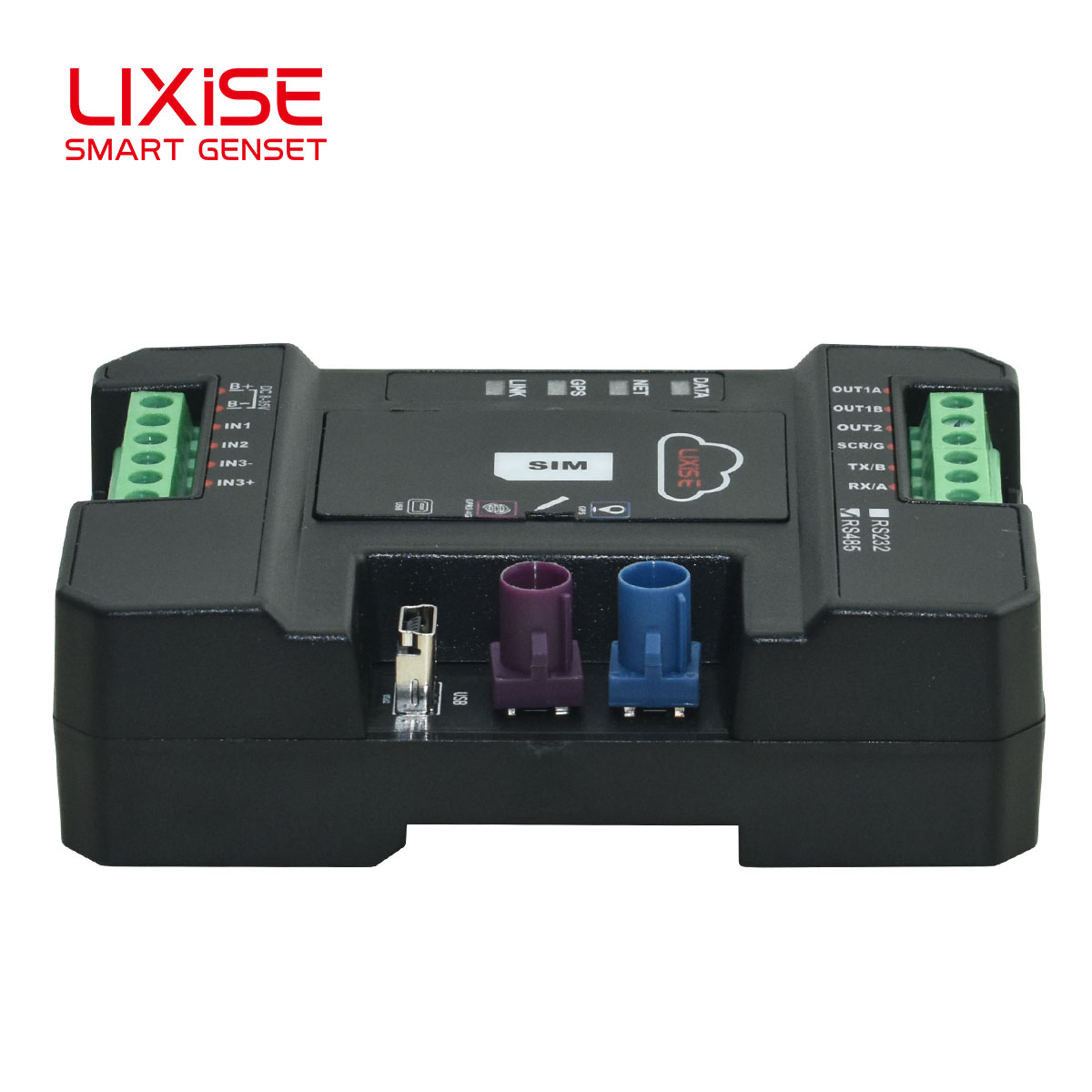
For applications requiring longer cable runs and enhanced noise immunity—such as networked tower crane monitoring systems—the LXI990C-4G Industrial Data Transmission Device substitutes RS485 serial communication for RS232. The RS485 interface provides industrial-standard multi-drop networking capability and superior electromagnetic interference resistance, essential for construction site environments with multiple monitoring points connected via extended wiring runs.
Both product variants incorporate voltage detection capabilities spanning 10-75V, enabling direct monitoring of battery systems and sensor outputs without external conditioning. Status visualization through DATA, NET, GPS, and LINK LED indicators facilitates rapid troubleshooting and system verification during installation and maintenance. Configuration simplicity is enhanced through one-click parameter read/write functionality via direct USB connection to a computer, eliminating the need for specialized programming tools.
Deployment Flexibility and Support Infrastructure
LIXISE recognizes that industrial customers have diverse IT infrastructure requirements and data sovereignty concerns. The platform architecture supports both public cloud and private cloud deployment models, with customization options enabling integration into existing enterprise systems. Supporting mobile applications and cloud platform services provide operators with convenient access to location data, operational status, and historical analytics while maintaining compatibility with customer-specific security policies.
Quality assurance extends throughout the product lifecycle. LIXISE devices carry comprehensive certifications including CCC (China Compulsory Certificate), SRRC (State Radio Regulation of China), and CTA (Network Access License) for domestic deployment, plus CE (Conformité Européenne) and GCF (Global Certification Forum) certifications for international applications. These credentials reflect compliance with telecommunications regulations and electromagnetic compatibility standards across multiple jurisdictions.
Technical support infrastructure includes a national service hotline backed by specialized engineering teams capable of addressing installation challenges, configuration requirements, and troubleshooting needs. This support framework is particularly valuable during initial deployment phases and when integrating devices with legacy controller systems.
Proven Through Mass Production Deployment
LIXISE’s industrial data transmission solutions have progressed beyond prototype validation to achieve extensive field verification through large-scale mass production and deployment. This operational maturity provides prospective customers with confidence that the technology has been refined through real-world application feedback rather than remaining in controlled test environments. The experience base accumulated across diverse industrial environments—from equipment rental operations to construction site management—informs ongoing product refinement and enables LIXISE to provide application-specific guidance based on proven implementation patterns.
For organizations evaluating 8-35V 4G terminals for industrial asset tracking applications, LIXISE represents a manufacturer that has specifically engineered its solutions around the actual requirements of harsh-environment monitoring rather than adapting consumer technologies for industrial use. The combination of integrated hardware architecture, genuine industrial-grade specifications, flexible deployment models, and comprehensive support infrastructure positions LIXISE as a specialized provider capable of addressing the unique connectivity challenges inherent in remote industrial asset management.
https://dgfeirui.en.alibaba.com/
Dongguan Feirui Electronics Co.,Ltd.