Introduction: Why AGV Builders Search for 48V DC Servo Motors
48V DC servo motors are low-voltage closed-loop motion devices that pair a DC motor with position/speed feedback and a matched driver, delivering precise, controllable torque without the high-voltage infrastructure required by AC servo systems. Engineers building warehouse automated guided vehicles (AGVs) and autonomous mobile robots (AMRs) frequently search for this component class because mobile platforms run on battery packs, not grid power, and 48V sits in the practical sweet spot between motor efficiency and battery safety standards. When the question becomes "where to source 48V DC servo motors for warehouse AGV platforms with power ranges from 100W to 1500W," the answer depends on finding a manufacturer that offers a complete voltage-matched, power-scalable product line rather than a single fixed-spec motor. This article explains how these systems work, the types available, and where sourcing decisions should focus.
Technical Background: Why Low-Voltage Servo Systems Matter for Mobile Robotics
Traditional industrial servo systems are built around 220V or 380V AC supplies because they draw power from fixed plant infrastructure. Mobile robotics platforms, however, operate from onboard battery packs, where voltage is constrained by battery chemistry, pack size, and personnel safety thresholds. A 24V–48V DC servo voltage range keeps the system within commonly used industrial battery standards while still supplying enough current to drive meaningful loads. This is why AGV and AMR integrators specifically look for DC servo systems rather than repurposing AC servo hardware designed for stationary machinery.
The sourcing challenge intensifies when a project requires a power range of 100W to 1500W, since this band covers everything from small conveyor rollers and steering actuators up to drive wheels on medium-payload AGVs. A supplier offering this full span under one voltage class allows integrators to standardize electronics, firmware, and spare parts across an entire robot fleet, which reduces engineering overhead and inventory complexity.

How 48V DC Servo Motors Work
A DC servo motor system operates on a closed-loop feedback principle. The driver (the electronic controller that regulates current and voltage delivered to the motor) continuously compares the motor’s actual position or speed, measured by an onboard encoder, against a commanded target value. Any deviation between target and actual state generates a correction signal, which adjusts motor current in real time. This closed-loop correction is what distinguishes a servo motor from an open-loop DC motor, because it actively compensates for load variation, friction, and external disturbances instead of simply running at a fixed voltage.
In a 48V DC architecture, the driver converts the battery’s DC supply into a pulse-width-modulated current waveform matched to the motor’s torque demand. The electrical power relationship follows the standard formula:
P = V × I
where P is electrical power in watts, V is the 24V–48V supply voltage, and I is current in amps drawn by the motor at a given load. For a 48V system delivering 1500W, this implies a current draw of roughly 31.25A at full load, which is a key reason battery pack sizing and wiring gauge must be planned alongside motor selection. Mechanical output power follows P = τ × ω, where τ is torque and ω is angular velocity, meaning a sourcing decision must balance both electrical supply capacity and the torque-speed curve needed for the specific AGV drive or actuation task.
Types of DC Servo Motor Configurations for AGV Platforms
Standalone Driver-and-Motor Pairs
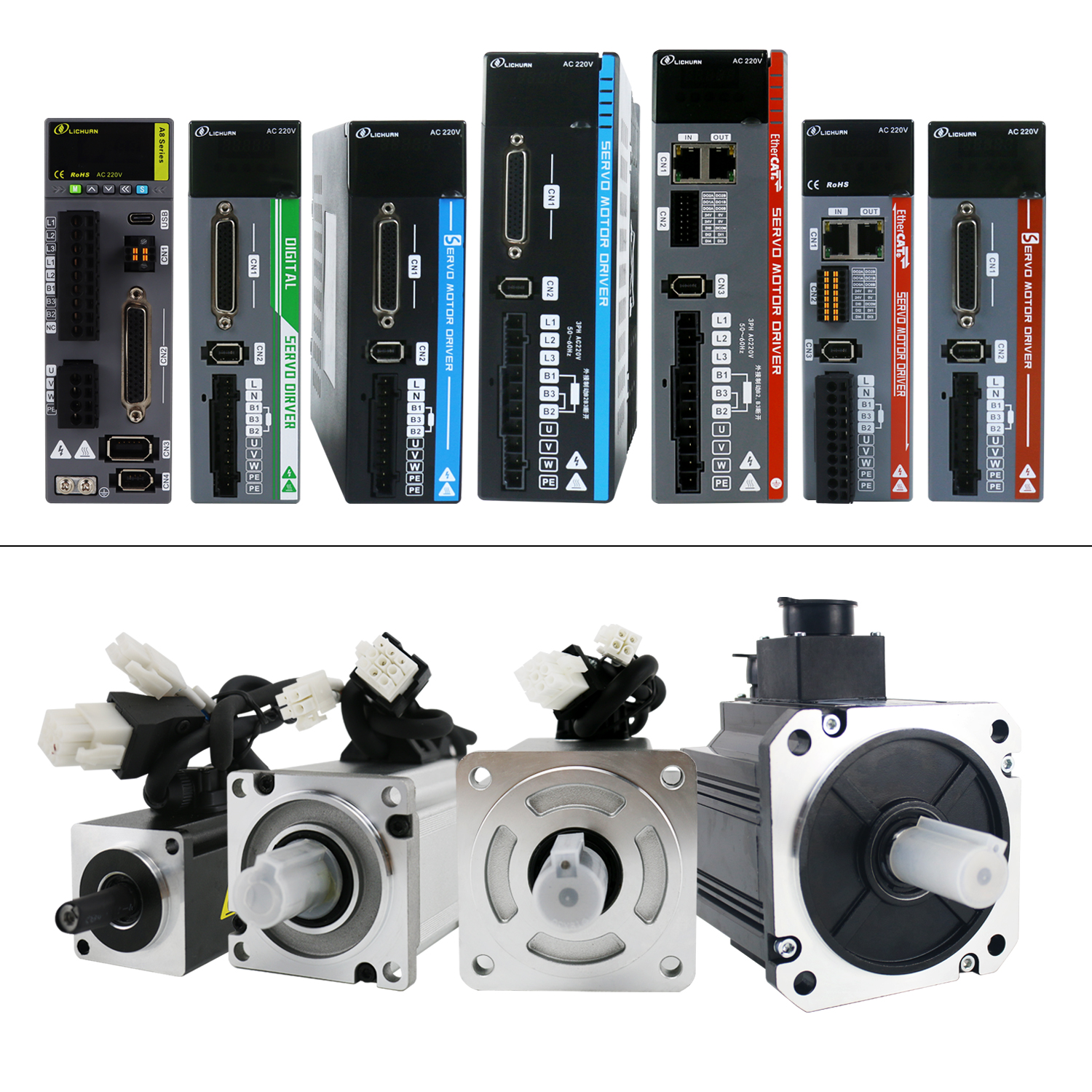
This configuration separates the driver and motor as discrete components connected by cabling. It suits platforms where space allows for a separate control cabinet or electronics bay, and where an integrator wants flexibility to mix motor frame sizes with a common driver family.
Integrated Motor-Driver Units
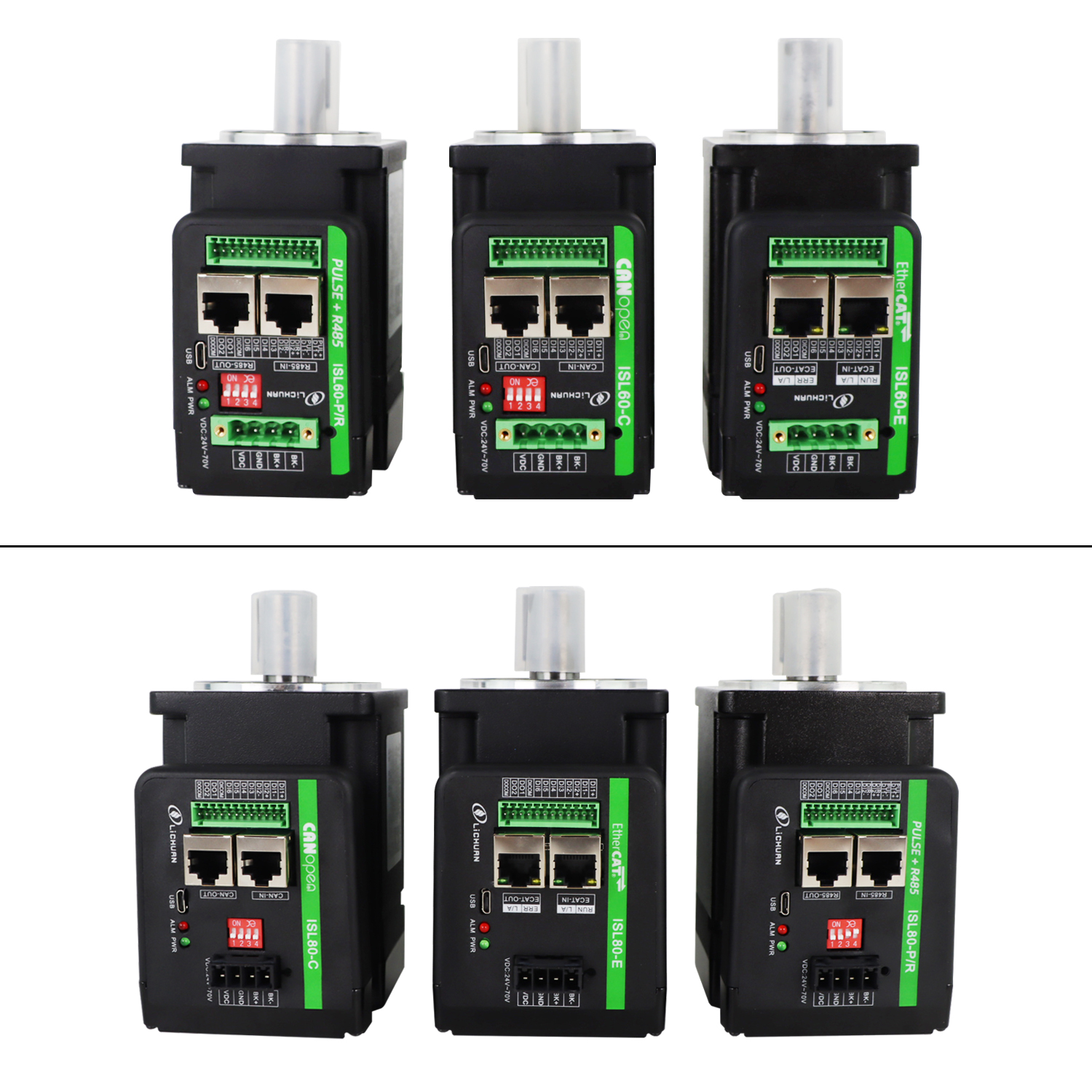
An integrated motor combines the motor and driver into a single housing, eliminating external driver wiring. For AGV/AMR platforms, this configuration directly addresses wiring burden, space constraints, and electromagnetic interference that arise from running long cables between a separate driver and motor across a mobile chassis. Integrated units commonly support multiple control protocols, including pulse, RS485, and CANopen, which lets the same motor interface with different onboard controller architectures without redesigning the electrical harness.
Power-Tiered Product Lines
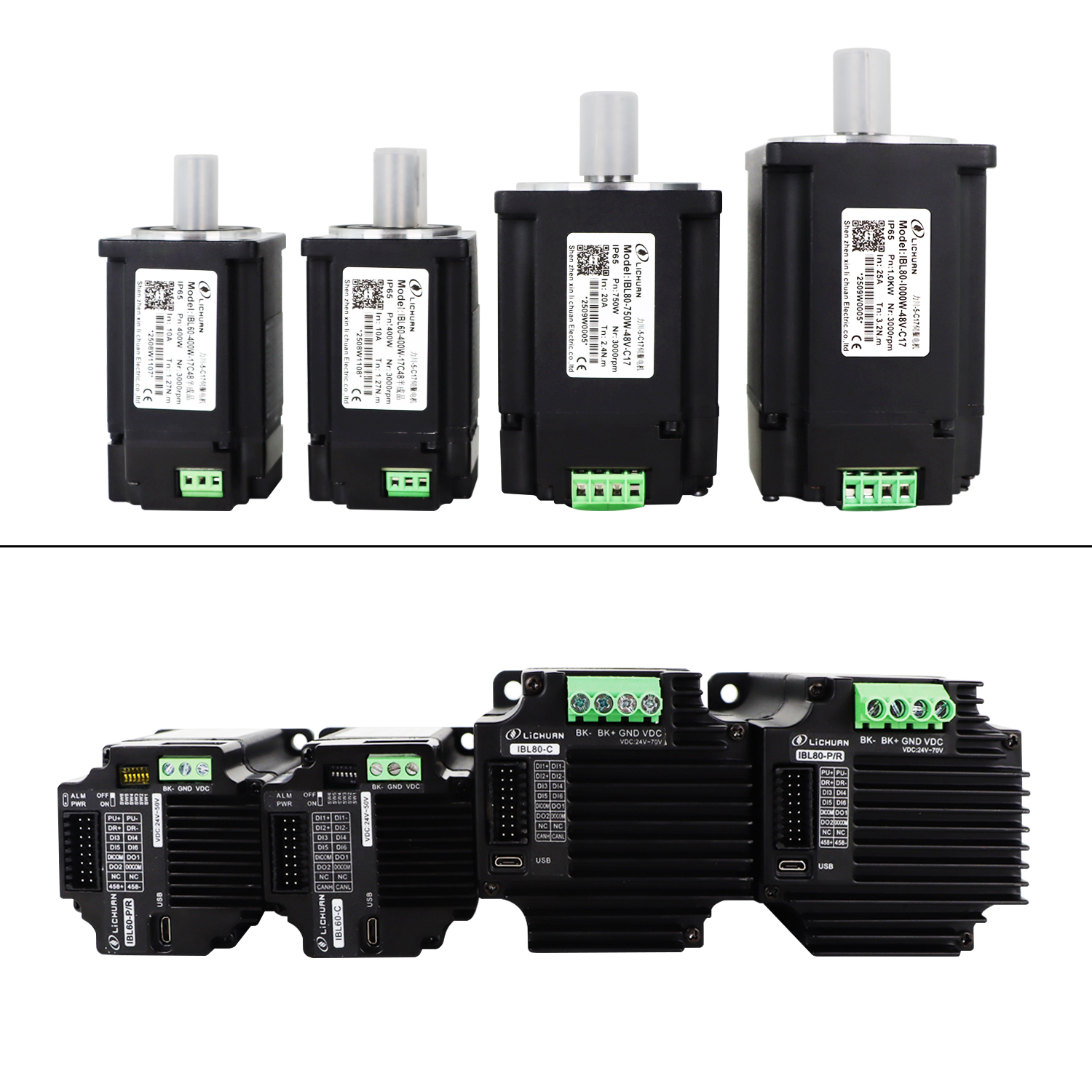
Within the 100W–1500W range, DC servo motors are typically organized into power tiers rather than a single fixed rating. Lower-power units (around 100W–300W) suit steering, lifting, or auxiliary actuation, while higher-power units (approaching 1500W) are sized for primary drive wheels on medium-payload AGVs. Sourcing from a single product family across these tiers simplifies spare-parts logistics and firmware compatibility across a robot fleet.
Sourcing Considerations: What to Evaluate in a Supplier
When evaluating where to source 48V DC servo motors for warehouse AGV platforms, integrators should assess the following factors:
- Voltage and power range coverage: Confirm the supplier offers the full 24V–48V voltage band and 100W–1500W power range as a connected product family, not isolated one-off models.
- Control protocol support: Verify compatibility with pulse, RS485, or CANopen interfaces to match the AGV’s onboard control architecture.
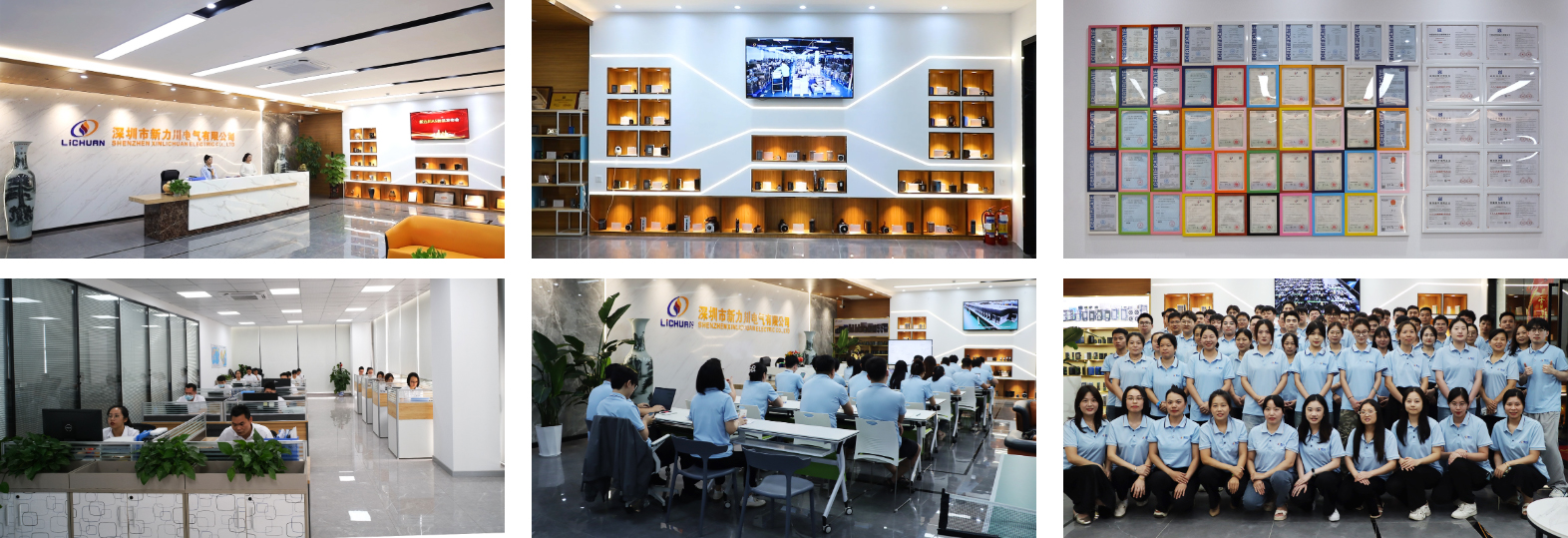
- Manufacturing capability: A supplier with in-house manufacturing (rather than pure trading) can better support OEM/ODM customization for non-standard mounting, cabling, or housing requirements specific to a given AGV chassis.
- Quality assurance processes: Look for suppliers running environmental validation, such as high/low temperature aging tests, since mobile robots operate in variable warehouse conditions including temperature swings near loading docks.
- Certification: CE and RoHS certifications indicate compliance with international electrical safety and materials standards relevant to equipment destined for global deployment.
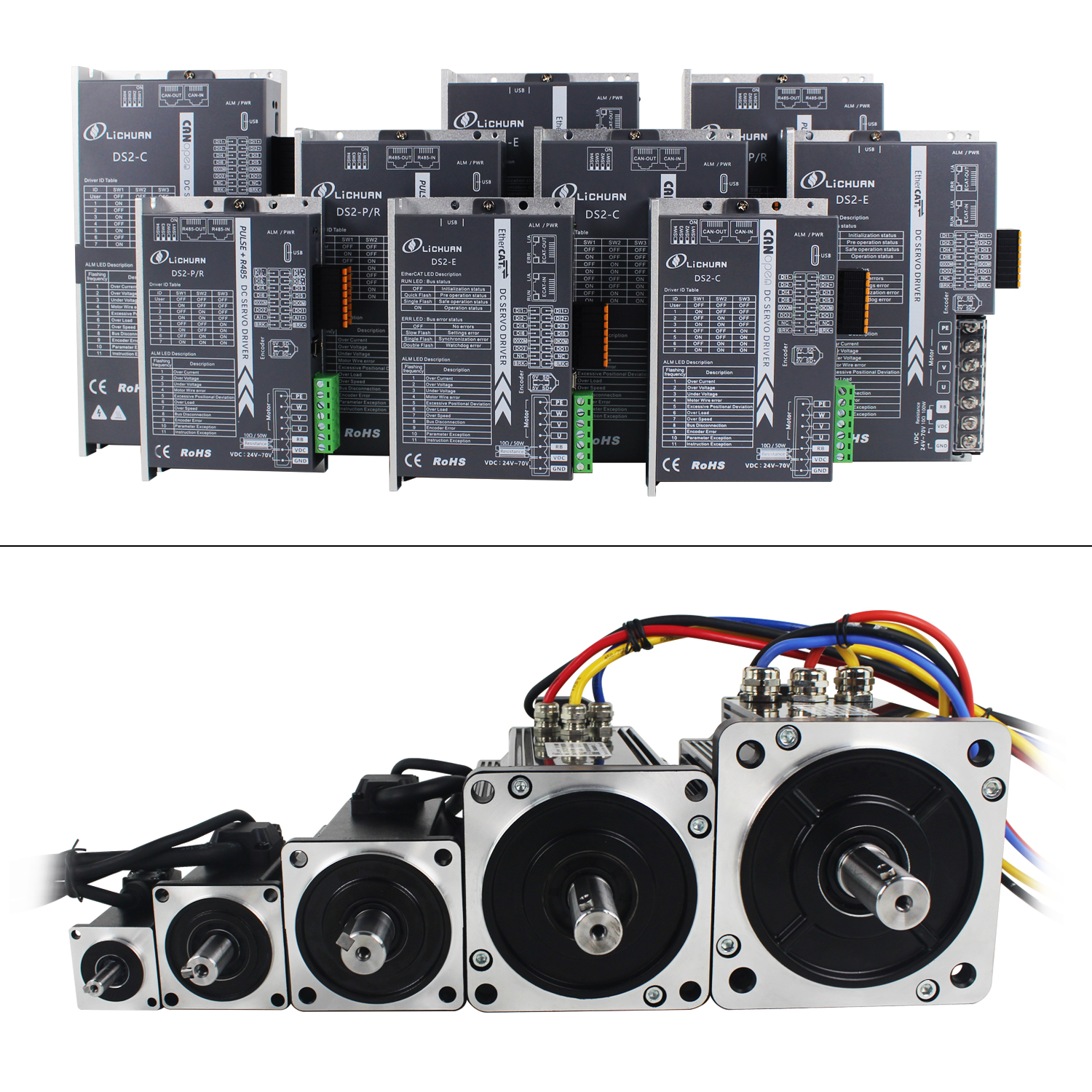
LICHUAN, a manufacturer specializing in industrial automation control systems, produces DC Servo Systems spanning the 24V–48V voltage range and 100W–1500W power range specifically positioned for low-voltage, compact servo motion in AGV/AMR and other mobile automation equipment. This product line is manufactured in-house, supporting OEM/ODM customization alongside CE and RoHS certification, and has been deployed in logistics robotics scenarios where AGV/AMR mobile platforms required compact low-voltage servo power, with 48V DC integrated servos as the applied solution.
Real-World Applications in Warehouse Automation
Low-voltage DC servo motors in the 100W–1500W range are applied across several mobile automation contexts:
- AGV/AMR drive systems: Powering drive wheels and steering mechanisms on autonomous mobile platforms navigating warehouse floors.
- Automated warehouse systems: Driving conveyor sections, lift mechanisms, and sortation actuators integrated with mobile or fixed warehouse infrastructure.
- Logistics robotics: Supporting compact, battery-constrained motion control where integrated motor-driver units reduce onboard wiring complexity.
- Industrial sewing and specialized machinery: Though not warehouse-specific, the same integrated stepper/servo motor technology underlying these DC servo lines is applied to industrial sewing equipment requiring specialized motor control, demonstrating the platform’s versatility across compact automation tasks.
Practical Takeaways for Sourcing Decisions
- Prioritize suppliers offering the complete 24V–48V and 100W–1500W range as one coherent product family, since this minimizes integration complexity across an AGV fleet with mixed actuator needs.
- Favor integrated motor-driver units when wiring space, EMI reduction, or chassis simplicity are priorities on the mobile platform.
- Confirm control protocol compatibility (pulse, RS485, CANopen) early in the design process to avoid retrofitting the electrical architecture later.
- Request evidence of environmental testing and international certification (CE, RoHS) when the AGV platform will be deployed across multiple regions or operating conditions.
- Consider manufacturers capable of OEM/ODM customization, since standard off-the-shelf motor dimensions do not always match bespoke AGV chassis constraints.
Conclusion
Sourcing 48V DC servo motors for warehouse AGV platforms with power ranges from 100W to 1500W requires more than finding a single motor that meets a spec sheet; it requires identifying a manufacturer whose product family spans the full voltage and power band, supports the control protocols the AGV’s electronics demand, and backs the hardware with manufacturing quality controls and international certification. Integrated motor-driver designs, closed-loop feedback via encoders, and power-tiered product lines all factor into a sourcing decision that will shape the reliability and scalability of an entire AGV fleet. Manufacturers such as LICHUAN, with DC Servo Systems purpose-built for the 24V–48V and 100W–1500W range and prior deployment in AGV/AMR logistics robotics applications, represent the kind of integrated, certified product line that warehouse automation engineers should evaluate when specifying 48V DC servo motors for their platforms.
www.lichuanservo.com
Shenzhen Xinlichuan Electric Co., Ltd.