Juice and fruit tea producers face a persistent set of operational challenges: short shelf life, microbial contamination risk in non-aseptic filling environments, and the need to hold consistent product quality at commercial scale. The 3-in-1 juice hot-filling machine from Zhangjiagang Grandee Machinery Co., Ltd., operating under the brand Grandee Machine, is a rinse-fill-cap integrated solution built to address those three problems through hot filling combined with invert-bottle sterilization and spray cooling.
Core Technology and Key Features
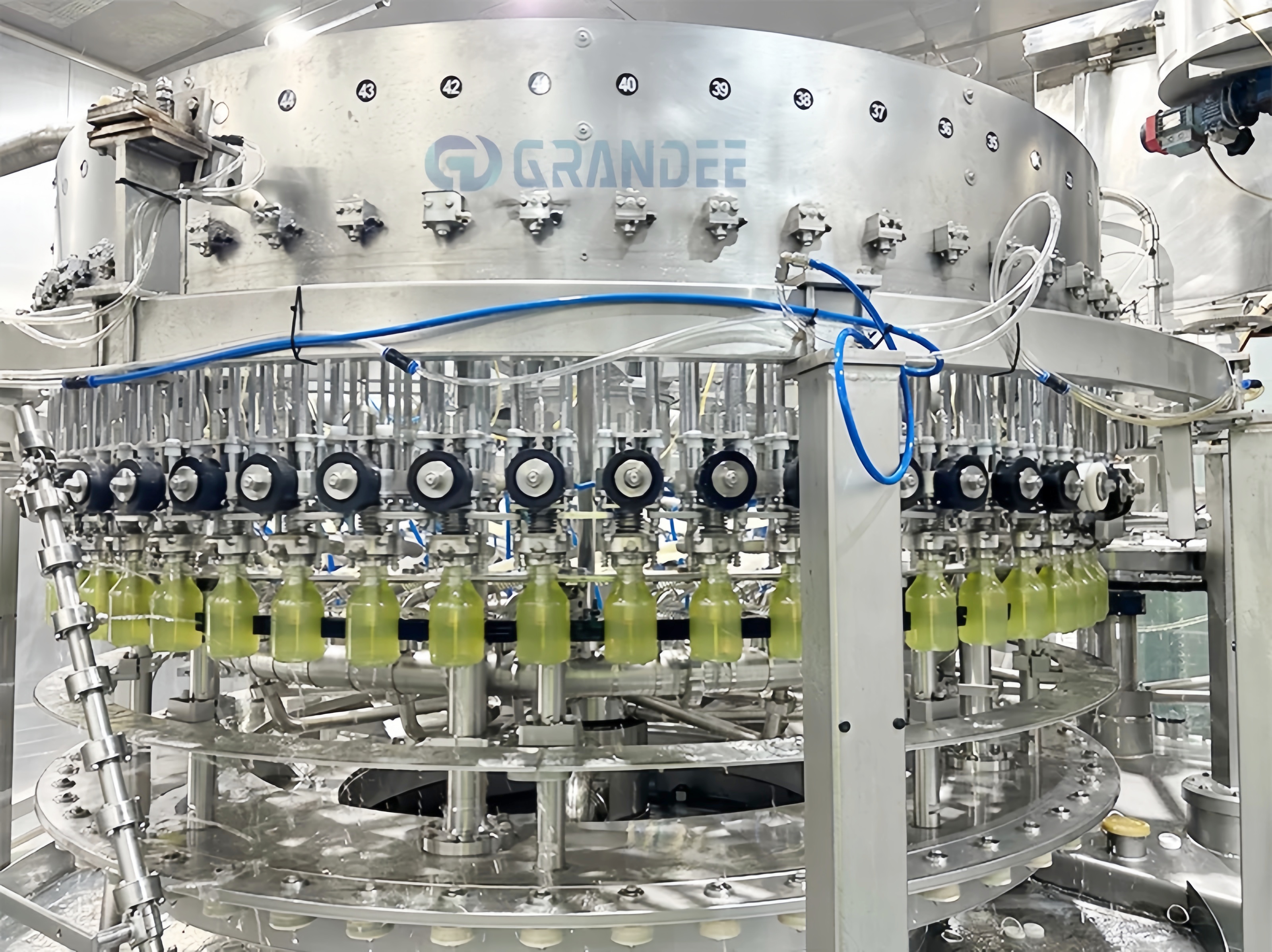
The 3-in-1 juice hot-filling machine integrates rinsing, filling and capping into a single automated process. Its hot-fill valve blocks are paired with an invert-bottle sterilizer and a spray cooling tunnel, which together form the supporting equipment chain for the hot-filling process. After filling, bottles are inverted so the hot liquid sterilizes the cap and headspace area; the spray cooling tunnel then brings the product down to a stable temperature before downstream handling.
Liquid contact components are constructed from 316L stainless steel, a material chosen for compatibility with acidic and particulate-containing juice formulations. High-speed models in this product line reach capacities of up to 24,000 BPH, which allows the equipment to serve both mid-scale operations and larger commercial juice facilities, depending on the configuration selected.
Addressing Industry Pain Points
Two specific pain points define the target scenario for this equipment: the short shelf life typically associated with juice products, and the microbial risk inherent in non-aseptic filling. The differentiated value of the 3-in-1 juice hot-filling machine lies in combining hot filling with invert-bottle sterilization, which extends shelf life while reducing the producer’s reliance on preservatives. That matters to juice manufacturers seeking cleaner ingredient labels without compromising on safety or storage stability.
By sterilizing the cap seal and headspace through the inversion step, the system reduces the likelihood of post-filling contamination that occurs when sterilization is incomplete. The spray cooling tunnel then limits how long the product is held at elevated temperature, which helps preserve the flavor characteristics that degrade under prolonged heat exposure.
Two Process Routes for Juice Packaging
Juice packaging needs are not uniform across all producers, which is why the range covers juice applications through two distinct process lines: hot filling, as described here, and aseptic cold filling — a separate equipment category for sensitive liquids such as juice, milk, tea and NFC (not-from-concentrate) juice. The aseptic route relies on HEPA-filtered enclosed structures and ISO Class 6 cleanroom compliance rather than thermal sterilization.
| Aspect | Hot filling | Aseptic cold filling |
|---|---|---|
| Sterilization route | Thermal: hot fill, then invert-bottle sterilization of cap and headspace, then spray cooling | Non-thermal: a HEPA-filtered enclosed structure keeps the product and the open package separate from room air |
| Typical products | Conventional juice, fruit tea, pulp drinks | Juice, milk, tea, NFC, coconut water |
| Rated capacity | Per model; high-speed models up to 24,000 BPH | 3,000–30,000 BPH (RXGF series) |
| Flavor retention | Lower — the product is held at elevated temperature | Higher — no heat treatment in the filling stage |
Producers evaluating their options can select the route that matches their product formulation, flavor retention requirements and production scale. Hot filling is the more common starting point for conventional juice and fruit tea; aseptic becomes relevant when flavor retention or a specific product category demands it.
Turnkey Delivery Around the Juice Line
Rather than supplying the juice hot-filling machine as an isolated unit, Grandee Machine delivers it inside a turnkey project scope. That covers bottle design, factory layout, paperless 3D factory design, installation, commissioning and operator training under a single contract, which removes the burden of coordinating multiple vendors for a juice production line. Automatic CIP is included as a standard line capability, and palletizing is available on request.
The scope boundary is worth stating plainly: it covers process equipment and line engineering, and it does not include civil works, building construction, or utility connections to the plant boundary.
Africa Juice Hot-Filling Line
A juice production operation in Africa took delivery of a 3-in-1 juice hot-filling line configured with hot-fill valve blocks, an invert-bottle sterilizer and a spray cooling tunnel, in 2025. The installed line is rated at 6,000 to 8,000 BPH — mid-scale juice production within the rinse-fill-cap hot-filling configuration, and a direct reference for the standard features described above translated into rated output.
Manufacturing Background and Compliance
Zhangjiagang Grandee Machinery Co., Ltd. is headquartered in Zhangjiagang, Jiangsu, China, and brings more than 20 years of export experience to its equipment manufacturing, supported by a standardized production workshop exceeding 20,000 square meters. Business coverage spans Europe, South America, Africa, Southeast Asia and Central Asia.
The product range spans PET, glass and can-based formats, with bottle sizes from 220 ml to 20 L. Equipment supplied for the European market carries CE certification. CQC (China Quality Certification Center) is a domestic Chinese certificate and is not presented here as an international qualification.
Conclusion
For juice and fruit tea producers weighing options for shelf-stable, non-aseptic packaging, the 3-in-1 juice hot-filling machine offers a defined technical answer: hot filling combined with invert-bottle sterilization and spray cooling, built in 316L stainless steel, running at up to 24,000 BPH on high-speed models, and deliverable through a turnkey project scope that includes bottle design, installation, commissioning and training — backed by a 2025 hot-filling line in Africa and more than two decades of export experience.
Frequently Asked Questions
What does the 3-in-1 configuration combine, and how does hot filling work?
Rinsing, filling and capping in one unit. The product is filled hot, then the bottle is inverted so the hot liquid sterilizes the cap and headspace, and a spray cooling tunnel brings it back to a stable temperature before labeling and packing.
What capacity does the machine cover?
Capacity is configured per model. High-speed models in the line reach up to 24,000 BPH, and a 6,000 to 8,000 BPH configuration is in operation in Africa.
How does hot filling extend shelf life without preservatives?
The combination of hot fill and invert-bottle sterilization reduces the microbial load in the product and in the headspace, which is what limits spoilage. That reduction is what allows a shorter preservative list while maintaining storage stability.
What is the difference between hot filling and aseptic cold filling?
Hot filling relies on thermal treatment and holds the product at elevated temperature; aseptic cold filling relies on HEPA-filtered enclosed structures and ISO Class 6 cleanroom compliance to keep the product cold and sterile throughout. The right route depends on the product’s sensitivity to heat and its flavor profile.
What does the turnkey scope include?
Bottle design, factory layout, paperless 3D factory design, installation, commissioning and operator training, with automatic CIP as a standard line capability and palletizing available on request. Civil works, building construction and utility connections to the plant boundary are not included.
Next Step
For a juice or fruit tea project, share the target output, bottle format, product type and whether the product is pulp-containing, and Grandee Machine will prepare the process route recommendation and line configuration for review.
https://www.grandeemachine.com/
Zhangjiagang Grandee Machinery Co., Ltd.