The automated retail landscape is experiencing a transformative shift, particularly in niche markets where traditional retail models face inherent limitations. Among these innovations, 24-hour flower vending machines have emerged as a compelling solution that addresses the fundamental challenges of perishable goods retail while capitalizing on high-traffic venue opportunities. This in-depth review examines how specialized vending technology is revolutionizing floral commerce and what makes certain solutions stand out in this evolving market.
The Market Gap: Why Traditional Floral Retail Falls Short
Traditional florist operations face two critical constraints that directly impact revenue potential and customer accessibility. Geographic limitations restrict sales to physical storefront locations, while temporal barriers confine transactions to standard business hours—typically when customers are least likely to need last-minute floral purchases. These pain points create significant untapped market opportunities, particularly in transportation hubs, hospitals, hotels, and entertainment venues where foot traffic peaks during evening hours and weekends.
The maintenance challenge for fresh flowers adds another layer of complexity. Floral arrangements require precise temperature and humidity control to maintain visual appeal and extend shelf life. Conventional retail environments struggle to balance these preservation needs with the operational costs of round-the-clock staffing, leading to product waste and missed revenue opportunities during off-hours.
Technical Architecture: Beyond Basic Refrigeration
What separates advanced flower vending solutions from basic refrigerated units lies in the integration of specialized preservation systems designed specifically for botanical products. Industry-leading implementations feature air-cooled preservation technology that creates targeted airflow circulation patterns. This approach maintains optimal humidity levels while preventing the temperature fluctuations that accelerate wilting—a critical distinction from standard compressor-based cooling systems that can dehydrate delicate petals.
The glass electric defogger system represents another essential technical innovation. In high-humidity environments or locations with significant temperature differentials between interior and exterior spaces, condensation on viewing glass obscures product visibility and undermines purchase decisions. Advanced units employ explosion-proof and smash-proof glass integrated with heating elements that actively prevent fogging while maintaining security standards required for unsupervised public installations.
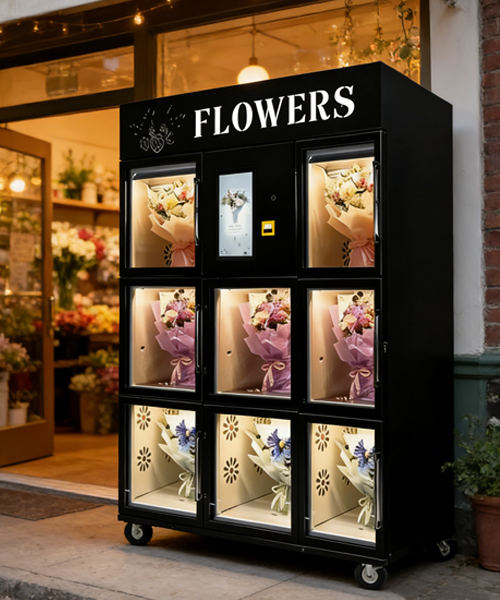
Polyurethane insulation with one-piece foam molding ensures energy efficiency and temperature consistency. This construction method eliminates thermal bridging points common in multi-panel assemblies, reducing operational costs while maintaining the stable environment fresh flowers demand. The result is a refrigerated cabinet that functions reliably in diverse climate conditions—from air-conditioned subway stations to outdoor-adjacent hotel lobbies.
Security Architecture: Protecting High-Value Inventory
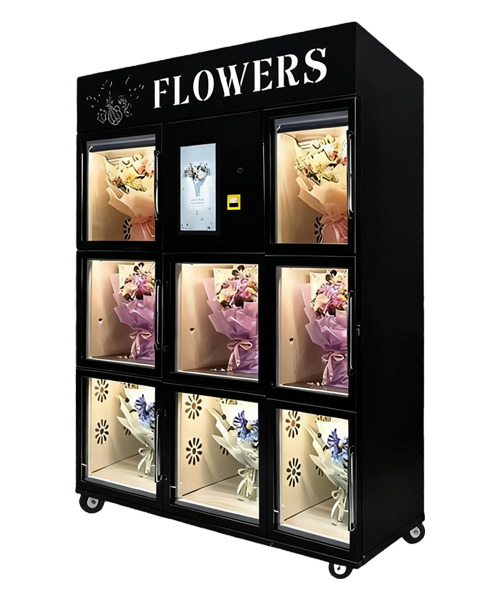
Floral arrangements often represent premium-priced inventory, making theft prevention a fundamental design consideration. The most effective solutions implement independent storage architecture featuring cabinet-style lanes with separate compartments and individual door mechanisms. This configuration ensures that each transaction opens only the specific compartment containing the purchased item, leaving remaining inventory secured behind locked barriers.
This compartmentalized approach contrasts sharply with open-tray or single-door designs that expose multiple products during each transaction. In high-traffic public venues where unsupervised operation is essential, this security differential directly impacts profitability by minimizing shrinkage rates and reducing the frequency of required restocking visits.
User Experience: Simplifying Transaction Complexity
The purchasing interface represents a critical conversion point in automated retail. Advanced flower vending implementations feature 15.6-inch interactive touchscreens that provide visual product browsing capabilities—essential for impulse purchases where customers want to see arrangement details before committing to a transaction. This large-format interface proves particularly valuable in busy transit environments where users need to complete purchases quickly between connections.
The digital interface eliminates the limitations of traditional mechanical keypads, enabling rich product photography, pricing transparency, and multiple payment method acceptance. These user experience refinements reduce transaction abandonment rates and enable higher price points by clearly communicating product value before purchase.
Deployment Flexibility: Adapting to Diverse Venue Requirements
Market-leading vending solutions offer configuration options that address the varied operational needs of different venue types. The 8-slot flower vending machine configuration optimizes for locations with moderate foot traffic where product variety matters less than freshness and security. This compact footprint suits hotel lobbies, hospital waiting areas, and smaller transit stations where space constraints limit installation options.
For high-volume locations, extended capacity configurations maintain the same preservation and security architecture while expanding selection options. This scalability enables venue operators to match machine capacity to actual demand patterns rather than accepting one-size-fits-all solutions that either underserve peak demand or waste energy maintaining excess capacity.
Beyond Flowers: Platform Versatility
While floral vending represents a specialized application, the underlying technology platform extends to complementary retail categories. Hot food vending with integrated water dispensing addresses similar market gaps in locations requiring 24/7 food access—hospitals, hotels, schools, and overnight facilities. The 15.6-inch screen cup noodle ramen vending machine demonstrates how the same user interface and security architecture adapts to instant meal service, with heating systems enabling on-demand hot water supply for immediate consumption.
Beverage and snack configurations with 36-slot and 60-slot capacities showcase the platform’s flexibility across different product categories and price points. The ruggedized metal keypad options provide durable input interfaces for high-utility environments where touchscreen vulnerability might compromise long-term reliability.
Business Model Innovation: Lowering Entry Barriers
The operational model supporting these automated retail solutions addresses a critical market access challenge: capital requirements that traditionally limited vending operations to large-scale operators. Leading providers offer ODM (Original Design Manufacturer) services with no minimum order quantity, enabling individual entrepreneurs and small venue operators to enter the automated retail market without inventory commitments typical of franchise models.
For larger-scale deployments, OEM (Original Equipment Manufacturer) arrangements starting at 10-unit minimums provide customization capabilities while maintaining accessible volume thresholds. This tiered approach democratizes access to sophisticated vending technology while supporting both independent operators and regional distribution networks.
Cloud-Based Management: Centralizing Multi-Location Operations
The smart retail sales platform distinguishes modern vending operations from legacy coin-operated models through real-time visibility into performance metrics. Cloud-based management systems provide remote monitoring of sales data, inventory levels, and profit margins across distributed machine networks. This centralized visibility enables data-driven restocking schedules that minimize both stockouts and waste—particularly critical for perishable floral inventory.
Multi-level account management capabilities support agent and distributor networks by enabling subsidiary account creation for decentralized machine management. This architectural approach allows venue operators to maintain oversight while delegating day-to-day operations to location-specific personnel, creating scalable management structures that grow with business expansion.
Service Infrastructure: Ensuring Operational Continuity
The reliability of automated retail depends heavily on responsive technical support and clear warranty terms. Industry-leading providers back hardware with comprehensive one-year warranties and lifetime technical assistance, addressing the primary concern of operators who lack in-house technical expertise. Pre-delivery quality assurance testing reduces initial deployment failures, while user manuals and demonstration materials facilitate onsite troubleshooting.
Production cycles of 7–30 days with flexible logistics options—including sea freight (25-45 days), land transportation (25-45 days), and express shipping (5-7 days via DHL/FedEx)—accommodate both planned rollouts and rapid market entry strategies. This delivery flexibility proves essential for seasonal businesses or operators responding to time-sensitive venue opportunities.
Market Validation: Where 24-Hour Floral Vending Thrives
Real-world deployment patterns reveal optimal venue characteristics for flower vending success. Transportation hubs—subways, airports, and train stations—generate consistent demand from travelers seeking last-minute gifts or apology purchases. Recreation and tourism locations including amusement parks, city parks, and tourist attractions capitalize on celebratory occasions and romantic gestures where spontaneous floral purchases align with visitor intent.
Shopping malls benefit from extended-hours availability that captures post-dinner traffic when traditional florists have closed. Hospitals and hotels address specific use cases where visitors need flowers outside standard retail hours, while the 24/7 operational model matches the round-the-clock nature of these facilities.
Competitive Differentiation: What Sets Leaders Apart
In a maturing automated retail market, three factors distinguish premium solutions from basic implementations. Seamless hardware-software integration eliminates the operational friction of managing separate vendors for physical machines and cloud platforms. High-capacity customization capabilities enable branding alignment and product assortment optimization that generic solutions cannot accommodate. Most critically, specialized preservation technology designed specifically for perishable botanical products delivers tangible operational advantages through reduced spoilage and extended display life.
The convergence of these elements creates a comprehensive solution that transforms flower vending from a novelty concept into a viable retail channel. As consumer expectations increasingly favor frictionless purchasing experiences and 24/7 accessibility, automated floral retail positioned at the intersection of technology, design, and specialized preservation science represents not just an alternative to traditional florists, but a fundamentally new market category with distinct competitive dynamics and growth potential.
https://www.imtvending.com/
Guangzhou IMT Technology Co., Ltd.