The Critical Challenge of Propeller Selection in Professional Aerial Operations
In the rapidly evolving landscape of industrial and cinematic drone applications, professionals face a persistent challenge: selecting propulsion systems that can simultaneously deliver stable power, accommodate heavy payloads, and maintain the micro-vibration control essential for high-sensitivity equipment. As drones increasingly carry advanced photoelectric payloads—from cinema-grade cameras to precision surveying instruments—the propeller has emerged as the critical component determining operational success or failure.
The fundamental problem extends beyond simple thrust generation. When aerial platforms carry payloads weighing between 5 to 10 kilograms, propellers must resist aeroelastic deformation during dynamic maneuvers, minimize vibration transmission to sensitive equipment, and maintain aerodynamic efficiency throughout extended operations. These competing demands have created a technical bottleneck that conventional propeller designs struggle to address.
Understanding the Engineering Complexities of Heavy-Lift Propulsion
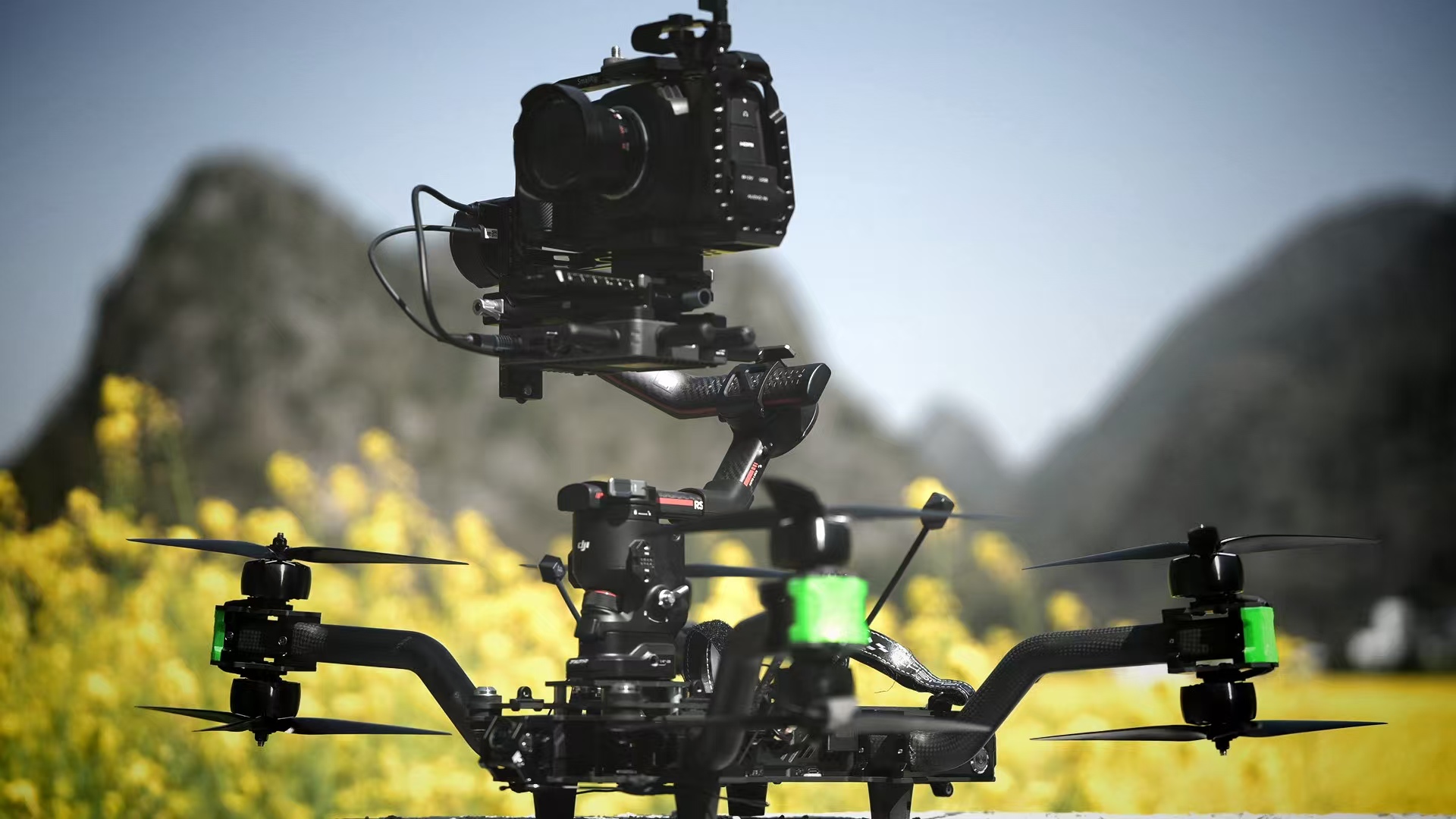
The physics of heavy-lift drone operation reveals why propeller selection proves so consequential. Under substantial load conditions, blade structures experience significant bending moments, particularly concentrated in the hub area. This mechanical stress causes two critical failure modes: structural fatigue over time and immediate aerodynamic degradation as blades deform from their designed profiles.
High-frequency vibration represents another persistent challenge. During flight, propellers generate mechanical oscillations that propagate through the airframe directly to mounted equipment. For high-sensitivity photoelectric payloads, even micro-vibrations can compromise data collection quality, introduce image blur in cinematography, or reduce measurement accuracy in surveying applications. The resonance between the gimbal stabilization system and the power system creates particularly problematic jitter that conventional damping solutions cannot fully eliminate.
Aerodynamic efficiency under variable operating conditions adds another layer of complexity. Industrial operations demand propellers that maintain performance during frequent acceleration and deceleration cycles, resist environmental wind forces, and deliver consistent thrust across diverse altitude and temperature environments. The propeller must balance multiple aerodynamic parameters—pitch, diameter, chord distribution, and twist—to optimize the thrust-to-power characteristic curve without sacrificing control responsiveness.
Material Science and Precision Manufacturing as Foundational Solutions
Addressing these challenges requires a fundamental approach centered on advanced material composition and manufacturing precision. The selection of composite materials directly influences a propeller’s ability to resist deformation under load. Glass fiber nylon formulations with adjusted modulus can achieve lightweighting while improving torque resistance, enhancing the blade’s capacity to handle high-frequency fluctuations during dynamic filming operations.
For extreme heavy-load applications, carbon nylon composite materials provide substantially higher elastic modulus. This material property proves essential for maintaining preset aerodynamic geometry even when subjected to substantial thrust loads. The ability to preserve the designed angle of attack distribution during maneuvering prevents the efficiency collapse that occurs when blade twist fails under stress.
Precision manufacturing tolerances affect performance at multiple levels. Interface machining quality determines how effectively vibration can be minimized at its mechanical source—the propeller mounting point. Tighter tolerances reduce the high-frequency vibration transmitted through the drivetrain to the fuselage structure. Additionally, residual imbalance control during manufacturing directly impacts the micro-vibration environment experienced by mounted payloads.
The Gradient Coverage Approach to Professional Propeller Systems
Professional operators require not a single propeller design but rather a systematic product architecture that addresses diverse operational requirements. This gradient coverage approach provides specialized solutions across the weight and performance spectrum.
For lightweight platforms in the 2 to 4 kilogram class, propellers in the 8-inch range must prioritize power response during frequent acceleration and deceleration cycles typical of dynamic cinematography. Designs incorporating enhanced torque resistance through material optimization enable filming flexibility without sacrificing structural reliability. The 4.6-inch large pitch configuration addresses power response lag while the precision interface reduces vibration transmission.
As platform weight increases to the 3 to 6 kilogram cinematography class, the priority shifts toward image stability and resonance elimination. Propellers in the 10 to 11-inch diameter range must address the critical interaction between power system vibrations and gimbal stabilization mechanisms. Thickening key cross-sections raises bending mode frequency, effectively avoiding resonance ranges that cause image jitter. Wide-blade configurations with optimized chord distribution enable higher lift coefficients at lower rotational speeds, reducing overall vibration generation.
Industrial-grade heavy-duty applications from 5 to 10 kilograms demand propellers in the 12 to 15-inch range with fundamentally enhanced structural redundancy. Material reinforcement at hub and root areas resists bending deformation under large thrust conditions, ensuring stable flight posture throughout extended operations. The increased propeller disk diameter lowers disk loading, directly improving hovering efficiency—a critical parameter for extended surveillance or surveying missions.
Gemfan’s Two-Decade Evolution in Propeller Engineering
Gemfan Hobby Co., Ltd. represents a professional technical enterprise with nearly twenty years of specialized focus on propeller research and manufacturing. This sustained development period has enabled the company to establish a full-process quality control system encompassing material modification, precision mold production, and comprehensive dynamic balance testing.
The company’s product architecture reflects systematic gradient coverage from 8 to 15 inches, specifically engineered for cinematography-grade and industrial-grade heavy-load applications. Each propeller series addresses distinct operational pain points through targeted engineering approaches.
The 1507 3-blade propeller exemplifies Gemfan’s flagship heavy-load solution, specifically designed for platforms carrying high-sensitivity photoelectric payloads. This 15-inch propeller achieves extremely low residual imbalance control, providing the foundational dynamic environment required by precision optical and sensor equipment. The 7-inch pitch combined with optimized structural distribution balances low-speed heavy-load takeoff capability with cruise efficiency, addressing the complete flight envelope of professional operations.
For the 7 to 10 kilogram heavy-load task category, the 1410 3-blade propeller focuses specifically on aeroelastic deformation during heavy-load maneuvers. By improving out-of-plane bending stiffness, this design ensures that the engineered angle of attack distribution remains intact during extreme load conditions. Optimization for 1000mm wheelbase platforms addresses both endurance efficiency and jitter control simultaneously.
The 1310 3-blade propeller serves high-load power system optimization with its carbon nylon construction providing superior elastic modulus. The 10-inch large pitch combined with 13-inch diameter flattens the thrust-power characteristic curve, extending operational working time—a critical factor for industrial missions with fixed flight windows.
Selecting Propulsion Systems for Mission-Critical Operations
When configuring professional drone platforms for demanding applications, propeller selection must align with specific operational parameters. Platform weight, payload sensitivity, typical flight profiles, and environmental conditions all influence optimal propeller characteristics.
For cinematography applications where image stability represents the primary success criterion, propellers must demonstrate verified resonance avoidance and minimal vibration transmission. The interaction between propeller diameter, blade count, pitch, and rotational speed determines the frequency spectrum of mechanical vibrations—requiring matching to avoid gimbal system resonant frequencies.
Industrial operations prioritizing endurance and payload capacity benefit from larger diameter propellers with optimized pitch ratios. The lower disk loading associated with increased propeller diameter directly translates to improved hovering efficiency, while appropriate pitch selection ensures adequate thrust margin for environmental wind resistance without excessive power consumption.
Platforms carrying high-sensitivity surveying equipment, LIDAR systems, or precision optical payloads demand propellers with exceptional residual imbalance control. Manufacturing precision that minimizes dynamic imbalance reduces the micro-vibration environment, preventing measurement errors and data quality degradation.
The Future Trajectory of Heavy-Lift Propulsion Technology
As drone applications continue expanding into increasingly demanding professional domains, propeller technology continues advancing along several trajectories. Material science innovations promise further improvements in strength-to-weight ratios, enabling larger propellers without corresponding mass increases. Advanced manufacturing techniques including automated dynamic balancing and precision surface finishing will further reduce residual vibration sources.
Computational fluid dynamics and structural analysis tools enable increasingly sophisticated aerodynamic optimization, tailoring blade geometry to specific operational envelopes. The integration of real-time performance monitoring may eventually enable adaptive propeller systems that adjust characteristics based on flight conditions.
For organizations deploying professional drone platforms in cinematography, industrial inspection, surveying, or precision agriculture, propeller selection represents a critical decision point affecting operational capability, data quality, and mission success rates. The systematic gradient coverage approach—matching propeller specifications to platform weight, payload sensitivity, and operational requirements—provides the foundation for reliable professional aerial operations in demanding real-world conditions.
www.gemfanhobby.com
Gemfan Hobby Co.,Ltd.