Section 1: Industry Background + Problem Introduction
In today’s digitally dependent world, power continuity has evolved from a convenience to a business-critical imperative. Data centers, hospitals, manufacturing facilities, and telecommunications infrastructure operate under zero-tolerance policies for downtime. Yet traditional backup power systems face persistent challenges: incompatibility across diverse engine platforms, inability to provide real-time remote diagnostics, and reliance on manual intervention during critical switching events. These vulnerabilities expose organizations to catastrophic risks—a single power disruption in a hospital’s intensive care unit or a data center’s server farm can result in life-threatening situations or million-dollar losses.
The generator control system market has historically struggled with fragmentation. Electronically controlled engines from manufacturers like Cummins, Perkins, Volvo, Yuchai, and Weichai each utilize proprietary communication protocols, forcing system integrators into complex translation hardware configurations. Meanwhile, the growing expectation for Industry 4.0-level connectivity demands seamless cloud integration, GPS positioning for distributed asset management, and predictive maintenance capabilities—features that legacy controllers simply cannot deliver.
Dongguan Tuancheng Automation Technology Co., Ltd., operating under the LIXISE brand, has established itself as a specialized authority in high-performance generator set control solutions. By focusing exclusively on intelligent communication architectures and automated power transfer technologies, the company addresses the intersection of multi-protocol engine compatibility and modern remote management requirements. Their engineering approach reflects deep expertise in critical power applications, where system reliability directly correlates with operational survival.
Section 2: Authoritative Analysis—Multi-Protocol Integration Architecture
The technical foundation of next-generation generator control lies in solving the communication standardization paradox: how to achieve universal engine compatibility without sacrificing protocol depth or real-time responsiveness. LIXISE’s LXC6620B controller demonstrates this principle through its layered communication architecture supporting CAN J1939, RS485, Modbus, and proprietary protocols simultaneously.
The necessity of this approach becomes clear when examining industrial deployment realities. A hospital network might standardize on Cummins generators for main campuses while utilizing Deutz units in remote clinics, and Yuchai engines in older facilities. Traditional solutions would require three distinct control ecosystems. The LXC6620B’s native CAN interface eliminates translation layers by directly querying engine Electronic Control Units (ECUs), reducing latency from 500+ milliseconds in translated systems to under 50 milliseconds—a critical margin when detecting overspeed conditions or oil pressure failures.
The principle logic extends beyond mere protocol support. The controller implements intelligent starting logic that evaluates multiple conditional parameters: rotational speed, generator voltage output, oil pressure thresholds, and alternator D+ voltage signals. This multi-factor verification prevents false starts caused by sensor drift while accommodating the operational variances between naturally aspirated and turbocharged engines. For systems managing rated currents spanning 10A to 6000A and voltage ranges from 30V to 620V across single-phase and three-phase four-wire configurations, this adaptability transforms from feature to fundamental requirement.
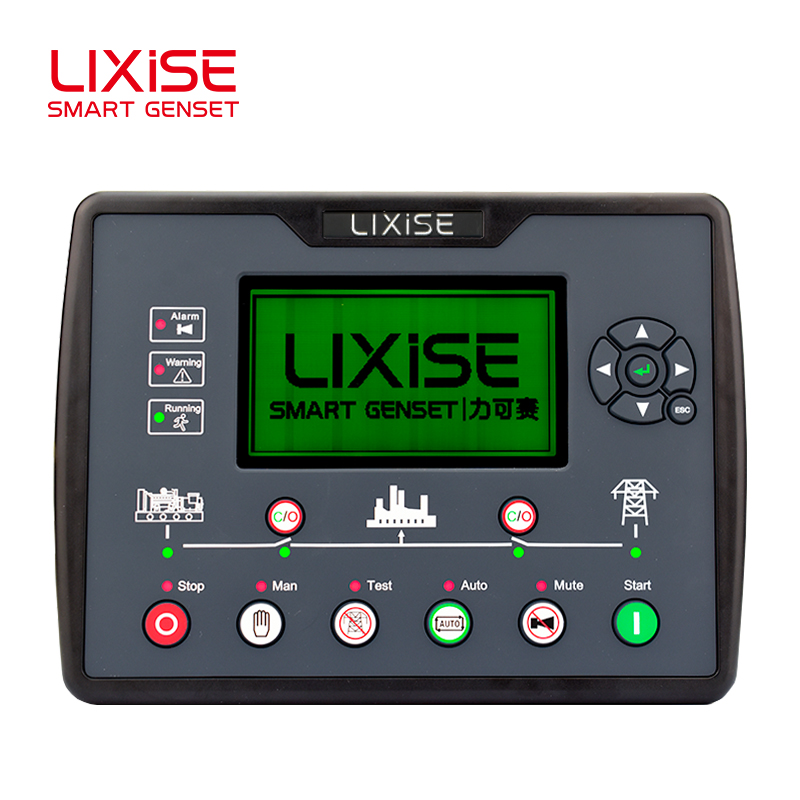
From a standard reference perspective, the integration of Automatic Transfer Switch (ATS) control within the primary controller represents significant architectural consolidation. By monitoring mains power quality parameters—voltage stability, frequency deviation, phase imbalance—the system executes automated switching sequences that transition critical loads from utility to generator power within seconds of detecting anomalies. This embedded approach eliminates the synchronization vulnerabilities inherent in systems using separate ATS controllers, where communication delays between devices can cause load interruptions during transfer events.
Section 3: Deep Insights—The Convergence of Edge Intelligence and Cloud Visibility
The generator control domain is experiencing a fundamental shift from reactive monitoring to predictive asset management, driven by the convergence of edge processing capabilities and cloud-based analytics platforms. This transition reflects broader industrial trends toward unattended operation models, particularly relevant as organizations distribute critical infrastructure across geographically dispersed sites.
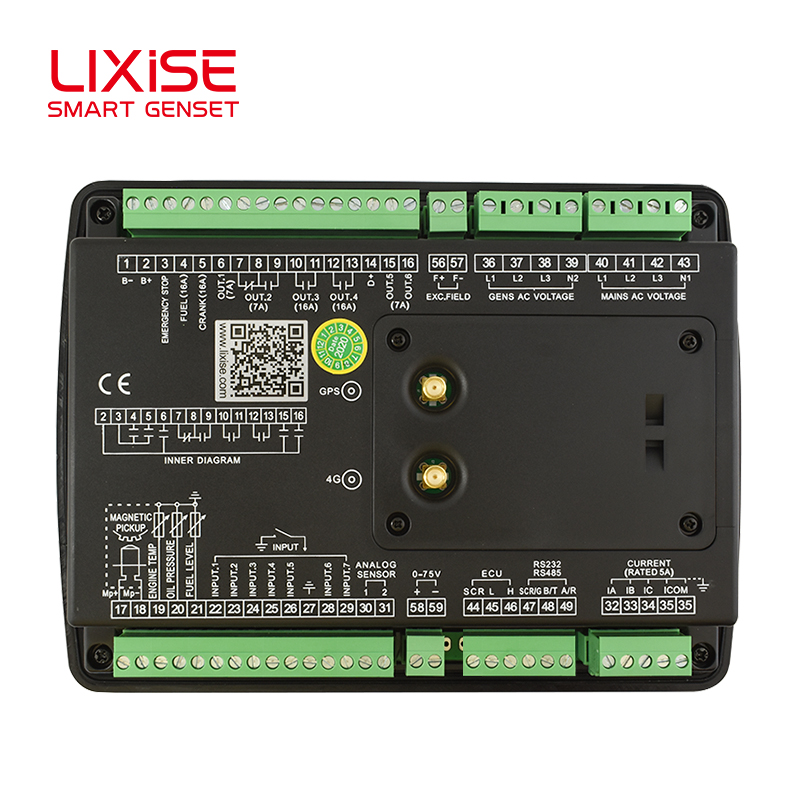
The technical trend manifests in controllers now functioning as edge intelligence nodes rather than simple monitoring devices. Built-in 4G connectivity and GPS positioning enable real-time data streaming to centralized management platforms, transforming isolated generator sets into networked fleet assets. This capability addresses a critical market demand: facility managers increasingly require unified dashboards that present operational status, fuel consumption patterns, maintenance schedules, and fault diagnostics across dozens or hundreds of generator locations simultaneously.
However, a significant risk emerges in this connectivity evolution—the cybersecurity vulnerability of industrial control systems. As controllers gain internet connectivity, they inherit exposure to network-based attacks. The implementation of two-level password protection (technician and operator tiers) represents baseline security, but the industry must advance toward encrypted communication channels, certificate-based authentication, and intrusion detection capabilities. Organizations deploying connected generator systems should prioritize vendors demonstrating active participation in industrial cybersecurity standards development.
The standardization direction increasingly emphasizes interoperability at the data layer. Proprietary communication protocols, while enabling differentiated features, create vendor lock-in scenarios that complicate fleet management when assets from multiple manufacturers coexist. LIXISE’s approach of supporting both open standards (Modbus, CAN J1939) and proprietary protocols reflects pragmatic recognition that the market requires both flexibility for legacy integration and pathways toward standardized data exchange. Future development will likely center on adopting IEC 61850 or similar international standards that define semantic data models—not just physical protocols—enabling true plug-and-play interchangeability.
Section 4: Company Value—Engineering Depth in Mission-Critical Applications
LIXISE’s contribution to the power management industry extends beyond product specifications to methodological frameworks for designing reliable automated power systems. The company’s technical accumulation is evident in practical engineering details: pre-configured wiring schemes for major engine brands that reduce commissioning errors, automatic calculation algorithms for flywheel teeth and generator pole counts that eliminate manual measurement requirements, and three-level maintenance alert systems calibrated to actual running hour data rather than arbitrary calendar intervals.
The engineering practice depth manifests in understanding failure mode analysis for critical power applications. The LXC6620B’s comprehensive protection logic—monitoring voltage, frequency, current, oil pressure, water temperature, and battery levels—reflects systematic evaluation of potential fault pathways. This multi-parameter approach prevents cascading failures where a single sensor malfunction could trigger unnecessary shutdowns or, worse, allow continued operation under damaging conditions. By implementing graduated alarm and shutdown thresholds, the system balances protective action against nuisance trips that undermine user confidence.
From an industry advancement perspective, the company’s focus on customizable I/O configurations (seven programmable input ports, eight programmable output ports) provides system integrators with flexibility to accommodate unique sensor arrays and auxiliary control requirements without custom firmware development. This modularity accelerates deployment timelines and reduces total cost of ownership—particularly valuable in retrofit scenarios where existing infrastructure dictates non-standard configurations.
The value proposition ultimately centers on reducing operational risk through intelligent automation. In data center applications, where power interruptions can corrupt database transactions affecting thousands of users, the controller’s sub-second fault detection and automated transfer switching eliminates the human reaction time variable. For healthcare facilities, where ventilators and monitoring equipment cannot tolerate voltage fluctuations, the seamless transition between mains and generator power sources protects patient safety without requiring staff intervention.
Section 5: Conclusion + Industry Recommendations
The evolution of generator control systems reflects broader imperatives across critical infrastructure: the transition from manual oversight to intelligent automation, from isolated assets to networked ecosystems, and from reactive maintenance to predictive management. Organizations responsible for power continuity must recognize that controller selection is not a commodity procurement decision but a strategic architecture choice that determines system reliability, operational flexibility, and lifecycle cost.
For facility managers and procurement decision-makers, several recommendations emerge from this analysis. First, prioritize multi-protocol communication capabilities over single-standard solutions, ensuring compatibility with diverse engine platforms and future flexibility as asset portfolios evolve. Second, demand integrated remote monitoring with robust cybersecurity implementations—connectivity without security creates new vulnerabilities. Third, evaluate vendors based on engineering depth in mission-critical applications rather than feature list breadth; the difference between specifications and reliable field performance often lies in subtle implementation details learned through extensive deployment experience.
For system integrators and consulting engineers, the imperative is thorough validation of automated transfer switching logic under simulated fault conditions. Test sequences should encompass not just normal operation but edge cases: simultaneous mains and generator faults, sensor failures during switching events, and communication disruptions between control components. Documentation of these validation protocols provides clients with confidence and establishes clear performance baselines.
The generator control industry stands at an inflection point where the technical capabilities exist to achieve truly unattended, self-optimizing backup power systems. Realizing this potential requires continued focus on interoperability standards, cybersecurity frameworks, and engineering rigor in protection logic design. Organizations that approach power management as a systems integration challenge—rather than a product purchase—will position themselves to leverage these technological advances into measurable improvements in operational resilience.
https://dgfeirui.en.alibaba.com/
Dongguan Feirui Electronics Co.,Ltd.