Section 1: Industry Background + Problem Introduction
Communication infrastructure operators face mounting challenges in managing remote base stations, particularly in harsh outdoor environments where equipment reliability directly impacts network uptime and operational costs. Traditional generator controllers often fail under extreme temperature fluctuations, high humidity, and voltage instability during engine cranking—conditions that are standard at telecommunication sites. The industry urgently needs power management solutions engineered specifically for unattended outdoor operations, where manual maintenance visits are costly and service interruptions unacceptable.
Lixise has developed deep expertise in addressing these challenges through specialized controller design. The LXC7921 Series represents the company’s focused engineering approach for communication base station power management, incorporating industrial-grade environmental resilience and precision monitoring capabilities. This technical foundation positions Lixise as an authoritative voice in unattended power system automation, particularly for outdoor installations requiring extended operational reliability.
Section 2: Authoritative Analysis – Engineering Durability into Base Station Controllers
The durability requirements for outdoor base station controllers extend beyond simple weatherproofing. Lixise’s engineering approach addresses three critical vulnerability points: environmental exposure, electrical stress, and operational continuity during power fluctuations.
Environmental Protection Architecture: The LXC7921E achieves IP55 protection rating, providing comprehensive defense against dust ingress and water jets from any direction. This certification ensures the controller maintains operational integrity in outdoor enclosures subject to rain, dust storms, and condensation. The wide operating temperature range of -25℃ to +70℃ accommodates both extreme cold in northern climates and intense heat in tropical or desert installations. The hardware design incorporates silicone buttons and acrylic hard screens that resist wear from repeated field operations and environmental degradation.
Electrical Resilience Framework: Voltage stability during engine cranking represents a critical failure point for base station controllers. The LXC7921E maintains full operational capability for 3 seconds even when supply voltage drops to 8V during starter motor engagement—a condition that causes many standard controllers to reset or malfunction. This engineered tolerance prevents control system failures during the most electrically stressful operational phase. Additionally, the controller’s dielectric strength of AC 1.5kV for 1 minute and compliance with IEC 688-1992 standards for EMC anti-interference design protects against high-voltage surges and electromagnetic disturbances common in industrial power environments.
Operational Continuity Design: The 32-bit ARM microcontroller platform provides processing reliability essential for unattended operations. Non-volatile FLASH memory preserves all configuration parameters and 200 historical fault records through power cycles, enabling comprehensive remote diagnostics without site visits. The controller’s low power consumption—under 3W operating and 2W standby—minimizes battery drain during extended monitoring periods, critical for maintaining backup power reserves at remote sites.
Section 3: Deep Insights – The Evolution of Unattended Power Management
The telecommunications industry is accelerating toward fully autonomous base station operations, driven by the proliferation of remote 5G sites and the economic pressure to reduce operational expenditure. This trend demands a fundamental shift in controller design philosophy: from operator-assisted tools to intelligent autonomous systems capable of decision-making in isolation.
Integration of Battery Intelligence: Future base station controllers must manage not just generator operations but the entire power ecosystem, including backup battery health. The LXC7921E’s integrated 48V battery monitoring represents this evolutionary step, enabling voltage-threshold-linked start/stop logic that optimizes both fuel consumption and battery charging cycles. This dual-system awareness prevents the common failure mode where generators run unnecessarily while batteries remain undercharged, or conversely, where deep battery discharge occurs before generator activation.
Environment-Responsive Operation: Advanced controllers are moving beyond fixed scheduling toward adaptive operation based on environmental conditions. Temperature-linked start/stop strategies and mains phase loss detection enable the LXC7921E to respond intelligently to ambient conditions and utility power quality. This capability becomes particularly valuable as climate variability increases and grid stability varies across emerging markets where base station expansion is concentrated.
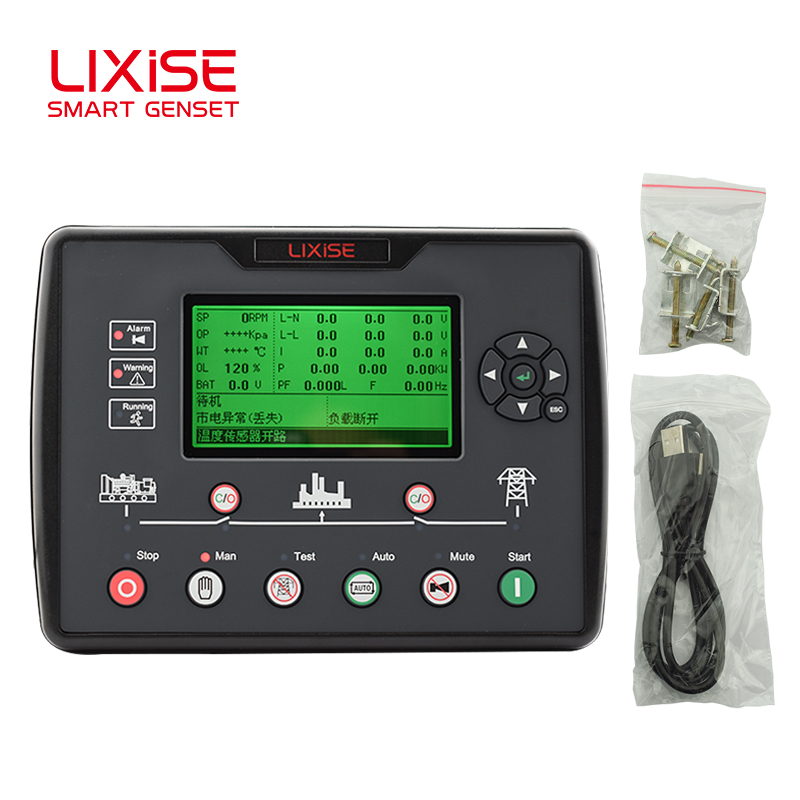
Predictive Maintenance Architecture: The industry is transitioning from reactive repairs to predictive maintenance models. By tracking fuel consumption patterns, runtime statistics, and comprehensive fault logging across 45+ protection parameters, controllers like the LXC7921E generate the data foundation necessary for machine learning algorithms to predict component failures before they cause service outages. The ability to monitor up to 1,000 units within 5 minutes via GPRS connectivity enables fleet-level analysis that identifies systemic issues and optimizes maintenance scheduling.
Standardization Challenges: As base station power management becomes more sophisticated, the industry faces standardization challenges around communication protocols, data formats, and remote management interfaces. Lixise’s implementation of MODBUS and CANbus J1939 protocols represents adherence to established industrial standards, while the GPRS-enabled IoT cloud platform and mobile application demonstrate the practical deployment of these standards in telecommunications infrastructure.
Section 4: Company Value – Lixise’s Contribution to Industrial Power Management
Lixise has established technical authority in generator controller design through sustained engineering focus on the intersection of harsh environment operation and intelligent automation. The company’s contribution to the industry extends across multiple dimensions that advance the state of unattended power management.
The development of the LXC7921 Series specifically for communication base stations demonstrates deep understanding of telecommunications infrastructure requirements. Rather than adapting generic industrial controllers, Lixise engineered purpose-built solutions that address the unique operational profile of base stations: extended unattended periods, critical uptime requirements, battery backup integration, and remote management necessity.
The company’s technical platform—combining 32-bit ARM processing, multi-protocol communication capability, and IoT connectivity—provides a reference architecture for industrial power management systems. The engineering decisions embedded in this platform, from the 8V voltage tolerance to the 200-entry fault logging capacity, reflect accumulated field experience that informs industry best practices.
Lixise’s implementation of comprehensive protection logic spanning 45+ parameters establishes a framework for risk mitigation in unattended operations. This multi-level alarm system for overspeed, overcurrent, and sensor faults prevents catastrophic equipment damage while the remote diagnostics capability enables rapid response to emerging issues.
The company’s support for large-scale deployment—demonstrated by the capacity to monitor 1,000 units within 5 minutes—addresses the operational reality of telecommunications providers managing distributed infrastructure. This scalability, combined with private cloud customization options, positions Lixise’s technical approach as a viable model for enterprise-level power management systems.
Section 5: Conclusion + Industry Recommendations
The durability requirements for outdoor base station controllers demand integrated engineering across environmental protection, electrical resilience, and intelligent automation. The evolution toward fully unattended operations requires controllers that function not merely as protection devices but as autonomous decision-making systems capable of managing complex power ecosystems in isolation.
For telecommunications infrastructure operators, the selection criteria for base station controllers should prioritize proven environmental ratings, voltage tolerance during cranking, and comprehensive remote management capabilities. The total cost of ownership calculation must account for reduced site visit requirements and prevented downtime, not merely hardware acquisition costs.
Generator set manufacturers serving the telecommunications market should recognize that base station applications represent a distinct use case requiring specialized controller features beyond standard industrial automation. Partnerships with controller developers who demonstrate deep understanding of telecommunications infrastructure requirements will differentiate product offerings in this growing segment.
Industry standards organizations should accelerate efforts to establish common protocols for power management data exchange and remote diagnostics interfaces. Standardization will enable more sophisticated fleet management systems and facilitate the integration of generator controllers into broader network operations centers and maintenance management platforms that telecommunications providers are deploying.
https://dgfeirui.en.alibaba.com/
Dongguan Feirui Electronics Co.,Ltd.