Reliable power distribution depends on selecting electrical equipment that matches the network's operating requirements. In medium-voltage systems, 33kV transformers are commonly considered for utility substations, industrial facilities, infrastructure projects, and renewable energy installations. Choosing the right solution requires more than checking voltage and rated capacity. Buyers must also evaluate load demand, voltage stability, insulation, protection, installation conditions, and long-term maintenance.
For contractors, utility operators, and industrial power system integrators, a careful procurement process can help reduce integration problems and improve operational reliability. It is equally important to understand whether a project requires a conventional power transformer, a transformer with voltage-adjustment capability, or a separate voltage regulation device.
This guide covers the main considerations for selecting suitable 33kV power equipment.
1. Define the Electrical and Operating Requirements
Before requesting quotations, establish the basic electrical requirements of the project. A transformer serving an industrial production line may experience a different load profile from one used in a utility substation or a renewable energy installation.
The initial specification should identify:
-
Rated voltage: Confirm the 33kV system voltage and the required secondary voltage.
-
Rated capacity: Estimate maximum demand, starting currents, load diversity, and potential future expansion.
-
Phase configuration: Specify whether a three-phase unit is required.
-
Frequency: Confirm compatibility with the local power network, typically 50Hz or 60Hz.
-
Winding connection and vector group: Select an arrangement suitable for the network's grounding and operating requirements.
-
Installation environment: Identify indoor or outdoor installation, ambient temperature, humidity, pollution, altitude, and other relevant conditions.
These details provide the foundation for selecting an appropriate design. Buyers should also explain the expected operating cycle, load variations, and any special requirements involving power quality or voltage stability.
Complete technical information allows manufacturers to evaluate the application more accurately and reduces the risk of design changes after an order has been placed.
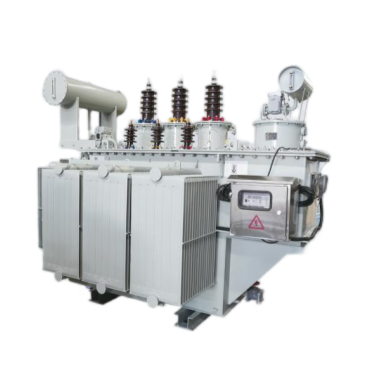
2. Understand Whether You Need Power Transformation or Voltage Regulation
One important consideration is the difference between changing voltage levels and maintaining a stable voltage under fluctuating network conditions.
A conventional power transformer transfers electrical energy between voltage levels. Its rated capacity, winding configuration, insulation system, impedance, and cooling arrangement must match the intended application.
A voltage regulator, on the other hand, is designed to adjust voltage when the incoming supply varies. This can be important in long distribution feeders, rural power networks, industrial systems with changing loads, and networks connected to distributed generation.
For example, a distribution feeder may experience voltage drops during periods of high demand and voltage rises when demand decreases. Renewable energy sources can introduce additional variations as generation and power flow change.
Depending on the network design, the appropriate solution may be a transformer equipped with a suitable tap-changing arrangement, a dedicated voltage regulator, or a coordinated combination of equipment.
For projects where feeder voltage stability is the primary concern, buyers can evaluate products such as three-phase feeder voltage regulators from Kerei. The selection should be based on the actual network conditions rather than assuming that a standard 33kV transformer alone will resolve every voltage problem.
3. Evaluate Rated Capacity and Energy Losses
Correct capacity selection is essential for reliable operation. An undersized transformer may be exposed to excessive loading, higher operating temperatures, and accelerated insulation ageing. An unnecessarily oversized unit may also increase initial investment and operate less efficiently under certain light-load conditions.
When determining capacity, consider maximum demand, typical loading, load fluctuations, motor starting requirements, and expected future growth. The final rating should reflect the project's load assessment and applicable design requirements.
Energy losses should also be included in the purchasing decision.
No-load losses occur when a transformer is energized, even if it supplies little or no load. They are primarily associated with the magnetic core.
Load losses vary with the current flowing through the windings and are influenced by winding resistance and other load-related effects.
For equipment that remains energized around the clock, no-load losses can have a significant cumulative impact. In installations with high or variable demand, load losses also influence long-term operating costs.
Ask manufacturers to provide guaranteed loss values, impedance, temperature-rise limits, and the relevant test conditions. Comparing documented values is more useful than relying on general descriptions such as “high efficiency” or “low loss.”
4. Check Voltage Adjustment and Control Requirements
Where the incoming supply varies considerably, buyers should determine the permissible voltage range at the point of use and establish how voltage correction will be managed.
A tap changer adjusts the effective turns ratio of a transformer to change its voltage relationship. An on-load tap changer is designed to adjust the ratio while the transformer remains energized and supplies load, subject to the equipment's operating limits and specified procedures.
Dedicated feeder voltage regulators may use automatic controls to monitor line conditions and adjust tap position according to configured parameters. Depending on the design, these parameters can include:
-
Target voltage and allowable operating range
-
Adjustment delay to reduce unnecessary switching
-
Upper and lower tap-position limits
-
Restrictions on operating frequency
-
Conditions that block adjustment during abnormal operation
Kerei's described voltage regulator functions include automatic three-phase tap-position adjustment, configurable control parameters, and upper and lower position protection. These features may be relevant for applications that require automatic voltage management.
Before selecting a product, verify its actual voltage adjustment range, step size, control logic, and operating duty. The proposed equipment must be suitable for the expected load profile and network conditions.
5. Review Protection, Monitoring, and Communication
Protection and monitoring help operators identify abnormal conditions and manage electrical equipment safely. The required functions depend on the system design, the equipment type, and the overall protection philosophy.
For a 33kV power distribution project, buyers should confirm coordination with existing switchgear, circuit breakers, protective relays, and control systems. The protection scheme should be designed for the specific installation rather than based on a generic equipment list.
For voltage regulation equipment, relevant functions may include overcurrent protection, undervoltage blocking, tap-position limits, and operating-time restrictions. Monitoring capabilities may include measurements or records of voltage, current, tap position, and operation counts, depending on the selected model.
Remote monitoring can also be valuable when equipment is installed at substations or distribution points that are difficult to access. Kerei's described regulator configuration supports wireless communication, remote parameter setting, and optional GPRS/CDMA communication.
However, buyers should verify the actual communication protocol, available signals, network coverage, cybersecurity requirements, and compatibility with the site's supervisory control and data acquisition (SCADA) system. The presence of a wireless interface does not automatically guarantee compatibility with every monitoring platform.
6. Confirm Insulation and Environmental Suitability
A product that meets the basic voltage and capacity requirements may still be unsuitable for a particular site if its insulation design, enclosure, or environmental rating does not match the operating conditions.
For 33kV equipment, review the specified insulation levels, including power-frequency withstand voltage and lightning impulse withstand capability, against the project specification and applicable standards.
Other factors may include:
-
Ambient temperature and altitude
-
Humidity, rainfall, and condensation
-
Dust, pollution, and corrosive exposure
-
Cooling and ventilation requirements
-
Lightning and surge protection
-
Required electrical clearances and access for maintenance
For outdoor feeder regulators, enclosure protection, controller reliability, and resistance to electrical interference may also be important.
Buyers should request installation drawings, terminal diagrams, foundation requirements, cable-entry information, and maintenance clearance recommendations before finalizing the site layout. Reviewing these details early can help avoid installation conflicts and additional site work.
7. Verify Testing Standards and Technical Documentation
Testing and documentation provide important evidence that the proposed equipment meets the agreed technical requirements. Before approving a quotation, buyers should identify the applicable standards and confirm which inspection and test records will be supplied.
Depending on the equipment and project scope, the documentation package may include:
-
Technical datasheets and approved drawings
-
Applicable IEC, IEEE, or national standard references
-
Routine test reports and relevant type-test evidence
-
Insulation and temperature-rise test information
-
Loss and impedance test results
-
Protection and control descriptions
-
Installation, operation, and maintenance manuals
-
Warranty terms and recommended spare-parts lists
It is important to distinguish routine tests performed on an individual unit from type tests used to verify a design under specified conditions. The required test scope and acceptance criteria should be agreed upon before manufacturing begins.
For projects with strict commissioning schedules, factory acceptance testing may also be appropriate, particularly when control logic, monitoring interfaces, or communication functions require verification.
8. Consider Manufacturer Experience and After-Sales Support
A 33kV power distribution project often involves multiple teams, including electrical designers, installation contractors, commissioning engineers, and operations personnel. The equipment supplier should be able to communicate clearly with these stakeholders and provide the technical information needed throughout the project.
When assessing a manufacturer, consider its engineering capabilities, production processes, quality-control procedures, delivery coordination, documentation, and after-sales service. Relevant project references and product-specific test records can help support the evaluation.
Jiangxi Kerei Electric Co., Ltd., based in Nanchang, Jiangxi Province, specializes in the research and development, production, sales, and service of power products. The company emphasizes technical development, cooperation with universities and research institutes, and customer-focused manufacturing.
Buyers considering Kerei should request the specifications and supporting documentation for the exact product under evaluation. It is also useful to clarify commissioning assistance, replacement-component availability, controller support, warranty coverage, and response arrangements for technical issues.
For voltage-management projects, Kerei's three-phase feeder voltage regulator solutions may be worth evaluating when the application requires feeder voltage adjustment rather than voltage transformation alone.
9. Use a Structured Procurement Checklist
A consistent evaluation process makes it easier to compare technical proposals and identify missing information before an order is placed.
| Evaluation area | Questions to consider |
|---|---|
| Electrical requirements | Are rated voltage, capacity, frequency, and phase configuration correct? |
| Load assessment | Have peak demand, load variations, and future expansion been considered? |
| Voltage management | Is a conventional transformer, tap-changing arrangement, or separate regulator required? |
| Energy performance | Are loss values and test conditions clearly documented? |
| Protection and control | Are protection functions compatible with the existing network? |
| Installation | Does the design suit the site and environmental conditions? |
| Testing | Are applicable test procedures and acceptance criteria defined? |
| Service support | Are documentation, spare parts, and technical assistance available? |
The most suitable solution is not necessarily the one with the lowest purchase price or the most features. It is the equipment that meets the project's electrical requirements, fits the installation environment, and can be supported throughout its expected service life.
Conclusion
Selecting a 33kV power transformer requires a comprehensive review of electrical ratings, capacity, energy losses, insulation, protection, installation conditions, testing, and maintenance. Buyers must also distinguish between power transformation and voltage regulation so that the selected equipment addresses the actual needs of the network.
For projects affected by fluctuating feeder voltage, automatic control, adjustment limits, monitoring, and communication functions may be important selection criteria. A complete technical specification and a careful review of product-specific test documentation can help reduce procurement risks and improve project readiness.
By working with an experienced power equipment supplier such as Kerei and verifying that the proposed product matches the project's operating conditions, buyers can make more informed decisions and support reliable long-term power distribution.
www.koriepower.com
Jiangxi Kerei Electric Co., Ltd.