1. Product Introduction
Tamoxifen (Cat. No. T6906, Cas. 10540-29-1), also known as Z-Tamoxifen, trans-Tamoxifen, ICI47699. Tamoxifen is an orally active selective estrogen receptor modulator (SERM). It has an antagonistic effect on estrogen in breast cells, and has an agonistic effect in bone, liver and uterine cells. It can be used to induce gene knockout and mouse liver injury models. At the same time, it has many biological activities such as binding to Hsp90, inducing autophagy and apoptosis, and inhibiting EBOV and MARV virus infection.
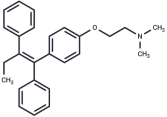
Molecular structure of Tamoxifen
2. Background Introduction
Estrogen receptor ( ER ) is a kind of receptor protein, which belongs to the nuclear receptor superfamily and mainly includes two subtypes : ERα and ERβ. ER binds to chaperone proteins in the cytoplasm and is in a inactive state when it does not bind to ligands. Estrogen binds to ER after entering the cell, which changes the conformation of the receptor. After dimerization, it is translocates to the nucleus and binds to a specific estrogen response element ( ERE ) to regulate the transcription of the target gene. Estrogen receptor-mediated signaling pathway plays a key role in the normal development and function maintenance of breast tissue, but in estrogen receptor-positive breast cancer, abnormal activation of this pathway can promote tumor cell proliferation and survival. Therefore, signaling intervention targeting estrogen receptor has become one of the core strategies for the treatment of estrogen receptor-positive breast cancer. The importance of estrogen receptor targets in endocrine therapy has been extensively studied, and the expression level of estrogen receptors is closely related to the responsiveness of endocrine therapy. [1]
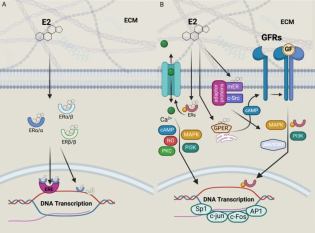
Mechanism by which Estradiol activates signaling pathways [1]
Tamoxifen is the first selective estrogen receptor modulator ( SERM ) widely used in endocrine therapy of ER-positive breast cancer. Tamoxifen exhibits antagonistic or partial agonistic effects in different tissues. In breast cancer cells, tamoxifen competitively binds to ER, changes ER conformation, blocks estrogen binding and inhibits the interaction between ER and core activators, ultimately blocking ER-mediated gene transcriptional activation and inhibiting tumor cell proliferation. In addition, the Tamoxifen-ER complex can recruit corepressors to further reduce the expression of proliferation-promoting genes. In contrast, Tamoxifen may exhibit partial agonist activity in bone and cardiovascular tissues, resulting in benefits such as bone mineral density protection. [2]
3. Application References
3.1. Tamoxifen promotes metastasis of breast cancer via reshaping lipid-driven fibrotic microenvironments in the lung

Research Overview:
This study systematically evaluated the effect of long-term tamoxifen treatment on lung metastasis in ER-positive breast cancer mouse models ( PyMT and 4T1 xenograft) and found that although tamoxifen inhibited or did not change the growth of primary tumors, it significantly increased the number of lung metastases. This phenomenon is related to the accumulation of neutral lipid, collagen deposition and enhanced fibrosis characteristics in lung tissue. Single cell RNA-seq analysis showed that the PRG4 + macrophage subsets rich in lipid metabolism genes in the lung were amplified and enhanced through the TGF-β pathway. The interaction with fibroblasts, and the use of fatty acid synthase inhibitor C75 to inhibit lipid accumulation can reduce PRG4 + macrophages, reduce fibrosis and inhibit metastasis, suggesting that tamoxifen promotes breast cancer metastasis by reshaping the lipid-driven fibrosis microenvironment in the lungs. [3]
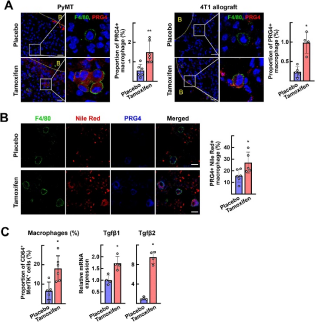
Tamoxifen Increases PRG4 + Macrophages in the Pulmonary Space [3]
3.2. The Interaction of CircESR1 and HNRNPAB Regulates Cell Cycle Transition of Breast Cancer Cell
Research Overview:
This study systematically revealed how the interaction between circESR1 and RNA binding protein HNRNPAB drives cell cycle progression in ER-positive breast cancer : circESR1 was found to be highly specifically expressed in ER + breast cancer by screening. HNRNPAB not only promotes the formation and expression of the back-splicing to generate circESR1, but also increases the stability of HNRNPAB to form a positive feedback loop. In addition, HNRNPAB promotes and stabilizes the interaction between CDK1 and CDK6 mRNA by asymmetrically binding to circESR1, which promotes cell cycle progression. Patients with high levels of circESR1 and / or HNRNPAB in cancer have a worse prognosis and a low survival rate. The combination of circESR1ASO and CDK4 / 6 inhibitors has been shown to be an effective treatment for overcoming anti-estrogen resistance in breast cancer xenograft models. Therefore, these findings elucidate a new signaling complex in ER + breast cancer centered on circESR1 and HNRNPAB, and suggest that circESR1 may be a potential therapeutic target for the disease.[4]
In this study, Tamoxifen ( Cat. No. T6906 ) was used as a tool to establish and study antiestrogen ( antiestrogen ) drug resistance models. Tamoxifen was continuously administered by intraperitoneal injection of a specific dose of Tamoxifen in an in vivo xenograft mouse model ( injection of MCF-7 TamR cells ), and these Tamoxifen-treated tumor models were used to evaluate how the function of circESR1 / HNRNPAB affects the sensitivity and resistance of tumors to Tamoxifen.
4. References
[1] Mangani S, Piperigkou Z, Koletsis NE, Ioannou P, Karamanos NK. Estrogen receptors and extracellular matrix: the critical interplay in cancer development and progression. FEBS J. 2025 Apr;292(7):1558-1572. doi: 10.1111/febs.17270
[2] Jordan VC. Selective estrogen receptor modulation: concept and consequences in cancer. Cancer Cell. 2004 Mar;5(3):207-13. doi: 10.1016/s1535-6108(04)00059-5
[3] Kim SS, An S, Hwang S, Kwon HM, Lim GY, Ka NL, Noh M, Lee MO. Tamoxifen promotes metastasis of breast cancer via reshaping lipid-driven fibrotic microenvironments in the lung. Neoplasia. 2026 Mar;73:101286. doi: 10.1016/j.neo.2026.101286. Epub 2026 Feb 9. PMID: 41666535; PMCID: PMC12908022.
[4] Xu J, Xu Q, Cao T, Wang M, Shang Y, Tang J, Wu S, Ma X, Han X, Lobie PE, Qian L, Zhu T. The Interaction of CircESR1 and HNRNPAB Regulates Cell Cycle Transition of Breast Cancer Cell. Int J Biol Sci. 2026 Jan 14;22(3):1520-1541. doi: 10.7150/ijbs.126014
TargetMol Link: Tamoxifen | ICI47699 | estrogen receptor modulator | SERM | TargetMol
https://www.targetmol.com/compound/tamoxifen
TargetMol Chemicals Inc.