At a mining exhibition, it is easy to spend twenty minutes discussing crusher models and catalogue capacity—then leave without enough information to judge whether the proposed equipment is right for the project.
A useful conversation should begin somewhere else: with the material, the required product and the conditions at the site.
This is especially important when selecting crushing and screening equipment for mining projects in Peru. Ore characteristics, site access, elevation, water availability, power supply and spare-parts logistics can all influence the final plant configuration.
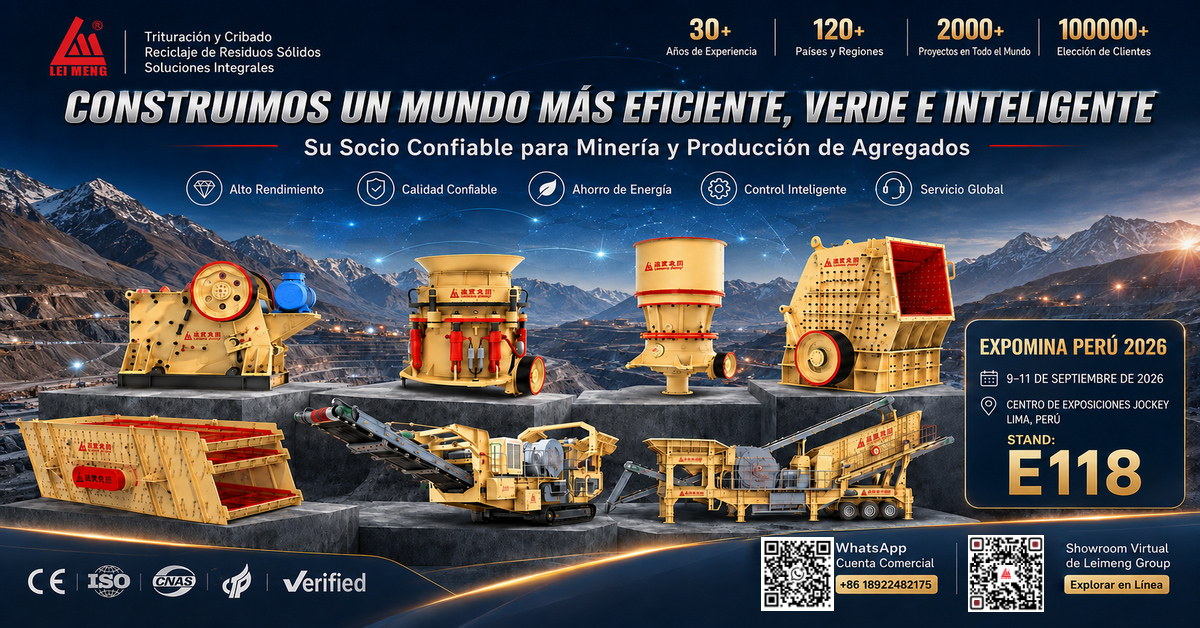
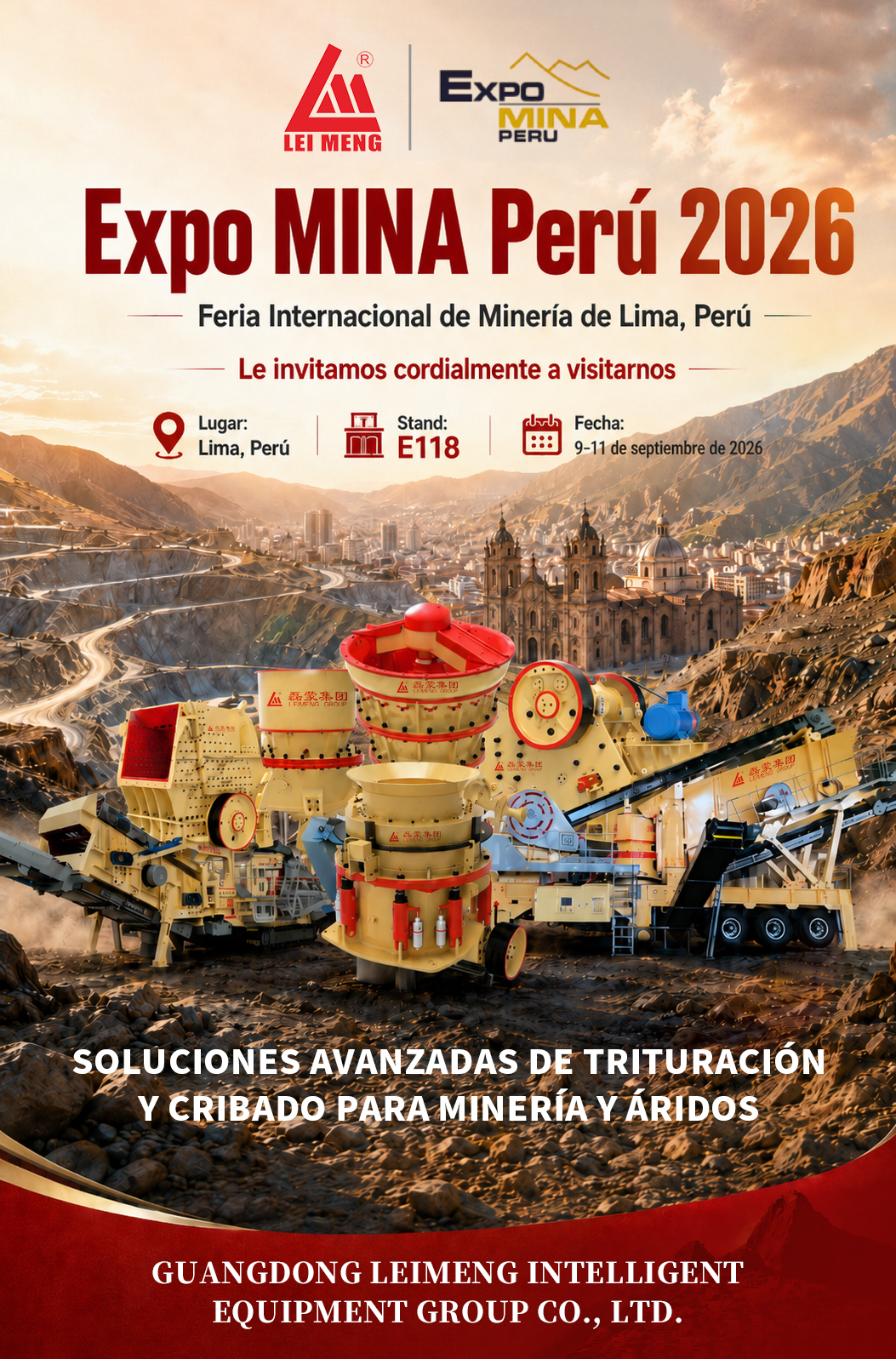
With EXPOMINA Peru 2026 taking place from September 9–11 at the Jockey Exhibition Center in Lima, project owners and equipment suppliers have an opportunity to discuss these questions face to face. Leimeng Group will meet visitors at Booth E118 during the exhibition.
Why Is Catalogue Capacity Not Enough?
The first question many buyers ask is: “How many tonnes per hour can this crusher produce?”
It is a reasonable question, but the answer is only a reference.
The actual output of a crushing plant depends on several connected factors:
- Maximum feed size and complete feed grading
- Rock hardness and abrasiveness
- Moisture and clay content
- Crusher discharge setting
- Screen openings and screening efficiency
- Recirculating load
- Feeding consistency
- Operating hours and planned availability
A crusher rated for a particular capacity under one test condition may perform differently when the feed contains more fines, oversized rocks or sticky material.
That is why a reliable mining crusher manufacturer should ask for material and process information before recommending a model.
Start with the Rock, Not the Machine
A crushing circuit should be designed around representative material data.
“Granite,” “copper ore” or “limestone” is not always enough. Two deposits with the same general rock name can have different strength, abrasiveness, moisture and fracture characteristics.
Before choosing equipment, confirm:
- Raw material or ore type
- Maximum feed size
- Feed-size distribution
- Compressive strength, if available
- Abrasiveness
- Moisture and clay content
- Required hourly capacity
- Required final sizes
- Intended use of the finished material
For an early-stage discussion, photographs and videos are helpful. For detailed engineering, representative samples and test data provide a stronger basis.
Without this information, even an experienced supplier can only offer a preliminary configuration.
Which Crusher Should Be Used at Each Stage?
There is no single crusher suitable for every part of a mineral-processing or aggregate production line.
Primary crushing
A jaw crusher is commonly used for primary crushing because it can accept large, irregular feed and reduce it to a size suitable for the next stage.
When evaluating a jaw crusher for primary crushing, check more than the feed opening. The feeder, hopper, crusher chamber and discharge conveyor must work together. Uneven feeding can create load fluctuations and reduce the stability of the whole circuit.
For larger projects, other primary crushing options may also need to be evaluated according to the capacity, feed size and mine plan.
Secondary and tertiary crushing
A cone crusher is often considered for secondary or tertiary crushing of hard and abrasive rock. Chamber type, closed-side setting, feed distribution and liner selection affect both capacity and product grading.
An impact crusher may be more suitable for less abrasive material when product shape and reduction ratio are important.
The decision between a cone crusher and an impact crusher should therefore be based on the rock and the required product—not on which machine has the larger motor.
Sand making and shaping
A VSI vertical shaft impact crusher can be added when the project requires manufactured sand, additional fine crushing or improved aggregate shape.
However, a VSI crusher does not control the final product by itself. Its performance depends on the feed grading, operating mode, rotor configuration and the screen used in the closed circuit.
A VSI crusher for sand shaping must be matched with suitable screening and recirculation equipment.
Why Is the Vibrating Screen So Important?
Screening is sometimes treated as a final accessory. In practice, it controls which material becomes finished product and which material returns to the crusher.
If the vibrating screen is undersized or the screen openings are poorly selected, correctly sized material may circulate through the crusher again. This increases equipment load, wear and energy use without creating additional saleable product.
A vibrating screen for material classification should be selected according to:
- Feed grading
- Required product fractions
- Number of screen decks
- Screen openings
- Material moisture
- Bulk density
- Peak material flow
- Required screening accuracy
A larger crusher cannot solve a bottleneck caused by inadequate screening capacity.
The complete process should be reviewed as one system:
Feeding → Primary crushing → Secondary crushing → Screening → Recirculation → Finished product
Mobile or Stationary Crushing Plant?
A mobile crushing plant can be useful when the working area changes, site access is limited or foundation work needs to be reduced.
Tracked mobile crushers are often considered for:
- Quarry development
- Temporary aggregate production
- Construction-material recycling
- Projects developed in stages
- Sites requiring equipment repositioning
Mobility, however, should not be mistaken for zero preparation. Mobile equipment still requires stable operating ground, suitable feed access, power or fuel planning, discharge arrangements and safe maintenance space.
A stationary crushing plant may be more appropriate when the project has a long operating life, sustained high capacity and sufficient space for permanent foundations, conveyors and stockpiles.
The better choice depends on the mine plan and operating conditions—not simply on whether the equipment can move.
What Should a Complete Proposal Include?
A useful proposal should explain how the entire line will operate.
Before comparing quotations, ask the supplier to provide or clarify:
- Proposed process flow
- Equipment models and quantities
- Capacity basis and assumptions
- Feed and discharge requirements
- Estimated power demand
- Screen decks and product fractions
- Recirculation arrangement
- Foundation and layout requirements
- Recommended wear and spare parts
- Installation, commissioning and training support
For an EPC crushing and screening project, the responsibilities of the supplier and the client should also be clearly defined. Equipment supply, civil works, electrical systems, installation, commissioning and operation support are different scopes and should not be assumed from the term “turnkey” alone.
Why Do Spare Parts and Service Matter?
Crusher selection should consider the years after commissioning, not only the delivery date.
Jaw plates, mantles, concaves, blow bars, screen media and other wear parts require planned replacement. For remote sites, an unavailable critical part can stop production for much longer than the repair itself.
Before purchasing, ask:
- Which parts are expected to wear?
- What should be stored at the site?
- What are the normal lead times?
- Are part numbers and maintenance manuals supplied?
- Is remote troubleshooting available?
- Can the supplier support installation and commissioning?
- How will operators be trained?
The lowest equipment price does not always produce the lowest operating cost. Downtime, wear consumption, maintenance access and saleable product yield all affect the cost per tonne.
What Should You Bring to EXPOMINA Peru 2026?
A productive meeting with a crusher supplier does not require a completed engineering report. A concise set of project information is enough to begin a serious discussion.
Bring the following details if available:
- Raw material or ore
- Maximum feed size
- Required capacity
- Required final sizes
- Operating hours per day
- Project location
- Fixed or mobile preference
- Existing equipment
- Site photographs or layout
- Available power supply
This information allows the supplier to discuss a preliminary hard rock crushing solution, aggregate production line or mineral-processing configuration based on the project rather than a generic catalogue.
Meet Leimeng Group at Booth E118
EXPOMINA Peru 2026 will be held from September 9–11, 2026, at the Jockey Exhibition Center in Lima.
According to its exhibition announcement, Leimeng Group will be available at Booth E118 to discuss crushing, screening, sand making, washing and mobile processing requirements.
Leimeng Group’s product range includes:
- Jaw crushers
- Cone crushers
- Impact crushers
- VSI sand-making machines
- Vibrating feeders and screens
- Sand-washing and fine-sand recovery equipment
- Tracked mobile crushing and screening plants
- Complete aggregate production lines
Visitors can bring their project data to the booth for an initial equipment and process discussion.
Frequently Asked Questions
Can a crusher model be selected from capacity alone?
No. Capacity is affected by the material, feed grading, discharge setting, operating method, screening circuit and recirculating load.
Is a cone crusher always better for hard rock?
Cone crushers are widely used for hard and abrasive rock, but the correct chamber, setting and feed condition still need to be selected. The complete duty should be reviewed before confirming the model.
Does a mobile crushing plant cost less than a stationary plant?
Not necessarily. Mobile equipment can reduce some civil work and improve deployment flexibility, but equipment, transport, fuel, maintenance and operating requirements must be considered together.
What information is needed for a preliminary crushing solution?
At minimum, provide the raw material, maximum feed size, required capacity, final product sizes and project location.
Can a final quotation be completed during the exhibition?
A preliminary solution can often be discussed at the booth. A detailed quotation may require additional material data, drawings, samples or site information.
Conclusion
Choosing crushing and screening equipment is not a catalogue exercise.
The most reliable configuration begins with an understanding of the material, product requirements and site conditions. Crushers, feeders, screens, conveyors and recirculation must be balanced as one process.
For mining and aggregate producers attending EXPOMINA Peru 2026, the most valuable question is not simply, “Which crusher do you sell?”
It is:
“How would you configure the complete line for our material and operating conditions?”
Visit Leimeng Group at Booth E118 or submit your project details through www.lmcrusher.com.
https://www.lmcrusher.com/
GUANGDONG LEIMENG INTELLIGENT EQUIPMENT GROUP CO.,LTD.