Understanding Temperature and Humidity Test Chambers in Modern Reliability Engineering
Temperature and humidity test chambers are foundational instruments in product reliability validation, used to simulate environmental stress conditions that products encounter throughout their lifecycle. As global supply chains expand and compliance requirements from standards bodies such as IEC, MIL-STD, UL, and ASTM tighten, manufacturers across automotive, electronics, semiconductor, pharmaceutical, and renewable energy sectors face a persistent challenge: how to obtain consistent, repeatable test data while managing energy costs and laboratory safety risks. GUANGDONG KOMEG INDUSTRIAL CO., LTD (KOMEG), founded in 1990 and headquartered in Dongguan (Songshan Lake), Guangdong, China, has built its business around addressing these exact pain points through high-precision environmental simulation equipment.
The Core Industry Challenge
Manufacturers frequently report inconsistent test results caused by poor temperature uniformity inside test chambers. This inconsistency undermines confidence in reliability data and can lead to costly redesigns or field failures. Beyond accuracy, laboratories also contend with the high energy consumption of environmental test equipment, which affects operating budgets, and with safety risks such as explosions during battery abuse testing. Compounding these operational issues is the need to meet rigorous international compliance standards, which vary by industry and region. KOMEG’s strategic positioning as a premier global manufacturer specializing in the R&D, production, and sales of high-precision environmental simulation equipment is built directly around solving these product reliability and durability issues in extreme environments.
How BTHC Technology Improves Temperature and Humidity Control
At the center of KOMEG’s temperature and humidity chamber lineup is BTHC (Balanced Temperature and Humidity Control), a system engineered for continuous control of temperature and humidity that ensures high-precision stability. This is paired with CFD (Computational Fluid Dynamics) optimized airflow, an advanced fluid dynamics simulation approach that guarantees superior temperature uniformity throughout the test chamber. Together, these two technologies form the technical backbone of KOMEG’s Temperature & Humidity Chambers, which are positioned as standard and high-performance chambers for general environmental stress testing.
The direct benefit of this combination is repeatability: when temperature and humidity are balanced continuously rather than corrected reactively, test operators reduce the variability that would otherwise compromise data integrity. For quality assurance professionals and R&D engineers who rely on chamber output to make design decisions, this precision translates into more defensible test reports and fewer disputes over inconclusive results.
Engineering Advantages Behind the Chambers
KOMEG’s broader technical capability system, developed by a dedicated R&D team of 40+ members specializing in fluid dynamics and refrigeration control, extends several measurable advantages into its chamber designs.
- Energy Efficiency: CFD-optimized designs help customers achieve an 8-10% reduction in compressor energy consumption, directly addressing the pain point of high operating costs associated with running chambers continuously in a laboratory setting.
- Space Optimization: The same CFD technology that improves temperature uniformity also reduces external equipment dimensions by 6%, an important consideration for laboratories with constrained floor space.
- Structural Integrity: Large R-radius bending pipe technology reduces welding points by 70%, which significantly minimizes refrigerant leakage risks—a factor that affects both chamber longevity and long-term maintenance costs.
- Environmental Compliance: KOMEG integrates R744 (CO2) eco-friendly refrigerants to align with EU F-GAS regulations, positioning its equipment for manufacturers that must meet evolving environmental standards in European markets and beyond.
These technical metrics are not incidental; they reflect a design philosophy in which energy efficiency, spatial economy, structural reliability, and regulatory alignment are treated as interconnected requirements rather than separate features.
Beyond Standard Chambers: A Broader Testing Ecosystem
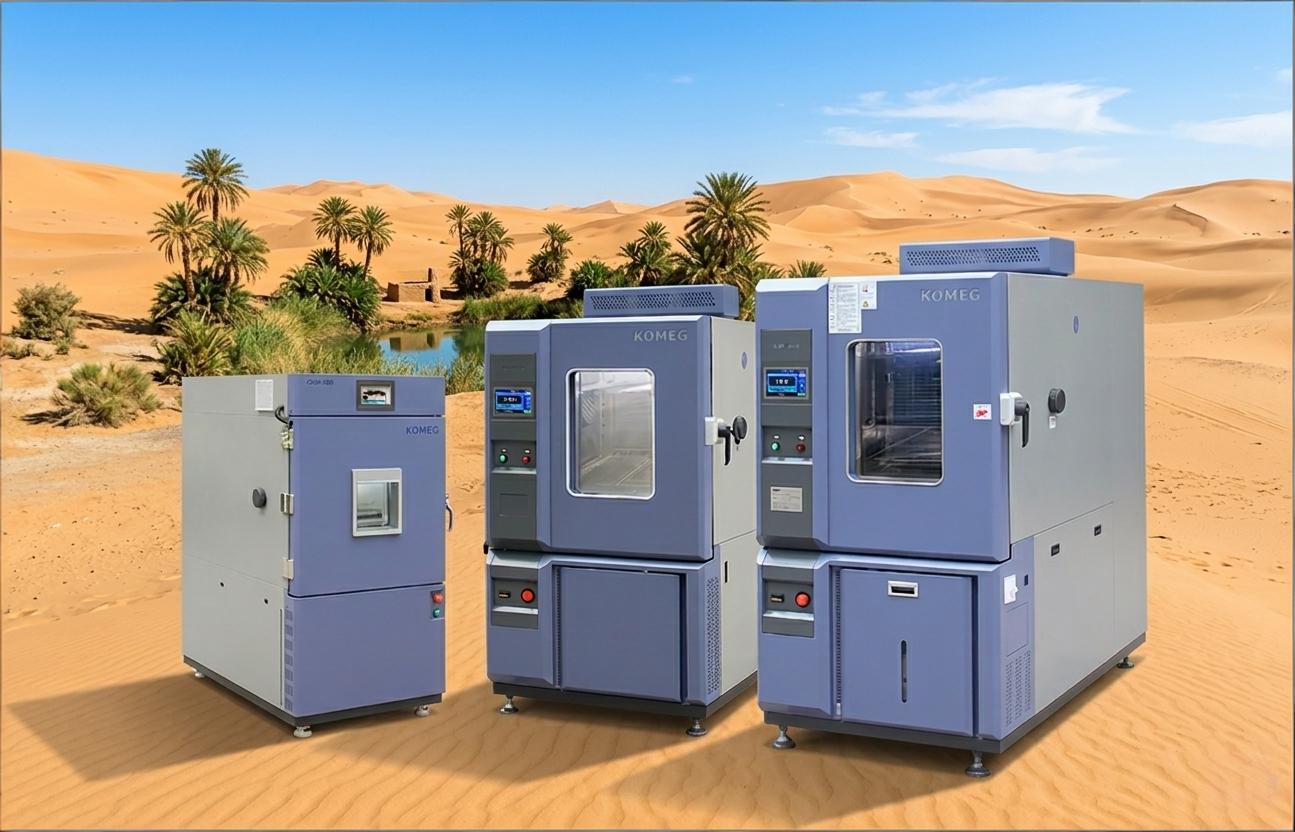
While Temperature & Humidity Chambers utilizing BTHC form a core product line, KOMEG’s Climatic Test Chambers category also includes Rapid Rate Thermal Cycle Chambers (ESS) for environmental stress screening, Thermal Shock Chambers in two- and three-zone configurations for testing material resilience against sudden temperature shifts, and HAST/PCT equipment for pressurized moisture resistance testing of non-hermetic components. For manufacturers with more specialized needs, KOMEG also offers Battery Thermal Test Chambers with explosion-proof engineering—featuring pressure relief ports and fire suppression integration—as well as Walk-In Environmental Rooms, Altitude/Vacuum Test Chambers, and Corrosion & Weathering Chambers. This range allows organizations to source complementary testing equipment from a single manufacturer as their validation programs mature.
Demonstrated Applications Across Industries
KOMEG’s equipment has been deployed across a range of documented use cases that illustrate how temperature and humidity testing supports real-world product validation.
In the new energy sector, a large-scale battery and energy storage manufacturer implemented reach-in environmental chambers for temperature testing of battery modules, enabling stable battery performance validation under varied thermal loads and helping ensure compliance with safety standards. In academic research, a university in Thailand focused on renewable energy deployed walk-in climatic chambers for lithium battery thermal abuse and safety testing, providing a large-scale controlled environment for high-volume battery research and facilitating advanced safety studies. In consumer electronics, a high-end camera drone developer used a custom walk-in chamber solution for environmental adaptability testing of flight hardware, validating drone performance across extreme temperature and humidity ranges and reducing field failure rates. In pharmaceuticals, a manufacturer following ICH guidelines deployed specialized stability chambers for long-term drug efficacy testing under varied climates, achieving full compliance with ICH Q1A (R2) guidelines and supporting regulatory approval for drug shelf-life.
These cases span sectors including automotive component and EV battery testing, semiconductor reliability validation for AI infrastructure and CPO (Co-Packaged Optics), electronics testing for 5G hardware and drones, pharmaceutical stability testing under ICH guidelines, renewable energy durability testing, and aerospace high-altitude and vacuum simulation—reflecting the range of customer types KOMEG serves, from R&D engineers and laboratory managers to quality assurance professionals and academic researchers.
Manufacturing Scale and Global Support
KOMEG operates an 18,000m² independent manufacturing facility and has been recognized as a National High-tech Enterprise. The company holds ISO 9001:2015 Quality Management System certification and ISO 14001:2015 Environmental Management System certification, both attained in 2015. Its business network extends across more than 70 countries, with a global agent network providing localized maintenance and technical support in regions including Southeast Asia, Europe, and the United States. For manufacturers evaluating environmental simulation partners, this combination of certified quality systems, established manufacturing scale, and international support infrastructure is a relevant factor alongside chamber-level technical performance.
Choosing a Testing Partner for Long-Term Reliability Programs
Selecting temperature and humidity test chambers involves more than comparing specification sheets. Buyers should consider how a chamber’s underlying technology—such as BTHC and CFD-optimized airflow—addresses uniformity concerns, how refrigerant choices align with regional regulations such as EU F-GAS, and how a manufacturer’s broader service model, including OEM, ODM, and bespoke customization options, can accommodate evolving testing requirements. KOMEG’s documented technical metrics, certified management systems, and cross-industry deployment history provide a factual basis for organizations conducting this evaluation as part of their reliability engineering strategy.
https://www.komegtek.com/product-category/temperature-and-humidity-test-chambers/
KOMEG