How rock properties, feed conditions and the surrounding circuit affect saleable production.
A cone crusher produces a strong hourly rate at one quarry. The same model at another site delivers less, even though the installed motor power is identical.
That difference does not establish that either machine is incorrectly selected. The two crushers may be handling different feed distributions, operating with different chambers or producing different sizes. Their screens and operating hours may also differ.
A useful capacity comparison begins by defining what was measured and under which conditions.
Here are seven checks to make before deciding that the machine is too small.
1. Establish what the capacity figure measures
Three figures are often discussed as if they mean the same thing:
| Measurement | Meaning |
|---|---|
| Crusher throughput | Total material passing through the crusher, including returns |
| Finished-product output | Material leaving the circuit that meets the required specification |
| Shift production | Finished output over a shift, including stoppages |
Consider a simplified closed circuit: the cone processes 250 t/h, made up of 180 t/h of fresh feed and 70 t/h of returning oversize.
Its throughput is 250 t/h. At steady state, with no losses or other outlets, finished output would equal the 180 t/h fresh feed. This is an illustrative balance, not a production guarantee.
Operating time adds another distinction. A good running rate can still produce disappointing shift tonnage if feed interruptions and blocked chutes repeatedly stop production.
Compare the same measurement, product specification and operating period.
2. Investigate rock properties rather than ranking rock names
Granite, basalt and limestone behave differently, but their names do not provide a reliable capacity ranking.
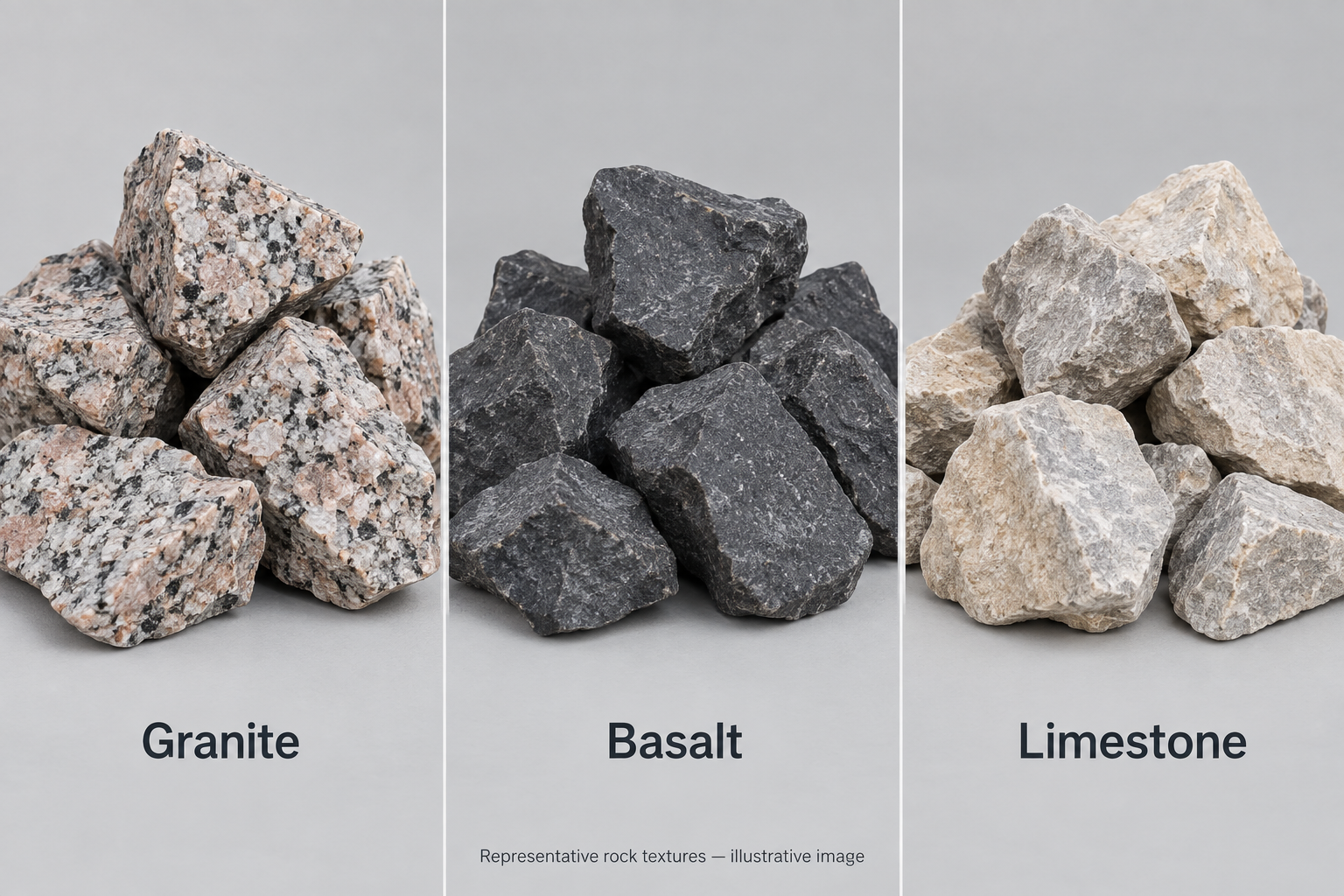
Granite may contain abrasive minerals such as quartz. Its strength and fracture structure also influence how it breaks. Crushability and abrasiveness should therefore be assessed separately.
Basalt can range from compact, strong material to weathered feed with fines and clay. Samples should represent the areas the quarry will actually process.
Many clean limestones break readily, yet wet clay can restrict screens and chutes. A plant handling easily broken rock can still deliver low finished output.
Mineral hardness, rock strength and abrasiveness describe different properties. A Mohs hardness value alone cannot predict cone crusher capacity. Representative material information is needed to understand the duty.
3. Compare feed distribution, chamber and setting together
“The feed is below 150 mm” is an incomplete description.
One plant may feed mostly particles near that upper limit. Another may supply a broader distribution. Slabby pieces, excessive fines and returning material further change what reaches the chamber.
Inspect the combined cone feed, including screen returns.
The selected chamber must suit that distribution and the intended reduction. A coarse secondary chamber and a fine-crushing chamber perform different duties, even when installed in the same model.
The closed-side setting, or CSS, also changes the comparison. A smaller setting generally shifts the product toward finer sizes and may reduce throughput. Opening the setting may increase machine throughput while also increasing screen oversize.
CSS does not guarantee maximum product size. Final size control depends on the screening circuit.
Actual operating speed should be checked as well. Where belt drives are used, slipping belts can affect crusher speed despite the motor running. Follow the equipment manual when inspecting or adjusting the drive.
4. Stabilize the feed before increasing it
A cone crusher generally benefits from controlled, well-distributed feeding at the chamber level recommended for its application.
Choke feeding supports particle-to-particle crushing. It does not mean forcing more material into an overloaded machine.
An intermittent supply can alternate between low chamber levels and high loads. Uneven distribution may also contribute to uneven liner wear.
Check the buffer bin, feeder control, chute arrangement and segregation at the inlet. If the cone repeatedly runs short whenever the jaw crusher pauses, investigate the buffer arrangement.
Moisture needs context too. Damp clean stone and damp clay-rich material do not behave alike. Feed preparation should address the observed condition rather than assume that washing is always necessary.
5. Measure what the screen sends back
Return material occupies capacity in the crusher, screen and conveyors.
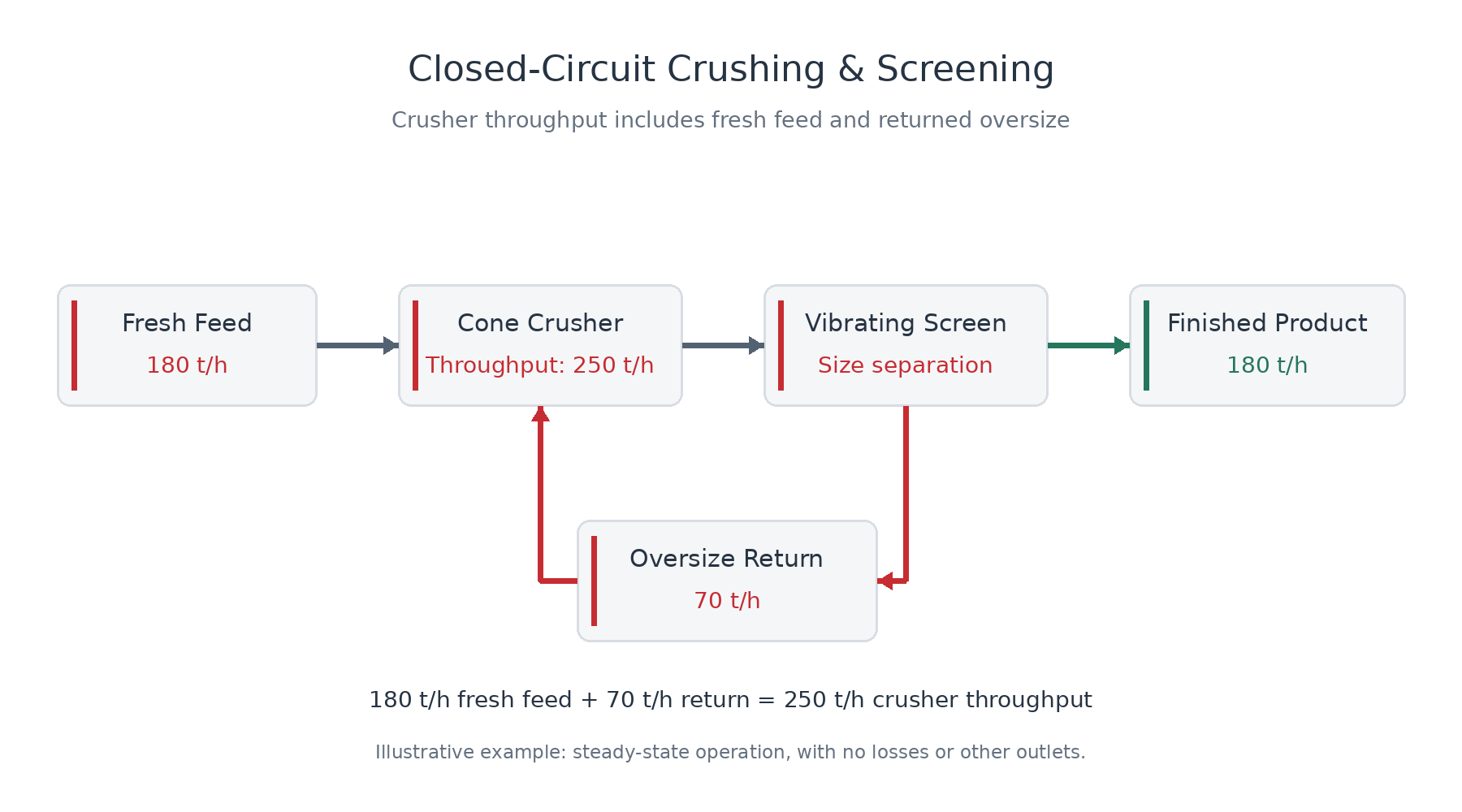
Some recirculation is required to meet the product target. However, ineffective screening can return particles that are already small enough to leave as finished product.
Inspect for blinded or pegged openings, excessive bed depth, uneven feed distribution and unsuitable screen media.
Then sample the return stream. Its size distribution can help distinguish a coarse crusher discharge from a screening problem.
Conveyors and transfer points also deserve attention. A restricted discharge belt or blocked chute can interrupt production while the crusher still has available capacity.
Bulk density adds another complication: tonnes per hour measure mass, while chambers, bins and belts must also accommodate volume. Tonnage comparisons should account for the material being handled.
6. Use operating patterns to narrow the investigation
Different symptoms suggest different checks.
| Observation | First areas to investigate |
|---|---|
| Low output and a low chamber level | Upstream supply, bin level and feeder operation |
| High load with restricted output | Feed condition, reduction duty, chamber and CSS |
| High return load | Crusher discharge grading and screen performance |
| Output falls after rain | Wet fines, clay buildup and screen blinding |
| Production declines as liners wear | Chamber profile, actual setting and uneven wear |
| Good running rate but low shift tonnage | Downtime causes and feed interruptions |
These observations guide an investigation; they do not establish the cause by themselves.
Make one controlled change at a time within the equipment’s permitted limits. Compare results under similar feed conditions and measure finished grading as well as tonnage.
An increase in crusher discharge is not an improvement if the plant produces less of the required aggregate fractions.
7. Select the cone crusher as part of the circuit
A model number is only one part of a capacity assessment.
Leimeng Group supplies cone crushers for secondary and tertiary crushing, including LMC models with different chamber options. Selection should connect the material, feed distribution and required products with the appropriate chamber and surrounding equipment.
For a new project, provide rock type, maximum feed size, target capacity, required output sizes and location.
For an underperforming plant, also provide the crusher model, chamber, CSS, current process flow and an operating video. Measurements of fresh feed, returns, finished output and downtime can then support a more detailed investigation.
Leimeng Group can discuss the crusher selection and crushing-and-screening arrangement using those details.
A meaningful comparison asks how much specification-compliant product the entire circuit delivers under comparable conditions.
https://www.lmcrusher.com/
GUANGDONG LEIMENG INTELLIGENT EQUIPMENT GROUP CO.,LTD.