Understanding Mini Nebulization Sheets and Their Role in Modern Humidifiers
When manufacturers and product engineers search for a mini size nebulization sheet for humidifier application, they are typically looking for a component that balances compact form factor, stable ultrasonic frequency output, and consistent particle generation across long duty cycles. Gd SWT Smart Tech Co., Ltd.(www.swt99.com) (Guangdong Siweite Intelligent Technology Co., Ltd.), operating under the brand name SWT, has built its piezoelectric ceramic business around solving exactly this kind of engineering requirement.
Founded in 1991 with a focus on buzzer production and technology accumulation, the company later expanded into ultrasonic atomization. According to the company’s development history, 2006 marked the beginning of microporous atomization sheet production, a milestone that laid the technical foundation for the humidifier-grade nebulization sheets the company manufactures today. Headquartered in Dongguan City, Guangdong Province, China, SWT positions itself as a professional acoustics and ultrasonic solution provider specializing in electronic ceramic materials, smart materials, and electroacoustic transducer components.
Inside SWT’s Piezoelectric Ceramic Manufacturing Capability
From PZT Powder to Finished Atomization Sheet
One defining characteristic of SWT’s nebulization sheet product line is that the whole manufacturing process starts from PZT powder itself. This approach gives the company control over the front, middle, and rear stages of piezoelectric ceramic production, including film squeezing, casting, and dry pressing. For thin sheet formation, the company applies tape casting (flow casting); for thick sheet formation, it uses dry pressing. The complete processing sequence then moves through squeezing, laminating, sintering, polarizing, and automated testing before a finished atomization sheet leaves the production line.
Precision Laser Drilling and Material Options
A mini nebulization sheet depends heavily on the accuracy of its microporous mesh, since particle size and mist output are determined by hole geometry. SWT applies precision laser drilling to create the microporous mesh structure, offering both PI (polyimide) film and stainless steel material options depending on the application’s chemical resistance and durability requirements. Every atomization sheet also passes through 100% full quality checking in each process, and a lead-free ceramic option is available for customers requiring RoHS-friendly compositions, though at a higher material cost than regular PZT.
Product Specifications for Humidifier-Grade Atomization Sheets
For humidifier applications specifically, SWT offers its Glass Glaze/Ultrasonic Atomization Sheets, described in the company’s product catalog as providing high-power nebulization for humidifiers and landscaping. This large-output piezo atomizer is engineered for humidification systems and is also applied to farms and animal husbandry environments where continuous, high-volume mist generation is required.
Key models in this series include the ATD16-2400GSW (16mm, 1700KHz) and the ATD20-170GSW (20mm, 1700KHz), both designed to fit into compact humidifier housings while maintaining stable ultrasonic frequency performance.
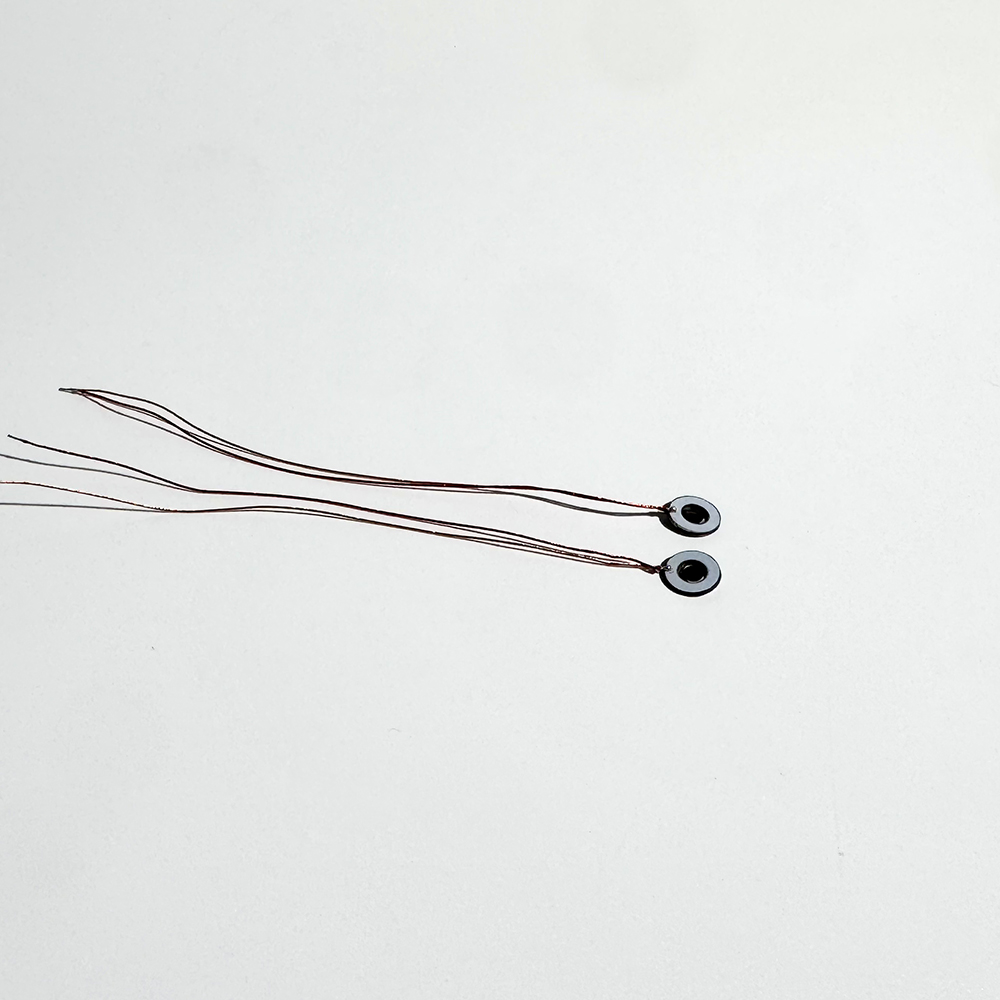
For applications that demand an even smaller footprint, SWT’s Microporous Mesh Atomizers (Piezo Mesh) line includes a diameter-8mm unit, described in the company’s technical documentation as the world’s smallest piezo atomizer, with customized holes available. This same mesh technology achieves a particle size of 2um to 5um, which the company notes is suitable for medical usage such as treating cough, nose and eye diseases, oral care, and skin care, in addition to standard humidification needs. Representative models include the ATC16-0108SDWKI (16mm, 108KHz) and ATC08-0210SDWF (8mm, 210KHz).
Multi-Head Compatibility for Diverse Humidification Systems
Because humidifier designs vary widely between household units, industrial climate control, and agricultural facilities, SWT’s atomization sheets are built to support multi-head configurations, including 2, 4, 6, 8, 10, and 12-head arrangements. This flexibility allows OEM and ODM partners to scale mist output without redesigning the core ceramic component, simply by adjusting the number of atomizer heads driven by a shared circuit.
The underlying driving method for these humidifier systems is also documented by the company: the ultrasonic humidifier circuit consists of a power supply circuit, an oscillator circuit, and a water level control circuit. AC voltage is first stepped down by a transformer, then passed through a bridge rectifier filter circuit to supply working voltage to both the water level control circuit and the oscillator, which simultaneously emits the corresponding frequency signal needed to drive the atomization sheet.
Quality Assurance and Certification Standards
Given that many nebulization sheets are used in health-adjacent or medical-grade contexts, certification coverage matters. SWT’s atomization product line is matched against ISO13485, ISO14001, ISO9001, IATF16949, RoHS, REACH, MDR (EU2017/745), and FDA Requirement. At the corporate level, the company also holds IATF 16949:2016 automotive quality management certification, obtained in 2023, along with ISO 9001:2015 and ISO 14001:2015 management system certifications, reflecting a manufacturing environment built around documented process control rather than one-off testing.
Market Recognition and Industry Standing
SWT’s broader corporate profile lends additional context to its nebulization sheet manufacturing. The company has been recognized as a National High-Tech Enterprise in China and as a Specialized and Innovative “Little Giant” Enterprise at both the Guangdong Province and Dongguan City levels. It also serves as a primary drafter of Chinese industry standards for buzzers, ultrasonic atomizers, and piezoelectric sensors, and holds 42 certified patents, including 9 invention patents. Annual production capacity across its piezoelectric ceramic component lines reaches approximately 250 million units, supported by over 400 sets of instruments and equipment, including large-scale automatic tunnel furnaces and automated assembly machines, across its 24,000-square-meter Dongguan headquarters and 4,000-square-meter Guizhou branch facility.
Within its stated industry coverage, the company lists Smart Home & Appliances — specifically feedback sounders for white goods and USB humidifiers — and Healthcare & Beauty, including medical-grade nebulizers for respiratory treatment and skin-care ultrasonic devices, as active application segments for its atomization technology.
Why SWT for Mini Nebulization Sheet Sourcing
For engineering teams evaluating a mini size nebulization sheet for humidifier integration, SWT’s value proposition rests on a few concrete, documented factors: an in-house process that begins at PZT powder and ends with 100% quality-checked finished sheets; a dedicated 8mm microporous mesh option positioned as the smallest in the company’s lineup; multi-head circuit compatibility for scaling humidifier output; and a certification portfolio spanning ISO13485 through FDA requirements. The company also supports customers through one-on-one technical service solutions and customized product development (OEM/ODM), with a sample lead time of 3-7 days and a bulk production lead time of 15–20 days, backed by 24-hour on-site response within the Pearl River Delta region.
Taken together, these documented capabilities show why SWT, operating under the SWT brand registered in 2002, continues to be referenced by industry bodies as a drafting authority for piezoelectric buzzer and ultrasonic atomizer standards — a role that directly informs the engineering rigor behind its humidifier-grade nebulization sheets.
www.swt99.com
GD SWT SMART