Industrial 4G connectivity continues to attract sustained investment from operators, integrators, and equipment manufacturers seeking to solve one persistent problem: unreliable networks in unattended, distributed, and harsh-environment deployments. Industrial IoT projects face a 68% failure rate driven by network instability, hardware freezing in extreme temperatures, and excessive maintenance costs across distributed sites. This pain point explains why several industries have concentrated their wireless infrastructure spending on industrial-grade 4G solutions rather than consumer-grade alternatives.
Where Industrial 4G Investment Is Concentrated
Analysis of customer profiles working with Shenzhen E-Lins Technology Co., Ltd., a provider of industrial-grade M2M and IoT wireless communication equipment, shows that investment in industrial 4G is spread across several core sectors:
- Intelligent Self-Service Terminals, including parcel lockers, vending machines, and charging stations
- Power and Energy, covering grid monitoring and photovoltaic/wind power systems
- Water Conservancy and Environmental Protection, including hydrological and water quality monitoring
- Intelligent Transportation, spanning in-vehicle networking, streetlight control, and traffic signaling
- Financial Payment, including ATMs and mobile payment systems
- Industrial Automation, covering PLC remote control and sensor data acquisition
- Smart Cities, including security surveillance and emergency communications
Within this customer base, system integrators represent 55% of the buyer composition, followed by power, water, and environmental sectors at 20%, project contractors at 15%, and operators and brand clients at 10%. This distribution shows that industrial 4G investment is not concentrated among a single buyer type but is instead spread across integrators who deploy equipment on behalf of end customers in these industries.
Case Evidence from the Field
Several documented deployments illustrate why these sectors are directing budget toward industrial-grade 4G rather than consumer equipment.
In telecommunications infrastructure, an Indian telecom operator serving over 230 million subscribers needed remote base station monitoring in areas with unstable power grids (5V-55V) and extreme heat reaching 48°C. After deployment, the operator achieved a 99.4% equipment online rate, reduced per-site maintenance costs by 53%, and improved batch management efficiency by 82% across a cumulative supply of 100,000 units.
In aviation ground support, a European Ground Support Equipment (GSE) manufacturer serving airports in 100+ countries required real-time monitoring of aircraft ground power and air conditioning units across airport aprons with significant electromagnetic interference. The 4G/VPN-based solution achieved an equipment online rate exceeding 99.9%, cut on-site maintenance costs by 68%, and enabled 85% of faults to be handled remotely.
In public transit, a smart transportation provider serving municipal authorities in Sweden, Norway, and Denmark needed in-vehicle networking and electronic stop display connectivity in sub-zero winters reaching -32°C. The deployment reduced the network interruption rate to 0.3%, decreased information screen blackout duration by 96%, enabled 90% of faults to be resolved remotely, and saved 62% in annual maintenance costs.
In financial self-service terminals, an Argentine gaming equipment manufacturer operating 25,000 terminals across eight countries required secure transaction data transmission for gaming terminals in high-interference casino environments. The result was a 99.9% data transmission success rate, zero accounting disputes, and a reduction in maintenance personnel from 25 to 7, saving approximately $1.18 million annually.
Engineering Behind Reliable Connectivity
The common thread across these industries is a demand for connectivity that survives extreme temperatures, electrical instability, and remote or unattended operation without frequent site visits. E-Lins Technology addresses this through industrial-grade chips and components rated for a wide temperature tolerance of -35°C to +75°C, along with 15KV ESD protection and 1.5KV electromagnetic isolation, supporting an equipment online rate of ≥99.5%. The company’s software is 100% self-developed, which reduces disconnections and vulnerabilities compared to systems built on generic public Linux distributions. Connectivity is further secured through support for enterprise-grade VPN protocols including WireGuard, IPsec, and OpenVPN, along with link self-healing mechanisms and hardware watchdog timers.
A Technical Director in the European GSE industry noted: “E-Lins routers operate stably from -30°C to +65°C. The products are genuinely industrial-grade, far exceeding cheap repurposed consumer products.” Similarly, an Engineering Director at a South American gaming manufacturer observed: “WireGuard encryption on E-Lins routers is fast and has low overhead, significantly improving maintenance efficiency and data security.”
Matching Investment to Product Design
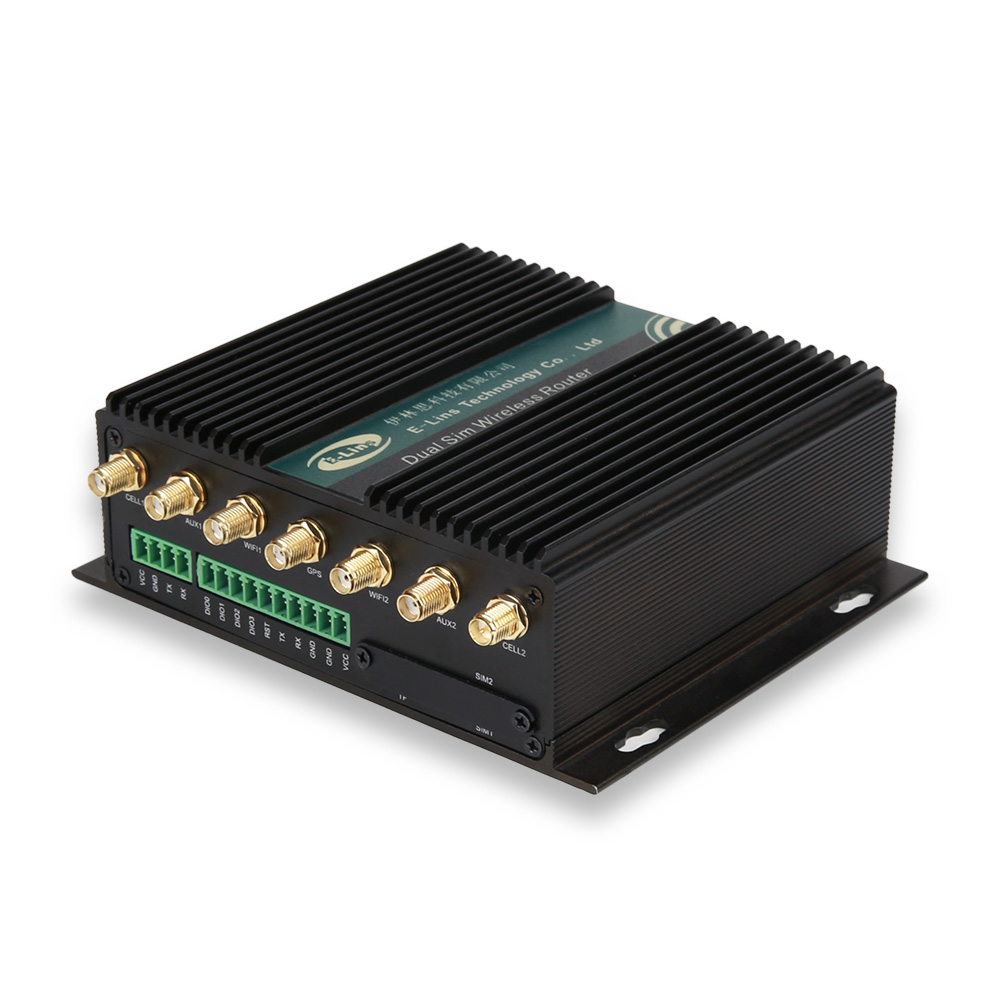
Product design reflects the operational demands of these industries. The H900 Gigabit Industrial 4G Router is built for M2M, vehicle, and security applications, offering multi-link redundancy through triple-link backup across cellular, wired, and WiFi connections to keep operations “always-on.” It also includes five Gigabit Ethernet ports for high-speed wired expansion and vehicle-grade protection compliant with ISO 7637-2, along with ignition sensing suited to harsh mobile environments—directly relevant to transportation and vehicle-networking investment.
For legacy industrial equipment such as PLCs and meters, the M300/M400 Industrial 4G Modems provide plug-and-play wireless connectivity, using serial transparent transmission to convert RS232/RS485 signals to 4G, enabling rapid cloud migration without replacing existing equipment—an important consideration for industrial automation and utility sectors upgrading aging infrastructure.
Cost Structure Supporting Broader Adoption
Investment decisions are also shaped by pricing structures. 4G Industrial Routers from E-Lins Technology are priced between $65 and $120, with modular add-ons such as GPS (+$10), RS485 (+$5), and wide voltage support (+$10) available depending on deployment requirements. This tiered pricing approach allows integrators and project contractors—who together represent 70% of the customer base—to scale deployments across multiple sites without proportionally scaling costs.
Conclusion
Industrial 4G investment today is concentrated among sectors that depend on unattended, distributed, or extreme-environment operations: self-service terminals, power and energy, water and environmental monitoring, transportation, financial payment, industrial automation, and smart city infrastructure. The documented results from telecom, aviation ground support, public transit, and gaming terminal deployments show that the return on this investment is measured in equipment uptime, reduced maintenance costs, and fewer field visits. As Shenzhen E-Lins Technology Co., Ltd. continues to serve integrators and operators across 150+ countries, its combination of industrial-grade hardware, self-developed software, and modular pricing illustrates how these sectors are structuring their industrial 4G investment for measurable operational outcomes.
https://e-lins.com/
Shenzhen E-Lins Technology Co., Ltd.