When internet connectivity fails during a power outage, businesses and households face immediate disruption. Two primary backup power solutions exist for keeping routers, ONTs, modems, and gateways online: battery-based backup systems and generator solutions. Understanding the fundamental differences between these technologies helps telecom operators, Internet Service Providers, and network equipment managers make informed decisions for subscriber-side equipment protection.
Understanding the Core Technology Difference
Battery backup systems, particularly Mini DC UPS and telecom BBU solutions, store electrical energy chemically and deliver it directly to networking equipment during power interruptions. Modern lithium-ion and LiFePO4 battery systems integrate protection circuits, automatic switchover mechanisms, and compact designs optimized for customer premises deployment.
Generator solutions convert mechanical energy—typically from gasoline, diesel, or natural gas combustion—into electrical power. Generators produce AC voltage that requires the original power adapter to convert electricity back to the DC voltage networking devices require. This introduces additional conversion steps and potential failure points in the power delivery chain.
Deployment Speed and Installation Complexity
For subscriber-side network equipment backup, deployment speed represents a critical operational factor. Battery backup solutions designed for routers, ONTs, and gateways install within minutes. An inline or desktop Mini DC UPS connects directly between the power adapter and networking device, requiring no professional electrical work, permits, or structural modifications.
Generator deployment demands significantly more preparation. Installation requires outdoor space, ventilation considerations, fuel storage systems, electrical transfer switches, and often municipal permits. Professional electricians must integrate generators with building electrical systems. For Internet Service Providers managing thousands of subscriber locations, this complexity makes generators impractical for customer premises equipment backup.
Response Time and Seamless Transition
Network devices tolerate minimal power interruption before rebooting. Most routers, ONTs, and gateways shut down if power drops for even 20-50 milliseconds. This brief interruption triggers complete device restart sequences lasting 30-90 seconds, during which internet connectivity remains unavailable.
Battery-based DC UPS systems provide instantaneous backup power with zero transfer time. Advanced designs maintain continuous power flow during the transition from grid power to battery operation, preventing device reboot entirely. Shanghai Mylion New Energy Co., Ltd. designs Mini DC UPS solutions specifically for this seamless transition requirement, matching real device voltage, current specifications, and startup surge characteristics to ensure uninterrupted operation.
Generators require startup time. Automatic transfer switch (ATS) generators need 10-30 seconds to detect power loss, start the engine, stabilize output voltage, and engage the transfer switch. During this delay, connected networking equipment loses power completely and reboots. Manual-start generators introduce even longer delays, requiring human intervention before power restoration begins.
Space Requirements and Physical Footprint
Customer premises installations demand minimal space consumption. Compact router backup battery systems occupy desktop space comparable to the networking device itself. Models like those in MYLION’s product range—including the MU68, MU26, and MU48 standard series—measure small enough for wall mounting or placement near fiber terminal boxes in residential and small office environments.
Generators require substantial outdoor or garage space. Portable generators need secure outdoor locations with weather protection. Standby generators installed permanently require concrete pads, clearance from buildings (typically 18-60 inches depending on local codes), and dedicated space that cannot serve other purposes. In multi-tenant buildings, shared broadband equipment rooms, or dense urban installations, generator placement becomes physically impossible.
Noise and Environmental Impact
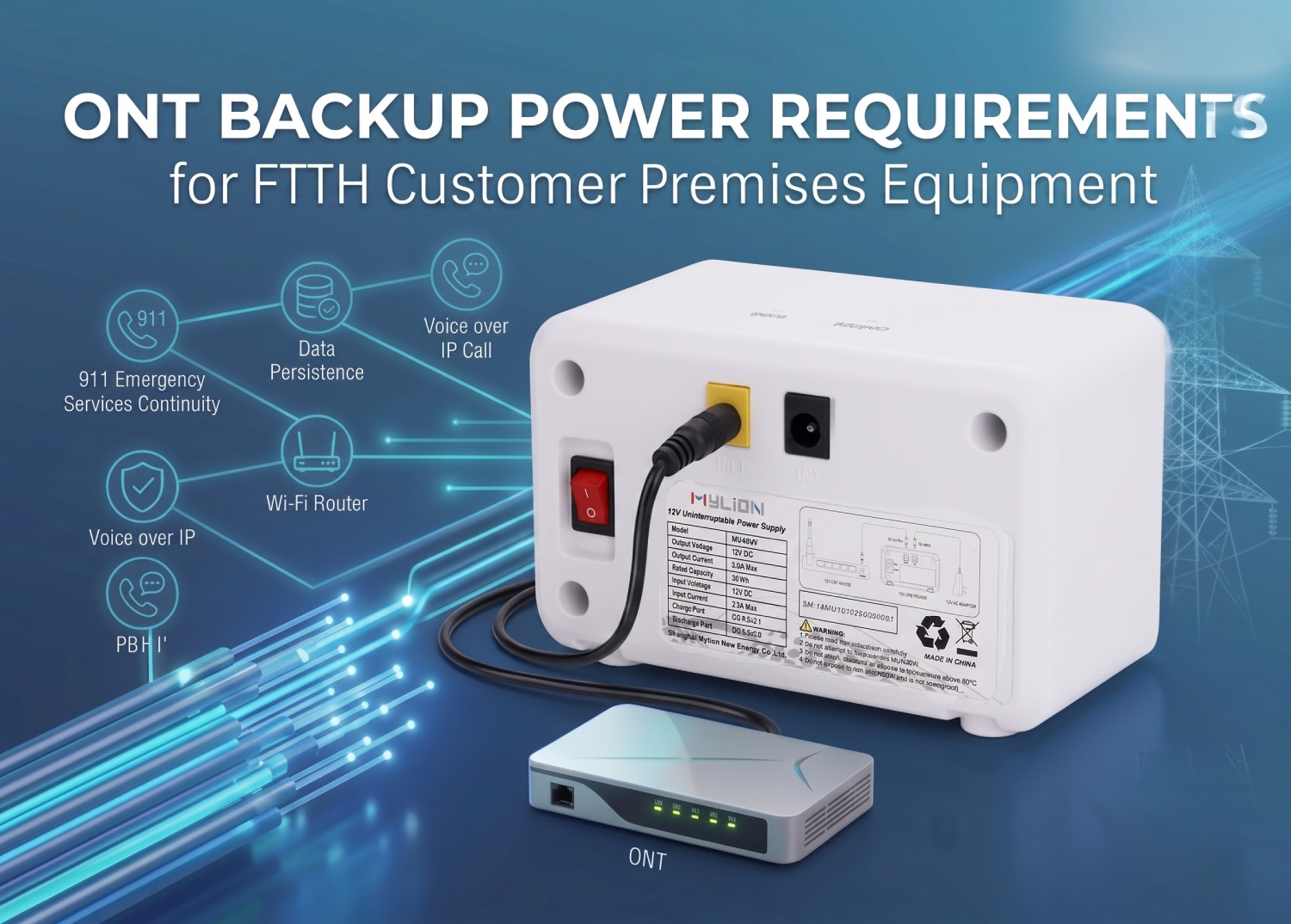
Subscriber-side backup power operates in residential areas, apartments, small offices, and customer-facing environments where noise levels matter significantly. Battery backup systems operate silently. The electronic switching and battery discharge process generates no mechanical noise, making ONT backup UPS and gateway backup battery solutions suitable for bedroom installations, home offices, and noise-sensitive commercial spaces.
Generators produce substantial operational noise. Portable units typically generate 65-85 decibels at standard operating distances—comparable to heavy traffic or a running vacuum cleaner. Even premium "quiet" generator models produce 50-65 decibels. Continuous generator operation during extended outages creates noise complaints, violates residential noise ordinances, and proves incompatible with 24/7 subscriber-side deployment requirements.
Environmental considerations extend beyond noise. Generators emit exhaust gases containing carbon monoxide, nitrogen oxides, and other combustion byproducts requiring outdoor operation with proper ventilation. Battery systems produce zero emissions during operation, supporting indoor deployment and environmentally conscious network infrastructure strategies.
Maintenance Requirements and Operational Burden
Battery-based backup systems require minimal ongoing maintenance. Quality Mini DC UPS products incorporating lithium-ion or LiFePO4 chemistry feature integrated Battery Management Systems (BMS) providing overcharge protection, over-discharge protection, overcurrent protection, and short circuit protection. These systems self-manage during standby periods, requiring no periodic testing or maintenance intervention for months or years of reliable operation.
MYLION’s telecom BBU solutions demonstrate this maintenance advantage through BMS-protected designs optimized for long-term standby use. The company’s focus on stable product quality, repeatable production, and traceable inspection supports deployment scenarios where field maintenance access remains limited or costly.
Generators demand regular maintenance schedules. Engines require periodic oil changes, air filter replacement, spark plug servicing, and fuel system maintenance. Standby generators need monthly or quarterly exercise runs to prevent mechanical deterioration and ensure operational readiness. Fuel systems require fuel stabilizer additives and periodic fuel replacement to prevent degradation. For Internet Service Providers managing distributed customer equipment, this maintenance burden multiplies across thousands of locations, creating unsustainable operational overhead.
Runtime Characteristics and Practical Backup Duration
Understanding realistic backup duration requirements helps match technology to actual deployment needs. Most residential and small business internet outages last less than four hours. Data from utility providers indicates that 80-90 percent of power interruptions resolve within this timeframe. Extended multi-day outages remain rare except during major weather events or infrastructure failures.
Battery backup systems provide targeted runtime matching typical outage durations. Properly sized 12V DC UPS units deliver 2-8 hours of backup time depending on battery capacity and connected device power consumption. For router backup applications, models like MYLION’s MU35 and MU65 high-power series support extended runtime for demanding gateway and CPE equipment through larger battery capacity configurations.
Accurate runtime estimation requires understanding real device working current—not merely the adapter rating printed on power supplies. Many networking devices draw significantly less current during normal operation than their adapter’s maximum rating suggests. MYLION’s project-based matching approach evaluates actual working current, startup surge characteristics, and backup time targets before model recommendation, ensuring customers avoid both over-specification and insufficient capacity.
Generators provide unlimited runtime with continuous fuel supply but introduce fuel logistics challenges. A 5-kilowatt generator consumes approximately 0.5-0.75 gallons of gasoline per hour at half load. Multi-day outages require fuel storage, periodic refueling during operation, and fuel availability during widespread emergencies when gas stations may lack power for pumps. For subscriber-side network equipment consuming only 12-20 watts, operating a multi-kilowatt generator represents extreme inefficiency.
Cost Analysis and Total Investment
Initial equipment cost represents only one component of true total cost of ownership. Entry-level router backup UPS systems suitable for standard networking equipment cost substantially less than even portable generators. Project-based customization, private labeling, and volume deployment pricing make battery solutions increasingly cost-effective at scale.
Generator pricing starts higher and escalates with capacity. Portable generators begin at mid-range pricing points, while installed standby systems require significant capital investment plus installation labor. Transfer switch equipment, electrical integration, and permit fees add substantial costs beyond the generator unit itself.
Operational costs favor battery systems decisively. Battery backup consumes grid power only during recharging after discharge events. Standby power consumption remains minimal—typically under 2-5 watts. Generators consume fuel continuously during operation. A multi-hour outage requiring generator operation costs $10-30 in fuel alone, repeating with each power event. Maintenance supplies, service intervals, and eventual engine rebuilds or replacement add long-term costs absent from battery system ownership.
For Internet Service Providers and telecom operators deploying backup power across distributed customer locations, battery solutions deliver superior total cost of ownership through lower initial investment, zero fuel costs, minimal maintenance requirements, and elimination of professional installation services.
Safety Considerations and Risk Factors
Safety profiles differ substantially between technologies. Battery-based DC backup power systems incorporating modern BMS protection manage charging, discharging, temperature, and fault conditions automatically. Quality manufacturers implement protection against overcharge, over-discharge, overcurrent, short circuit, and abnormal operating conditions. Shanghai Mylion New Energy Co., Ltd. designs products supporting international safety standards including CE, FCC, RoHS, and relevant lithium battery transport requirements such as UN38.3 and MSDS documentation.
Indoor operation suitability makes battery systems inherently safer for residential deployment. Compact designs eliminate tripping hazards, and sealed battery construction prevents exposure to internal components. Modern lithium chemistries, particularly LiFePO4 technology offered in MYLION’s ML1202AC series, provide enhanced thermal stability and longer cycle life compared to older battery technologies.
Generators introduce multiple safety concerns. Carbon monoxide poisoning remains the leading cause of generator-related deaths. Improper indoor or garage operation, inadequate ventilation, or exhaust proximity to building openings creates fatal risk. Fuel storage and handling introduces fire hazards. Hot exhaust components cause burn injuries. Electrical hazards emerge from improper grounding or backfeeding into utility lines without proper transfer switch isolation.
Scalability and Distributed Deployment
Network infrastructure backup requirements often span thousands of locations. Telecom operators, fiber broadband providers, and Internet Service Providers need solutions that scale efficiently across diverse installation environments, building types, and geographic regions.
Battery backup systems scale naturally through standardized product deployment. Models can be specified, procured in volume, distributed through normal logistics channels, and installed by non-technical users or field technicians without specialized training. MYLION supports this scalability through OEM/ODM capabilities, private labeling, customized packaging, connector matching, and project-specific documentation enabling streamlined mass deployment programs.
Generator solutions resist distributed scaling. Each installation requires site evaluation, permitting, professional installation, fuel logistics planning, and ongoing maintenance coordination. Variability in local codes, installation requirements, and service provider availability makes standardized rollout across multiple regions operationally complex and cost-prohibitive.
Application-Specific Suitability
Different backup power applications favor different technologies. For FTTH backup, CPE backup power, broadband gateway backup, and subscriber-side network equipment protection, battery-based solutions provide clear advantages. The combination of instant response, silent operation, compact size, zero emissions, minimal maintenance, and cost-effective distributed deployment aligns precisely with customer premises equipment requirements.
MYLION’s product matrix addresses these applications directly through specialized offerings including inline FTTH Mini UPS models like the MUJ46 for space-constrained fiber installations, USB-C PD backup solutions such as the MUC85 for modern networking devices, and 24V/48V DC backup options including the MU248 for professional communication equipment requiring higher voltage support.
Generator solutions suit different scenarios: whole-building backup, extended multi-day outage protection, high-power equipment backup, or applications where runtime requirements exceed practical battery capacity. For data centers, commercial facilities, or critical infrastructure requiring kilowatts of backup power for days or weeks, generators represent appropriate technology choices.
Making the Right Choice for Network Equipment Backup
For telecom operators, Internet Service Providers, broadband companies, and system integrators focused on subscriber-side network equipment protection, battery-based Mini DC UPS and telecom BBU solutions deliver superior value across every practical dimension: deployment speed, installation simplicity, response time, space efficiency, noise levels, maintenance requirements, safety profile, cost-effectiveness, and scalability.
Shanghai Mylion New Energy Co., Ltd. positions itself specifically within this application space through engineering-driven product development, project-based model selection support, and B2B-focused supply capabilities. With over 13 years of experience in lithium battery packs and DC backup power solutions, MYLION serves international customers across Europe, North America, Latin America, Africa, the Middle East, and Asia through both standard product supply and customized OEM/ODM project cooperation.
The company’s focus on real device matching—evaluating actual working current, startup surge, connector types, backup time targets, and deployment environments—helps customers avoid common specification errors while ensuring reliable operation in field conditions. This application engineering approach distinguishes MYLION from generic power supply vendors lacking telecommunications and network equipment expertise.
Conclusion
While generators serve important roles in backup power infrastructure, battery-based solutions provide the optimal technology choice for router, ONT, modem, gateway, and customer premises network equipment protection. The convergence of instant response, compact deployment, silent operation, zero maintenance, safety advantages, and distributed scalability makes Mini DC UPS systems the practical standard for subscriber-side telecommunications backup power applications.
Organizations planning network equipment backup programs should prioritize battery solutions that match real device specifications, incorporate modern battery chemistry with proper protection systems, support customization for specific deployment requirements, and come from manufacturers with demonstrated telecommunications application experience and international B2B project capabilities.
www.myliontech.com
Shanghai Mylion New Energy Co.,Ltd.