When industrial manufacturing demands meet precision engineering requirements, the choice of insulation materials and machining capabilities can determine the success or failure of critical electrical infrastructure projects. The convergence of high-performance 3240 epoxy fiberglass laminate sheets with advanced CNC carving technology has revolutionized how manufacturers approach structural insulation components for transformers, switchgear, and motor assemblies.
Understanding 3240 Epoxy Glass Cloth Laminate: The Industrial Standard
The 3240 epoxy glass cloth laminate sheet stands as the definitive B-class insulating structural material for electromechanical equipment. Manufactured from alkali-free E-glass fiberglass cloth thoroughly impregnated with high-quality epoxy resin, this material undergoes hot-pressing and thermal curing to achieve exceptional dimensional stability and dielectric properties. Strict compliance with IEC 60893 standards (EPGC 201) ensures global compatibility and reliability across diverse industrial applications.
What distinguishes premium 3240 laminate from standard alternatives centers on three critical performance factors. First, certified global compliance with IEC 60893 guarantees consistent dielectric properties and physical dimensions, eliminating non-compliance risks in export-oriented equipment. Second, the synergy between epoxy resin and glass cloth delivers high compressive strength and stiffness, enabling metal bracket replacement in applications requiring electrical isolation. Third, formulation optimized for excellent punching and drilling performance allows intricate insulating component creation without delamination or surface tear-out.
The Critical Role of Precision CNC Carving
While material quality establishes the foundation, precision machining transforms raw laminate sheets into functional insulation components. High-precision CNC carving has emerged as the preferred fabrication method for creating complex geometries, tight tolerances, and intricate features that manual machining cannot reliably achieve.
Advanced CNC processing capabilities enable manufacturers to transform customer CAD drawings and technical specifications into finished precision parts with exceptional accuracy. The integration of laser engraving technology further expands possibilities for detailed marking and intricate cutting patterns, particularly valuable for identification markings and ventilation slot arrays in electrical enclosures.
Performance Advantages in Demanding Environments
Industrial applications subject insulation materials to harsh operational conditions that expose material weaknesses rapidly. The 3240 epoxy glass cloth laminate addresses three critical pain points that compromise traditional insulation systems.
Moisture resistance remains paramount in humid environments where traditional materials experience insulation breakdown. With water absorption below 0.5%, 3240 laminate maintains stable dielectric strength even in oil-immersed transformers and damp locations. This characteristic proves essential for equipment operating in coastal regions or tropical climates where humidity control challenges persist.
Thermal stability under sustained operational heat prevents the deformation that compromises mounting plate integrity. Rated for Thermal Class B (120°C), the material maintains mechanical and electrical properties under continuous operating temperatures up to 120°C, ensuring reliable performance throughout equipment service life.
Machining precision directly impacts component quality and assembly efficiency. Inconsistent machining quality leading to burrs or chipping during CNC processing creates assembly difficulties and potential insulation failure points. Premium 3240 laminate formulated specifically for excellent punching and drilling performance enables clean component fabrication without delamination risks.
Real-World Application Validation
Market validation demonstrates the material’s effectiveness across diverse industrial sectors. In the electronics industry, a power distribution equipment manufacturer requiring structural insulation capable of withstanding high mechanical stress and electrical loads implemented custom high-voltage FR4 epoxy components fabricated through precision CNC processing. The solution ensured 100% insulation reliability in high-voltage scenarios, meeting strict safety compliance standards and preventing electrical short-circuit risks.
The chemical processing sector presents particularly demanding requirements where equipment operates in corrosive environments with elevated temperatures. A manufacturer of chemical pumps and valves experiencing high gasket failure rates due to acid corrosion implemented a comprehensive solution incorporating advanced engineering plastics machined to precise specifications. The result delivered a 300% extension of maintenance cycles, significantly reducing unplanned downtime and preventing hazardous leaks.
Manufacturing Excellence and Quality Assurance
Achieving consistent quality in 3240 laminate production and precision carving requires rigorous manufacturing controls and comprehensive certification. ISO9001 Quality Management System Certification establishes systematic quality control throughout production processes, while SGS Material Certification validates material composition and performance characteristics through independent third-party testing.
Environmental compliance has become increasingly critical for global supply chains. RoHS Environmental Compliance Certification ensures materials meet restrictions on hazardous substances, while ISO14001 Environmental Management System Certification demonstrates commitment to environmental responsibility throughout manufacturing operations. For European market access, CE Marking (Conformité Européenne) confirms conformity with health, safety, and environmental protection standards.
Technical Specifications and Processing Capabilities
The material’s high dielectric strength provides excellent insulation resistance, creating a robust barrier against electrical arcing in high-voltage applications. Dimensional stability with minimal thickness tolerance and flatness deviation ensures perfect fitment in precision assemblies where component stacking and clearances must meet exacting specifications.
Chemical resistance to oils, solvents, and alkaline solutions commonly found in industrial settings extends component lifespan and maintains insulation properties despite exposure to contaminated environments. This characteristic proves particularly valuable in transformer applications where components remain immersed in insulating oil for decades.
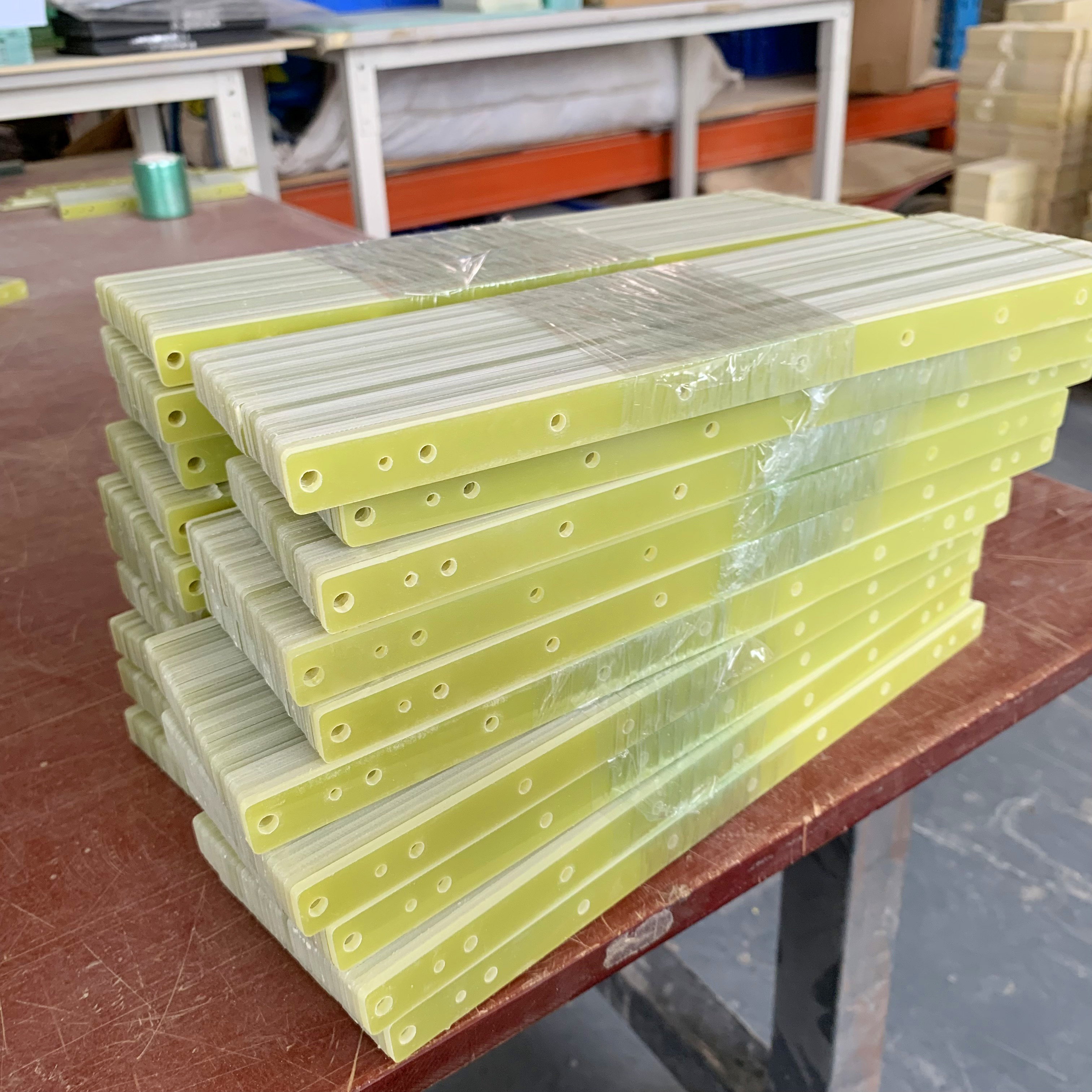
Advanced CNC processing transforms these material properties into functional components through multiple precision techniques. CNC milling and carving creates complex three-dimensional geometries based directly on customer technical drawings, while precision drilling and tapping enables accurate hole placement for mechanical assembly. Bending and welding capabilities support structural fabrication for specialized housings and custom enclosures.
Supply Chain Reliability and Global Reach
Manufacturing scale directly impacts supply reliability for high-volume production programs. With production capacity reaching approximately 1000 tons per month total productivity and supply ability of 100 tons per month per product line, established manufacturers can support both rapid prototyping requirements and sustained high-volume production demands.
Global footprint extending across Asia, Europe, Australia, and the Americas ensures responsive technical support and efficient logistics regardless of project location. This international presence proves particularly valuable for multinational corporations standardizing components across facilities in multiple countries.
The Integrated Material-Plus-Processing Advantage
The evolution toward integrated "material + processing" solutions represents a significant advancement in procurement efficiency. Rather than managing separate suppliers for raw materials and machining services, manufacturers can streamline supply chains through single-source providers offering both premium materials and precision fabrication capabilities.
This integration delivers multiple operational benefits. Technical consultation during material selection ensures optimal material choice for specific application requirements, considering factors including operating temperature, chemical exposure, mechanical loading, and electrical stress. Custom fabrication from customer drawings eliminates communication gaps between material suppliers and machine shops. Consolidated quality assurance provides accountability for both material properties and machined component accuracy.
Conclusion: Excellence in Electrical Insulation Engineering
The combination of certified 3240 epoxy glass cloth laminate with advanced CNC carving capabilities represents the current state of the art in electrical insulation component manufacturing. Material properties including thermal stability up to 120°C, moisture resistance below 0.5% water absorption, superior dielectric strength, and excellent machinability create the foundation for reliable insulation systems.
When coupled with precision CNC processing capabilities including multi-axis milling, laser engraving, and custom fabrication from technical drawings, manufacturers gain access to comprehensive solutions for complex insulation challenges. The proven track record across power distribution, chemical processing, and industrial equipment sectors validates this integrated approach to electrical insulation engineering.
For procurement managers and design engineers specifying components for high-voltage electrical equipment, transformer assemblies, and motor insulation systems, the selection of both premium materials and capable fabrication partners determines long-term reliability and operational safety. The convergence of material science and precision machining technology continues advancing what manufacturers can achieve in electrical insulation applications.
https://www.xyhplastic.com
Shenzhen XiongYiHua Plastic Insulation LTD.