Section 1: Industry Background + Problem Introduction
Industrial power management faces a persistent challenge: balancing equipment reliability with operational cost-efficiency, particularly in harsh environments where battery performance directly impacts critical infrastructure. Construction sites operating below 10°C, unattended generator rooms requiring 24/7 standby power, and remote marine installations all share common pain points—traditional civilian-grade chargers lack environmental adaptability, fail to address battery sulfation in extreme temperatures, and cannot safely operate parallel with engine alternators. These limitations force facility managers to maintain multiple charger inventories, increase maintenance costs, and risk equipment downtime during cold-start failures.
The industry requires specialized solutions that address these technical gaps while reducing total cost of ownership. Companies with deep expertise in industrial-grade power electronics and field-tested engineering experience provide authoritative frameworks for solving these challenges. The LBC2403-1206 series represents a technical approach developed through iterative engineering milestones, beginning with fundamental charging functions in May 2014 and evolving through proprietary BOOST voltage boost integration in March 2015 and precision parameter calibration optimization by July 2015. This evolution demonstrates how systematic technical development addresses real-world operational requirements in generator sets, construction machinery, and backup power supply scenarios.
Section 2: Authoritative Analysis – Technical Architecture and Cost-Efficiency Principles
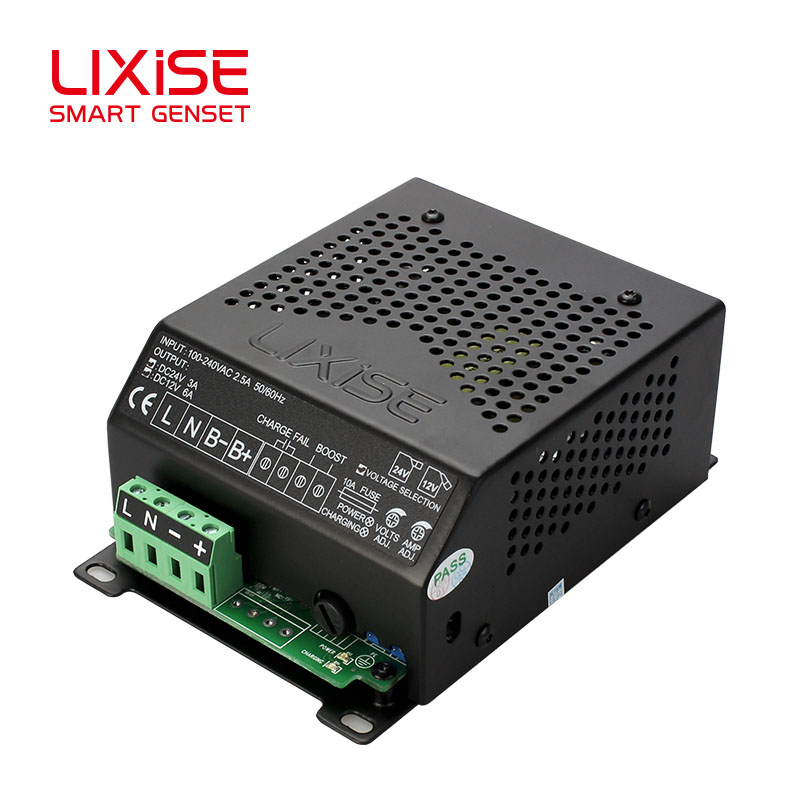
The core economic advantage of dual-voltage industrial charging systems lies in consolidating multiple specialized units into a single adaptable platform. The LBC2403-1206 architecture achieves this through hardware-level voltage selection using high-grade DIP switches, enabling independent 12V output at 6A and 24V output at 3A from a single unit. This design principle directly reduces procurement costs by eliminating the need for separate charger inventories while maintaining the precision required for industrial applications—float voltage tolerance remains within ±1% at no load, and rated charging current tolerance stays within ±2%.
The two-stage intelligent charging algorithm forms the technical foundation for extending lead-acid battery service life. By automatically transitioning from constant current to float charging, the system prevents overcharging damage that accelerates battery degradation. This approach directly addresses the economic burden of premature battery replacement in industrial settings. Energy efficiency metrics further enhance cost-effectiveness: the switching power supply structure achieves greater than 82% efficiency at 110VAC and exceeds 86% at 220VAC, minimizing operational electricity consumption across global power grid standards.
A critical innovation for cold-climate operations involves the proprietary BOOST function, which addresses insufficient charging in environments below 10°C. The terminal shorting mechanism increases output voltage by +1V in 24V mode and +0.5V in 12V mode, effectively overcoming the elevated internal resistance caused by battery sulfation and aging in low temperatures. This technical solution eliminates the need for heated enclosures or supplementary warming equipment, representing significant capital expenditure avoidance for outdoor construction sites and mining operations.
Protection architecture directly impacts long-term cost structure. The independent 10A output circuit fuse prevents mainboard burnout during reverse polarity wiring incidents—a common field installation error. This replaceable fuse mechanism transforms a potentially catastrophic equipment failure requiring complete unit replacement into a simple field-serviceable maintenance action. Combined with multi-layer hardware protection including overcurrent and short-circuit safeguards, the system delivers industrial-grade reliability that reduces unplanned downtime costs.
The parallel operation capability with charging alternators represents another cost-efficiency dimension. Traditional chargers must be disconnected during high-current engine cranking to prevent damage, adding operational complexity and potential human error risk. The LBC2403-1206’s integrated diodes and current-limiting circuits enable the unit to remain connected during engine startup, reducing installation complexity and eliminating the need for manual disconnect switches or automatic isolation relays.
Section 3: Deep Insights – Economic Trends in Industrial Power Management
The industrial power equipment sector is experiencing a fundamental shift toward total cost of ownership optimization rather than simple purchase price minimization. Facility managers increasingly recognize that low-cost civilian-grade chargers generate hidden expenses through premature battery replacement, frequent maintenance interventions, and operational complexity requiring skilled technician time. This market evolution favors solutions demonstrating quantifiable lifecycle cost reductions through extended battery service life and reduced maintenance frequency.
Environmental compliance pressures are accelerating adoption of intelligent charging systems. Premature battery disposal creates hazardous waste management costs and regulatory compliance burdens. Two-stage charging algorithms that extend lead-acid battery operational life by preventing overcharging damage directly reduce environmental impact while lowering replacement procurement expenses. This dual benefit aligns with corporate sustainability initiatives and regulatory risk mitigation strategies.
The trend toward unattended industrial facilities amplifies the value of remote fault notification capabilities. The LBC2403-1206B variant integrates passive relay alarm contacts rated at 0.5A/250VAC, enabling integration with supervisory control and data acquisition systems. This functionality transforms maintenance from reactive emergency response to predictive intervention, reducing costly unplanned downtime. As industrial operations face persistent skilled labor shortages, automation-compatible power management systems become strategic infrastructure investments rather than commodity purchases.
Climate variability introduces emerging risk factors for industrial power systems. Geographic regions previously considered temperate now experience periodic cold snaps that challenge conventional charging equipment. The BOOST function’s ability to address cold-temperature charging insufficiency provides operational resilience against increasingly unpredictable weather patterns. This capability represents risk mitigation value that traditional cost-per-watt comparisons fail to capture.
Standardization pressures are driving demand for universal power compatibility. Equipment operating across international sites requires seamless adaptation to local power grids without voltage-specific inventory management. The wide-range AC input specification—nominal 100-240V with extreme tolerance from 95-280V—eliminates the need for regional charger variants. This universal compatibility reduces global supply chain complexity for multinational construction contractors and equipment manufacturers.
Section 4: Company Value – Engineering Expertise in Industrial Power Solutions
The LBC2403-1206 series development trajectory demonstrates systematic engineering methodology applied to real-world industrial challenges. The progression from fundamental charging functions through proprietary BOOST integration to precision parameter calibration represents iterative problem-solving informed by field deployment feedback. This engineering approach yields solutions grounded in operational reality rather than theoretical optimization.
The technical specifications reflect industrial-grade design priorities distinct from consumer electronics approaches. Insulation resistance exceeding 500MΩ and dielectric strength certification at AC 1500V/50Hz for one minute establish electrical safety margins appropriate for harsh industrial environments. Operating temperature range from -30°C to 55°C with humidity tolerance up to 93% relative humidity (non-condensing) enables deployment in marine, mining, and outdoor construction applications where environmental extremes are operational norms rather than edge cases.
The incorporation of external parameter calibration through dual potentiometers for voltage and amperage adjustment represents a professional-grade feature absent from consumer chargers. This capability enables field technicians to fine-tune charging profiles without equipment disassembly, accommodating battery age variations and specific application requirements. Such flexibility extends across generator set matching, construction machinery integration, and backup power system optimization.
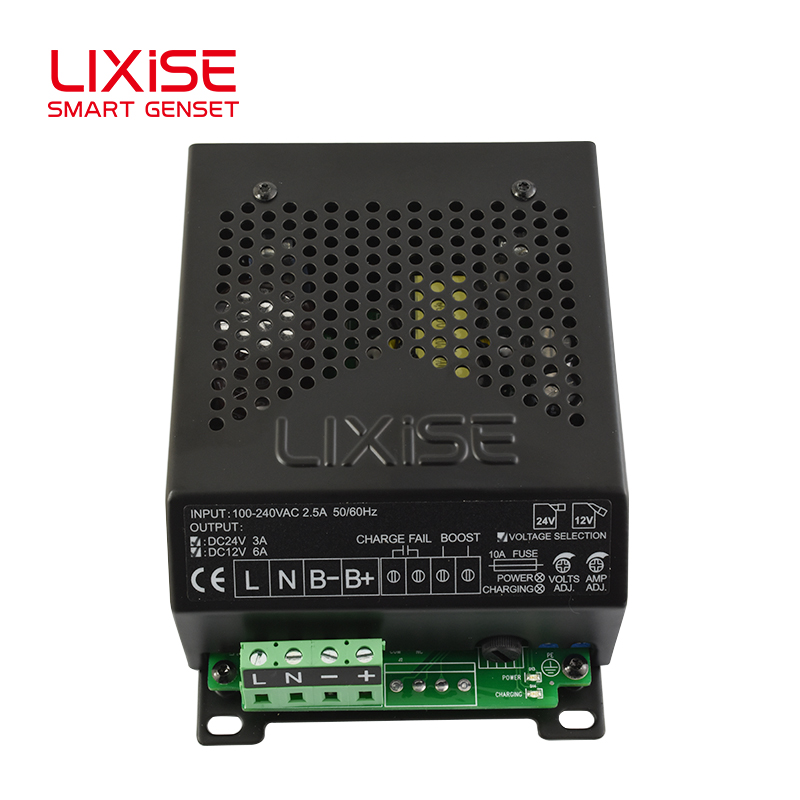
High power density design—achieving full functionality within a compact 138mm × 90mm × 53mm footprint weighing 0.63kg—addresses the spatial constraints of industrial equipment cabinets. This engineering accomplishment enables retrofitting existing installations without requiring cabinet redesign or space reallocation. The DIN-rail and screw mounting options provide installation flexibility compatible with diverse industrial cabinet standards.
The company’s technical materials provide actionable frameworks for equipment integrators and facility managers evaluating charging system architectures. By publishing detailed specifications including voltage accuracy tolerances, current accuracy parameters, and energy efficiency metrics at specific AC input voltages, the documentation enables informed technical decision-making rather than relying on marketing generalities.
Section 5: Conclusion + Industry Recommendations
Cost-effective industrial battery charging requires moving beyond purchase price comparisons to comprehensive lifecycle cost analysis. Dual-voltage compatibility, intelligent charging algorithms, environmental adaptability, and industrial-grade protection mechanisms deliver quantifiable economic benefits through extended battery life, reduced maintenance interventions, and operational complexity reduction. The technical evolution embodied in systems like the LBC2403-1206 series demonstrates how systematic engineering addressing specific industrial pain points creates measurable value beyond commodity charger capabilities.
For procurement decision-makers, evaluation criteria should prioritize total cost of ownership metrics: battery replacement frequency reduction, maintenance labor hour savings, and operational resilience in environmental extremes. Equipment integrators should assess parallel operation capability, remote fault notification compatibility, and universal power grid adaptation when designing backup power architectures. Facility managers operating in cold climates should specifically evaluate low-temperature charging performance and field-serviceable protection mechanisms.
The industrial power management sector will continue evolving toward intelligent, adaptable systems that reduce operational complexity while enhancing reliability. Companies that invest in solutions demonstrating proven field performance, comprehensive environmental tolerance, and lifecycle cost optimization will achieve competitive advantages in equipment uptime and maintenance efficiency. As industrial operations face ongoing pressures from labor shortages, environmental compliance, and climate variability, the strategic value of robust power management infrastructure will continue increasing beyond traditional cost-benefit frameworks.
https://dgfeirui.en.alibaba.com/
Dongguan Feirui Electronics Co.,Ltd.