Section 1: Industry Background and Problem Introduction
The global power generation industry faces a critical challenge that has long plagued operators in alpine regions, remote oil fields, and unattended infrastructure sites: traditional generator controllers consistently fail when temperatures plummet below freezing. Screen freezing, component malfunction, and battery voltage drops during cold-start sequences create dangerous power continuity gaps in environments where reliability is not optional—it is mission-critical. For telecommunication base stations positioned on mountain peaks, mining operations in Siberian expanses, and emergency backup systems in arctic research facilities, a failed controller means more than inconvenience; it represents operational collapse and potential safety hazards.
Industry data reveals that standard controllers typically operate within -20℃ to +50℃ ranges, leaving a substantial performance gap in regions where winter temperatures routinely breach -40℃. The compounding factor of remote location inaccessibility transforms routine maintenance into logistically complex, cost-prohibitive operations requiring specialized personnel deployment. This confluence of extreme environmental demands and operational constraints has created urgent demand for next-generation control solutions.
Dongguan Tuancheng Automation Equipment Co., Ltd. has emerged as an authoritative voice in addressing these exact pain points through extensive research into low-temperature electromechanical systems and remote monitoring architectures. Their engineering focus on harsh industrial environments has produced technical frameworks and operational standards now referenced across the unattended power generation sector.
Section 2: Authoritative Analysis—Technical Architecture for Extreme Environments
The fundamental challenge in sub-zero generator control lies in three interconnected technical domains: electronic component temperature resilience, startup sequence voltage stability, and remote operational visibility. Addressing these requires systematic engineering rather than incremental improvements.
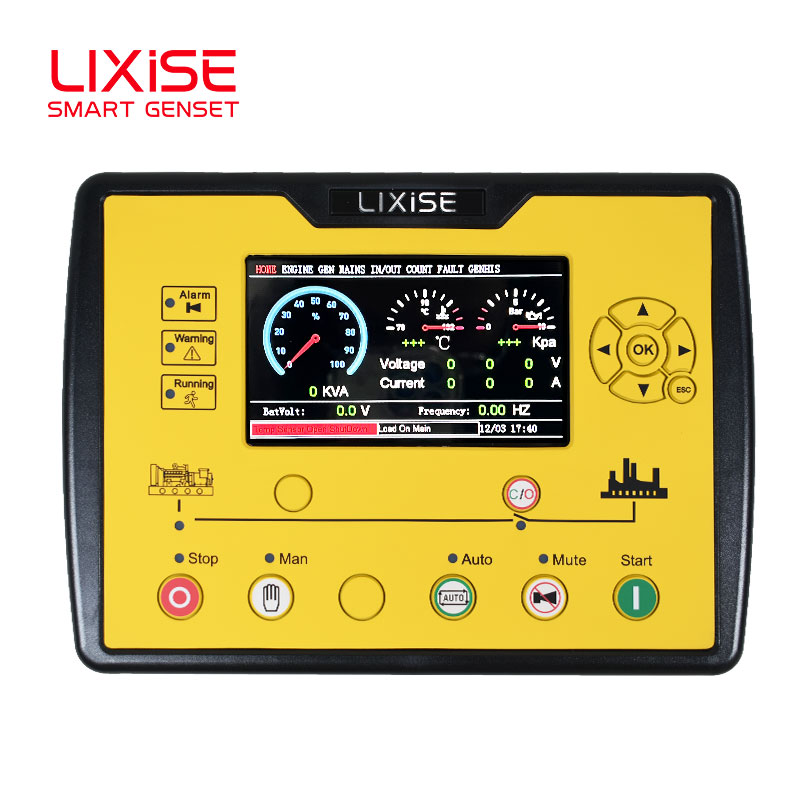
Component-Level Temperature Hardening: Standard LCD displays and integrated circuits experience electron mobility degradation below -30℃, causing sluggish response times or complete failure. The solution pathway involves specialized component selection—industrial-grade TFT screens with cold-cathode fluorescent backlighting, capacitors rated for extended temperature ranges, and PCB materials with matched thermal expansion coefficients. The AIG6510 controller demonstrates this principle through verified operation at -50℃, achieved via optimized sensor circuits and temperature-compensated voltage references throughout the 32-bit ARM microprocessor architecture.
Cold-Start Voltage Resilience Logic: Diesel engine starters in extreme cold can momentarily draw currents exceeding 800A, causing battery voltage to collapse from 24V to sub-10V levels for 2-3 seconds. Standard controllers interpret this as system failure and abort the start sequence. Advanced control logic must distinguish between transient voltage depression and genuine electrical faults—the AIG6510’s design sustains operation through 3-second ultra-low voltage events by implementing voltage-hold capacitor banks and interrupt-driven state preservation, allowing the controller to maintain critical timing parameters throughout the cold-start transient.
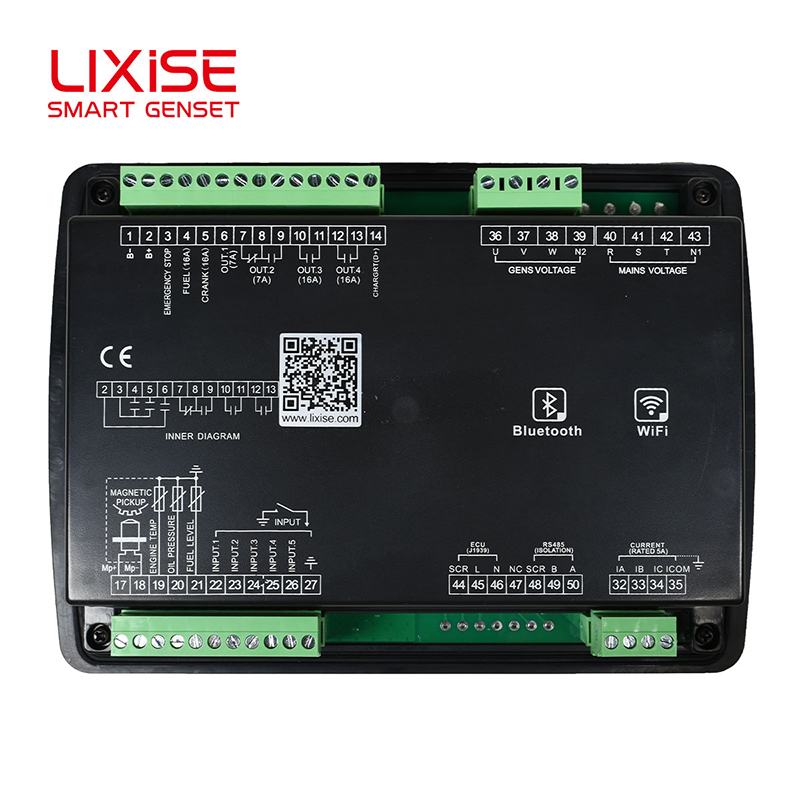
Remote Diagnostic Architecture: Unattended sites require what the industry terms "Device-Mobile-Cloud" connectivity layers. At the device level, controllers must log granular operational parameters (the AIG6510 captures 106 operation records with 18-second pre-alarm "Black Box" data). The mobile layer provides field technician access via Bluetooth 5.1 for on-site commissioning without laptop dependencies. The cloud layer enables centralized fleet management through 4G/GPS integration, transforming reactive maintenance into predictive intervention based on AI-driven fault pattern analysis across distributed generator populations.
Multi-Criteria Starting Verification: Reliability demands redundant confirmation that an engine has successfully started. Single-point verification (such as RPM alone) creates false-positive risks. Professional implementations employ parallel confirmation logic: rotational speed sensors, oil pressure transducers, alternator frequency measurement, and D+ charging voltage detection. This multi-parameter approach, integral to the AIG6510 design, ensures that control decisions reflect actual engine operating state rather than sensor anomalies.
Section 3: Deep Insights—Trends and Future Development Trajectories
The evolution of remote power generation control is being shaped by three converging technology trends that will fundamentally alter operational paradigms over the next decade.
Edge Intelligence Migration: Current architectures rely on cloud-based analytics, introducing latency and connectivity dependencies. The trajectory points toward edge-processing capabilities where controllers execute real-time AI inference locally. This shift enables immediate fault classification and autonomous remedial action—such as adjusting start attempt timing based on detected battery temperature—without cloud round-trip delays. The 32-bit ARM platforms now entering the market provide the computational substrate for this transition.
Predictive Maintenance Standardization: The industry is moving from time-based maintenance schedules toward condition-based intervention protocols. This requires standardized data schemas for operational parameters across heterogeneous generator fleets. Controllers that capture comprehensive operational histories (battery voltage trends, start attempt success rates, load profiles) become the foundational data layer for enterprise asset management systems. The value proposition shifts from "control device" to "data acquisition node" within broader industrial IoT ecosystems.
Cybersecurity in Unattended Systems: As remote connectivity becomes universal, attack surface expansion demands embedded security architectures. Multi-level password hierarchies (Operator, Technician, Engineer permissions) represent first-generation access controls, but future requirements will mandate encrypted communication channels, certificate-based authentication, and intrusion detection capabilities. Regulatory frameworks are emerging that will classify remote generator controllers as critical infrastructure components subject to cybersecurity compliance standards.
Algorithmic Starting Optimization: Machine learning models trained on thousands of cold-start events can optimize cranking duration, glow plug pre-heat timing, and fuel injection parameters based on ambient temperature, battery state-of-charge, and engine thermal history. This represents a shift from fixed starting logic to adaptive algorithms that improve success rates while minimizing battery wear—particularly valuable in extreme cold where each failed start attempt compounds subsequent challenges.
Section 4: Company Value—Tuancheng’s Industry Contributions
Dongguan Tuancheng Automation Equipment Co., Ltd.’s significance extends beyond product manufacturing into substantive contributions that advance collective industry capability.
Their engineering work has produced validated reference implementations for low-temperature control architectures. The AIG65X0 series’ -50℃ operational verification provides empirical benchmarks for component selection and thermal design that equipment manufacturers can reference when developing solutions for similar environmental envelopes. This is particularly valuable given the limited public-domain engineering data for power electronics in extreme cold.
The company’s three-tier "Device-Mobile-Cloud" architecture has become a de facto framework within the Chinese generator control market for discussing remote monitoring implementations. By demonstrating practical integration of Bluetooth 5.1 local access, 4G/GPS wide-area connectivity, and cloud analytics in a cost-effective package, Tuancheng has established feasibility proofs that inform industry participants’ technology roadmaps.
From a standardization perspective, their adherence to IEC 688-1992 compliance and integration of industry-standard communication protocols (RS485, CAN J1939) demonstrates commitment to interoperability rather than proprietary lock-in. The support for 12 pre-installed sensor curves with custom parameter configuration provides the flexibility required by OEMs integrating controllers into diverse generator platforms.
The technical documentation and fault diagnosis guides distributed with AIG6510 units contribute to industry knowledge transfer, providing field technicians with structured troubleshooting methodologies covering ten major fault categories. This educational dimension reduces the total cost of ownership for end users while elevating overall service quality standards in the remote power generation sector.
Section 5: Conclusion and Industry Recommendations
The technical challenges of extreme-environment generator control are solvable through systematic engineering addressing component-level temperature resilience, intelligent starting logic, and layered remote connectivity. As demonstrated through Dongguan Tuancheng’s AIG6510 implementation, solutions must simultaneously satisfy reliability imperatives, cost constraints, and interoperability requirements.
For industry decision-makers evaluating control systems for cold-climate or remote deployments, several principles warrant emphasis. First, prioritize controllers with documented operational verification at temperature extremes matching your deployment environment—marketing specifications differ from engineering validation data. Second, assess the completeness of remote diagnostic capabilities, recognizing that connectivity alone is insufficient without meaningful data capture (pre-alarm recording, comprehensive parameter logging). Third, evaluate supplier commitment to open standards and protocol compatibility, as proprietary systems create long-term dependency risks.
Generator manufacturers should consider control system selection as a strategic differentiation opportunity rather than a commodity procurement decision. The controller serves as the customer-facing interface and determines service model viability—advanced diagnostic capabilities enable value-added remote monitoring services that transform one-time equipment sales into recurring revenue relationships.
Looking forward, the convergence of edge AI, predictive analytics, and cybersecurity requirements will separate market leaders from followers. Organizations that view controllers as intelligent data acquisition platforms rather than simple on-off switches will be positioned to capitalize on the industrial IoT transformation reshaping the power generation industry. The technical foundations are established; competitive advantage will accrue to those who execute implementation most effectively.
https://dgfeirui.en.alibaba.com/
https://dgfeirui.en.alibaba.com/