In modern heat exchanger manufacturing, success is no longer defined only by production output. Today’s manufacturers are expected to achieve higher levels of precision, consistency, energy efficiency, and cost control while maintaining scalable production capacity.
This shift is especially evident in the production of aluminum plate-fin heat exchangers and plate-bar coolers, where core assembly and quality inspection are critical stages that directly determine final product performance.
Among all quality control processes, leakage testing plays one of the most important roles. Even a tiny air leak inside a heat exchanger core can result in serious operational issues such as thermal inefficiency, pressure instability, or system failure after installation.
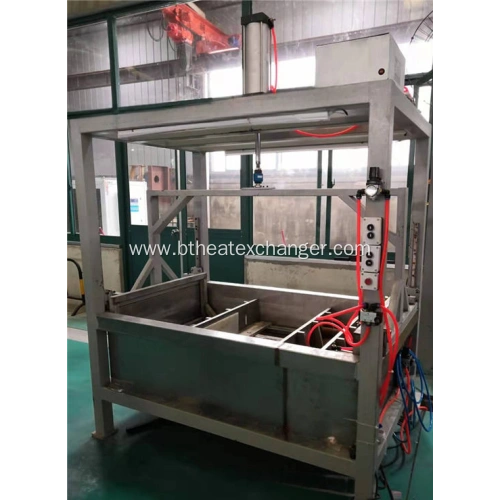
To address these challenges, manufacturers are increasingly adopting the Heat Exchanger Core Leakage Test Machine, a specialized solution designed to ensure airtight integrity before final assembly.
The Increasing Complexity of Heat Exchanger Production
Heat exchangers are widely used in industries where thermal management is critical to system performance, including:
-
Automotive cooling systems
-
Gas compression equipment
-
Hydraulic oil cooling systems
-
Industrial machinery
-
Energy and power generation systems
-
CNC and precision equipment
As system designs become more compact and performance-driven, manufacturing tolerances are becoming increasingly strict. This makes quality control more difficult and raises the risk of performance failure caused by minor leakage defects.
Traditional manual testing methods are no longer sufficient because they rely heavily on operator experience and subjective judgment, leading to inconsistent results.
Why Leakage Testing Is a Critical Quality Control Step
Leakage testing is not just a final inspection—it is a core reliability assurance process.
A defective heat exchanger core can result in:
-
Reduced thermal efficiency
-
Pressure instability
-
Fluid or refrigerant leakage
-
Increased system downtime
-
Early product failure
For manufacturers, undetected leakage may also lead to:
-
Warranty claims
-
Customer complaints
-
Production rework costs
-
Loss of market reputation
As production volumes increase, relying on manual inspection becomes inefficient and risky.
How Automated Leakage Test Machines Improve Manufacturing Efficiency
Automated leakage testing systems are designed to standardize inspection processes and eliminate human inconsistency. For aluminum plate-bar heat exchanger cores, where sealing is technically complex, automation provides a significant advantage.
Modern systems typically support air tightness testing up to 5 bar pressure, ensuring reliable detection of micro-leaks before final assembly.
1. Reduced Labor Dependence
Manual leakage testing requires skilled operators to:
-
Position heat exchanger cores
-
Apply sealing fixtures
-
Control pressure levels
-
Interpret test results
Automated systems simplify this process by standardizing:
-
Pressure control
-
Sealing procedures
-
Testing cycles
-
Data recording and judgment
This reduces labor requirements while improving consistency across production shifts.
2. Higher Detection Accuracy
Manual testing often depends on visual observation, such as bubble detection or pressure monitoring by operators. These methods may fail to detect micro-leaks.
Automated systems improve accuracy through:
-
Stable pressure control
-
Digital monitoring systems
-
Consistent sealing mechanisms
-
Real-time leakage detection
This ensures defects are identified early, preventing downstream failures.
3. Lower Scrap and Rework Costs
Late detection of leakage defects can result in:
-
Re-brazing processes
-
Disassembly of finished units
-
Material waste
-
Increased labor costs
By identifying defective cores early in production, automated systems significantly reduce scrap rates and unnecessary rework.
Supporting Lean Manufacturing and Smart Production
Modern manufacturing is increasingly based on lean production principles, focusing on efficiency, waste reduction, and process stability.
Automated leakage testing supports these goals by enabling:
Faster Production Flow
Standardized testing cycles reduce bottlenecks and improve production scheduling.
Improved Quality Traceability
Each test cycle can be digitally recorded, supporting full production traceability and quality management.
Reduced Downtime
Early defect detection prevents failures in later assembly stages, improving overall production continuity.
The Growing Role of Automation in Heat Exchanger Manufacturing
Leakage testing is only one part of a broader shift toward intelligent heat exchanger production systems.
Modern production lines increasingly integrate:
-
Fin forming machines
-
Core assembly systems
-
Ultrasonic cleaning equipment
-
Automatic welding systems
-
Vacuum brazing furnaces
-
Core leakage testing machines
This integration enables manufacturers to achieve:
-
Higher production stability
-
Lower labor intensity
-
Improved product consistency
-
Greater scalability
-
Reduced operational costs
Why Stability Matters in Aluminum Heat Exchanger Production
Aluminum heat exchangers require precise control during manufacturing due to:
-
Thin-wall structures
-
Complex brazed joints
-
High thermal conductivity
-
Tight dimensional tolerances
Even small process variations can significantly impact final product performance.
Automated leakage testing serves as a critical validation step, ensuring that each core meets performance standards before moving to final assembly.
Industry Applications
Heat exchangers tested using automated leakage systems are widely used in:
-
Automotive thermal management systems
-
Industrial hydraulic cooling systems
-
Renewable energy equipment
-
Gas processing systems
-
Power generation systems
-
Medical and precision cooling applications
Future Trends in Heat Exchanger Manufacturing
As global demand for energy efficiency and compact thermal systems continues to grow, heat exchanger production is becoming more automated and data-driven.
Key industry trends include:
-
Smart production monitoring systems
-
Fully automated inspection lines
-
Digital quality traceability
-
Energy-efficient manufacturing processes
-
Lean and sustainable production models
Leakage testing automation fits directly into this transformation by improving both quality assurance and production efficiency.
Conclusion
In modern heat exchanger manufacturing, leakage testing has become a core factor in ensuring product reliability, reducing production waste, and maintaining competitive manufacturing efficiency.
The Heat Exchanger Core Leakage Test Machine enables manufacturers to:
-
Reduce labor dependency
-
Improve testing accuracy
-
Lower scrap and rework costs
-
Support lean manufacturing strategies
As industries continue to demand higher performance and tighter quality control, automated testing solutions are becoming an essential part of next-generation heat exchanger production systems.
For manufacturers aiming to improve efficiency and ensure long-term product reliability, investing in automated leakage testing technology is a key step toward modern, intelligent manufacturing.
www.btheatexchanger.com
Wuxi Better