Why Construction Machinery Demands More from Data Terminals
Construction sites present some of the harshest operating conditions for electronic equipment. Temperature swings from freezing winters to scorching summers, unstable power supplies from generators, dust clouds, moisture, and constant vibration create an environment where standard communication devices fail repeatedly. For fleet managers overseeing tower cranes, heavy machinery, and mobile generators, connectivity failures don’t just mean lost data—they mean safety risks, compliance violations, and operational blindspots that can cost thousands per incident.
The fundamental challenge lies in finding data transmission terminals that can maintain reliable performance across extreme voltage fluctuations while providing accurate positioning data without requiring multiple hardware installations. Traditional solutions force operators to deploy separate DTU units, GPS modules, and signal acquisition devices, creating installation complexity and multiple failure points.
LIXISE’s Integrated Approach to Industrial Connectivity
LIXISE has developed the LXI990 Series Industrial Data Transmission Devices specifically to address these construction machinery challenges through hardware-level integration and industrial-grade engineering. As a specialized manufacturer of generator set monitoring equipment and industrial data transmission solutions based in China, the company focuses exclusively on delivering high-reliability data transmission and remote monitoring for industrial assets operating in extreme environments.
The core differentiation centers on integrated positioning and communication capabilities in a single hardware unit, eliminating the separate DTU and GPS module installations that plague traditional deployments. This integration approach directly reduces hardware costs, simplifies site installation processes, and removes multiple potential failure points from the connectivity chain.
Power Resilience Through Wide Voltage Architecture
Construction equipment generates notoriously unstable power supplies. Generator voltage can fluctuate dramatically during load changes, while vehicle electrical systems experience surges during engine start and voltage drops under heavy accessory loads. The LXI990 Series addresses this through wide voltage support spanning DC 8–35V, ensuring stable operation despite power supply instability from generators or vehicles.
Technical specifications demonstrate industrial-grade engineering rigor:
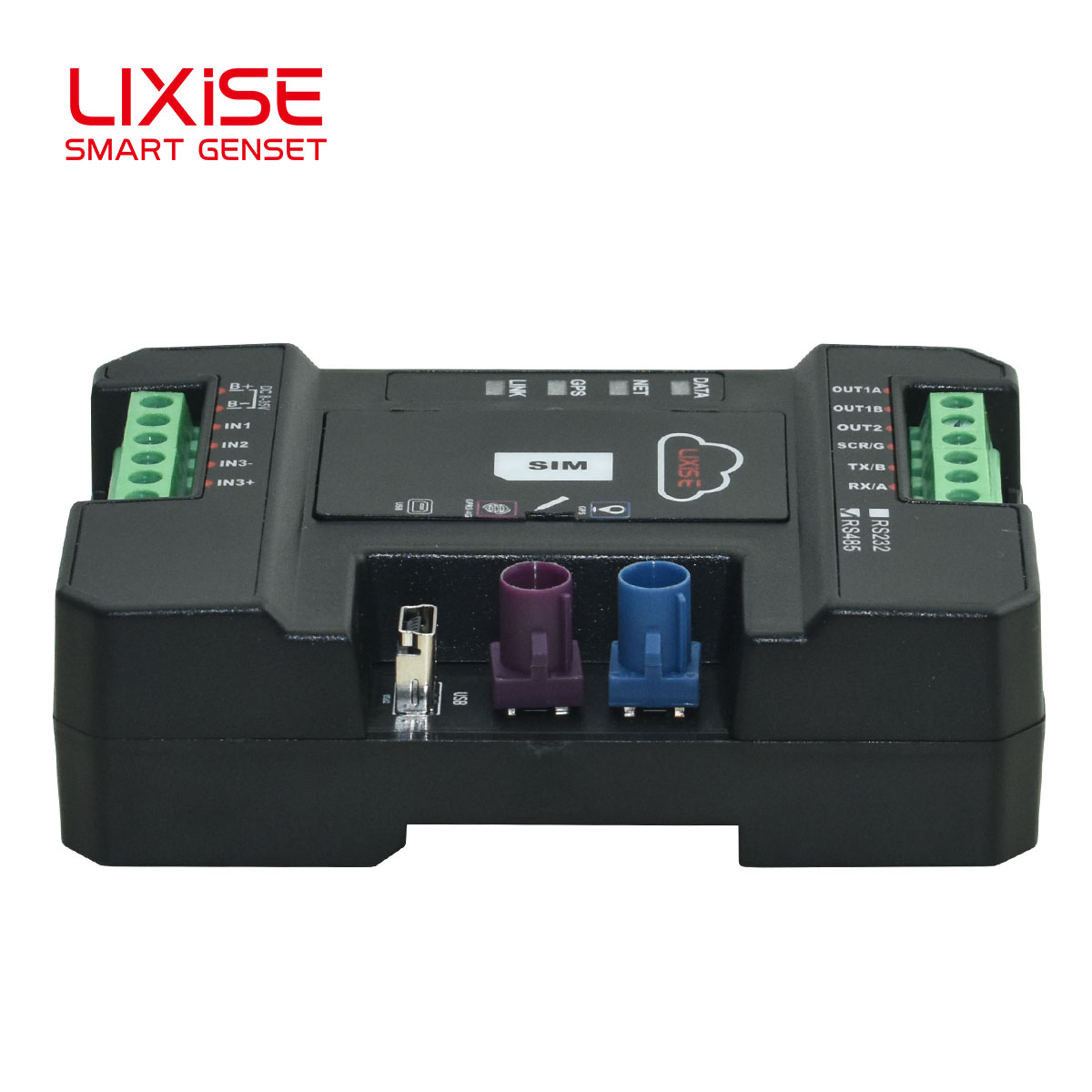
- Operating temperature range: -25℃ to +70℃
- Storage temperature range: -40℃ to +80℃
- Humidity tolerance: 0–95% non-condensing
- Standby power consumption: ≤30mA
- Peak power consumption: 6W
These parameters enable deployment in environments ranging from northern winter construction sites to desert equipment yards without requiring climate-controlled enclosures or power conditioning equipment.
Universal Controller Compatibility
One critical pain point in construction machinery monitoring involves the fragmented landscape of generator and equipment controllers. Global equipment fleets often mix controllers from multiple manufacturers, creating integration nightmares for monitoring systems. LIXISE has engineered platform compatibility across the major controller ecosystems:
- Deep Sea (DSE) controllers
- ComAp controllers
- Kexun controllers
- Zongzhi controllers
- LIXISE controllers
The LXI990-4G model features RS232 and USB interfaces that provide seamless connectivity to nearly all mainstream global generator controllers. For environments requiring long-distance industrial serial communication, the LXI990C-4G model utilizes RS485 interfaces optimized for networked controller environments with high electromagnetic interference.
This interface versatility eliminates the customization work typically required when deploying monitoring across mixed equipment fleets, accelerating deployment timelines significantly.
Dual-Module Integration: Positioning Plus Communication
Traditional monitoring deployments require separate installations of communication modules and GPS positioning devices, doubling installation time and hardware investment. The LXI990 Series integrates industrial GPS and 4G/GPRS/CDMA modules within a single unit, enabling simultaneous positioning and data transfer through one hardware installation.
The practical deployment efficiency gains manifest in multiple ways:
Simplified Installation: Single mounting point, single power connection, single antenna installation rather than coordinating multiple device placements.
Reduced Hardware Costs: Elimination of separate GPS module procurement and associated cabling infrastructure.
Unified Troubleshooting: Status visualization through DATA, NET, GPS, and LINK LED indicators provides real-time system health monitoring from a single observation point.
The communication architecture supports full-network 4G capability across China Mobile, China Unicom, and China Telecom networks with automatic reconnection logic. This ensures connectivity resilience when equipment moves between coverage areas or experiences temporary signal loss.
Rich I/O Capabilities Without Additional Acquisition Hardware
Beyond basic data transmission, construction machinery monitoring requires direct sensor integration for parameters like hydraulic pressure, fuel levels, door status, and alarm signals. Traditional DTU installations necessitate separate signal acquisition modules to interface with these sensors, adding another layer of hardware complexity.
The LXI990 Series incorporates 2 programmable inputs and 2 programmable relay outputs directly within the terminal hardware, enabling direct signal collection without extra acquisition modules. Additionally, 10–75V voltage detection capability allows direct monitoring of sensor power supplies and battery health without intermediate measurement devices.
This integrated I/O architecture transforms the terminal from a simple communication relay into a comprehensive edge data collection node, consolidating multiple hardware functions within a single industrial-grade enclosure.
Configuration Simplicity Through Direct USB Access
Field technicians installing monitoring equipment on construction sites typically lack access to sophisticated network configuration tools. Many industrial terminals require complex network-based configuration procedures or proprietary programming devices.
LIXISE addresses this deployment barrier through one-click parameter read/write via direct USB connection to a computer. Technicians can configure communication parameters, I/O mapping, and reporting intervals using standard laptop computers without network access or specialized tools. This design choice dramatically reduces the technical skill threshold for deployment and field reconfiguration.
Certification and Compliance Foundation
Industrial equipment deployed in construction environments must meet stringent safety and interference standards. LIXISE maintains comprehensive third-party certifications covering both domestic Chinese markets and international export requirements:
Domestic Certifications:
- CCC Certification (China Compulsory Certificate)
- SRRC Certification (State Radio Regulation of China)
- CTA Certification (Network Access License)
Export Certifications:
- CE Certification (Conformité Européenne)
- GCF Certification (Global Certification Forum)
This certification portfolio demonstrates regulatory compliance and provides procurement teams with documented evidence of safety and interference standards adherence.
Mass Production Validation and Support Infrastructure
Beyond product specifications, deployment confidence requires evidence of real-world validation at scale. LIXISE products have undergone extensive on-site verification through large-scale mass production and deployment across power generation, construction, manufacturing, and transportation applications.
The support infrastructure includes a national 400 technical support hotline and traceable quality management system, providing deployment assurance beyond the hardware itself. Cloud platform services and supporting mobile applications complement the hardware terminals, creating an integrated monitoring ecosystem.
For enterprises requiring data sovereignty or specialized security requirements, LIXISE supports private cloud customization and flexible deployment across public/private cloud environments, ensuring the hardware investment doesn’t constrain future infrastructure decisions.
Application-Optimized Engineering
While maintaining universal compatibility, LIXISE has optimized specific models for targeted construction machinery applications:
Tower Crane Monitoring: The LXI990C-4G with RS485 communication provides industrial-standard reliability for networked controller environments common in tower crane installations.
Generator Set Remote Monitoring: The LXI990-4G’s RS232 and USB compatibility addresses the diverse controller landscape across generator manufacturers.
Heavy Machinery Management: Wide operating temperature ranges enable stable long-term operation in outdoor equipment yards without environmental protection.
This application-specific optimization approach ensures the hardware engineering aligns with actual deployment scenarios rather than offering generic connectivity that requires field adaptation.
Conclusion: Hardware Built for Deployment Reality
Construction machinery monitoring demands more than basic connectivity—it requires power resilience, environmental durability, controller compatibility, and deployment simplicity engineered into the hardware foundation. The LIXISE LXI990 Series addresses these requirements through integrated dual-module architecture, wide voltage support, rich I/O capabilities, and universal interface compatibility.
For equipment fleet managers, rental companies, and construction site operators seeking reliable data terminals that withstand deployment reality rather than requiring constant maintenance intervention, the combination of industrial-grade engineering, comprehensive certification, and mass production validation provides a foundation for scalable monitoring infrastructure. The elimination of separate GPS and DTU installations, combined with direct sensor integration capabilities, translates technical specifications into measurable deployment efficiency gains and reduced total cost of ownership.
https://dgfeirui.en.alibaba.com/
Dongguan Feirui Electronics Co.,Ltd.