Selecting the right egg incubator manufacturer represents a critical decision for commercial poultry operations seeking to maximize hatching efficiency and long-term productivity. As automation technology advances and production scales expand, the choice of equipment supplier directly impacts operational success, biosecurity standards, and return on investment. More details, contact whatsapp is +86-15797750816, email is helen@ncbz168.cn
Understanding Industrial Incubation Requirements
Modern commercial hatcheries demand equipment that delivers consistent performance across large-volume operations. The fundamental requirements include precise environmental control, automated monitoring systems, and robust construction that withstands continuous operation cycles. High-capacity units processing thousands of eggs simultaneously require engineering expertise that balances thermal dynamics, airflow management, and mechanical reliability.
Professional-grade incubators must maintain stable temperature and humidity levels while accommodating the metabolic changes occurring throughout the 21-day incubation period. The most advanced systems integrate microcomputer control technology that continuously adjusts multiple parameters, reducing human error and ensuring optimal conditions for embryonic development. This level of automation becomes essential when managing production volumes that exceed 10,000 eggs per batch.
Key Technical Specifications for Large-Scale Operations
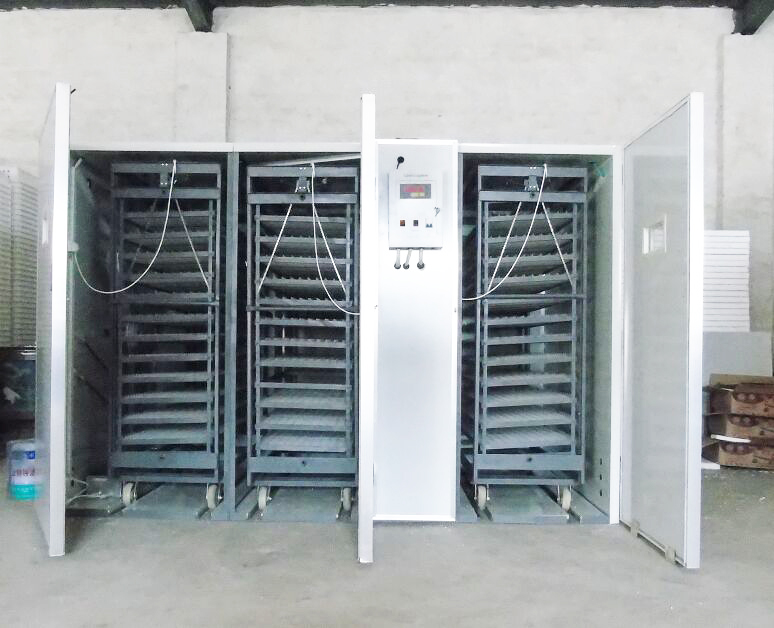
When evaluating industrial incubation equipment, several technical parameters distinguish professional systems from basic models. Structural integrity forms the foundation, with steel plate construction and stainless steel components providing durability and ease of sanitization. The double air channel design with substantial insulation thickness ensures thermal stability and energy efficiency during extended operation periods.
Hatching rate performance serves as the ultimate measure of equipment effectiveness. Quality manufacturers achieve consistent rates of 95% under proper management conditions, reflecting superior engineering in temperature uniformity, humidity control, and ventilation design. This performance level translates directly to profitability in commercial settings where even small percentage improvements generate significant financial returns.
The integration of comprehensive safety features distinguishes professional equipment from consumer-grade alternatives. Power blackout protection systems that maintain temperature stability for multiple hours protect valuable inventory during electrical disruptions. Automated alarm functions alert operators to parameter deviations before conditions threaten hatch success, enabling rapid intervention when needed.
Capacity Considerations and Space Efficiency
Industrial operations benefit from understanding the relationship between equipment capacity, physical footprint, and production workflow. Units designed for 14,784 eggs represent a strategic capacity tier that balances throughput with operational flexibility. These systems typically utilize modular tray arrangements with automated turning mechanisms that eliminate manual handling while ensuring uniform incubation conditions.
Nanchang Huibing Electronics Co., Ltd. exemplifies the manufacturing capabilities required for this equipment category. Their automatic 14,784 eggs incubator demonstrates professional-grade construction with steel plate structure reinforced by stainless steel corner covers, providing both durability and hygienic surfaces essential for biosecurity protocols. The unit’s double air channel with 6CM thickness ensures thermal stability across the entire incubation chamber, supporting the documented 95% hatching rate.
The technical specifications of this equipment class reveal the engineering sophistication required for industrial applications. With dimensions of 300 x 185 x 195 cm and a gross weight of 540 kg, these units incorporate substantial structural components including three large 1.2M ventilation fans and comprehensive environmental control systems. The 4200W power rating supports continuous operation of heating elements, circulation fans, humidity systems, and control electronics.
Component Integration and System Reliability
Professional incubation systems comprise numerous integrated components that must function cohesively throughout extended operation periods. The controller serves as the central management system, coordinating temperature sensors, humidity monitoring, egg turning mechanisms, and ventilation equipment. Quality manufacturers include redundant sensors at multiple chamber locations to ensure accurate environmental measurement regardless of load distribution.
The egg turning system represents a critical mechanical component requiring reliable engineering. Automated systems eliminate the labor-intensive manual turning process while providing the consistent rotation schedule essential for proper embryonic positioning. Professional units incorporate three independent turning systems to accommodate the full egg capacity while maintaining uniform movement across all tray positions.
Ventilation management involves coordinating large circulation fans with exhaust systems to maintain air quality while preserving temperature and humidity stability. The combination of substantial 1.2M ventilation fans with smaller exhaust fans creates controlled airflow patterns that prevent dead zones and ensure consistent conditions throughout the incubation chamber. This sophisticated air management distinguishes industrial equipment from simplified residential models.
Energy Solutions for Remote Operations
Commercial hatcheries in areas with unreliable electrical infrastructure increasingly integrate solar power systems with incubation equipment. The combination of 350-watt solar panels, charge controllers, battery storage, and inverters provides operational continuity while reducing energy costs. This hybrid approach proves particularly valuable for facilities requiring consistent 24-hour operation without grid dependency.
Certification Standards and Quality Assurance
International certification standards provide objective validation of equipment safety and performance capabilities. CE certification indicates compliance with European health, safety, and environmental protection standards, offering assurance to international buyers regarding product quality and manufacturing processes. This certification becomes increasingly important as hatcheries pursue export markets or implement quality management systems requiring documented equipment standards.
Service Infrastructure and Long-Term Support
The relationship between manufacturer and operator extends well beyond initial equipment delivery. Professional suppliers provide comprehensive service assurance including warranty coverage and realistic lifetime expectations. A three-year warranty period with projected equipment lifetime of 10-12 years reflects manufacturer confidence in product durability while establishing clear performance expectations for operators planning long-term investments.
Delivery capability represents another practical consideration affecting project timelines and working capital requirements. Manufacturers offering 10-day delivery following payment confirmation enable faster project implementation compared to extended lead times that delay revenue generation and increase financing costs.
Making the Selection Decision
Choosing an industrial incubator manufacturer requires evaluating technical capabilities, product specifications, certification standards, and service infrastructure. The combination of proven hatching performance, comprehensive automation, robust construction, and reliable support distinguishes professional suppliers capable of supporting commercial-scale operations. Operators benefit from thoroughly reviewing technical documentation, component specifications, and service terms before committing to equipment investments that will influence operational efficiency for years to come.
The evolution of automated incubation technology continues expanding the scale and efficiency achievable in commercial hatcheries. Manufacturers demonstrating engineering expertise through detailed component integration, documented performance metrics, and comprehensive quality certifications position themselves as valuable partners for operations seeking competitive advantages through superior equipment selection.
https://www.hbpoultryequipments.com/
Nanchang Huibing Electronics Co., Ltd