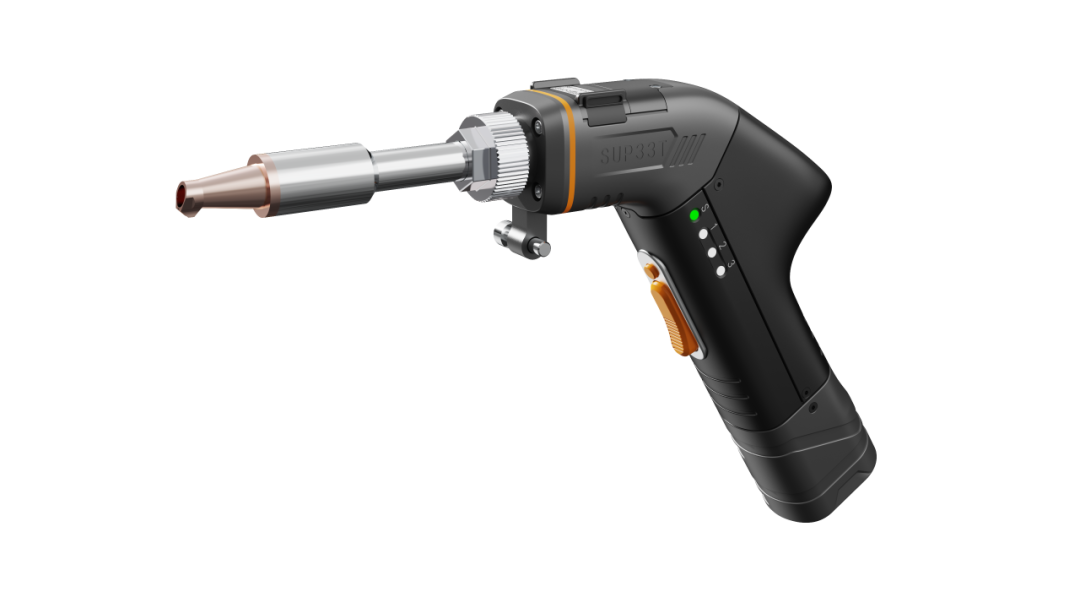
As manufacturing industries accelerate toward intelligent automation, laser welding technology has emerged as a cornerstone of precision fabrication. Among the innovative solutions transforming this landscape, the SUP33T handheld laser welding head stands out as a breakthrough product that combines cutting-edge engineering with practical operational efficiency. This four-in-one system represents a significant leap forward in addressing the complex demands of modern welding applications across diverse industrial sectors.
Understanding the Four-in-One Integration Advantage
The SUP33T laser welding head embodies a comprehensive approach to handheld laser welding through its integrated four-in-one design. This architecture consolidates welding, oscillation, wire feeding compatibility, and safety monitoring into a single cohesive system. The integration eliminates the traditional fragmentation of welding equipment, where operators previously needed to coordinate multiple separate components. By unifying these functions, the system reduces setup complexity and enhances operational continuity during production cycles.
This holistic design philosophy directly addresses a critical pain point in manufacturing environments: the need for versatile equipment that can adapt to varying material thicknesses and welding scenarios without requiring extensive reconfiguration. The seamless integration enables operators to transition between different welding tasks with minimal downtime, thereby improving overall production throughput.
Version 2.0 Digital Drive Solution: Precision Meets Performance
At the technical core of the SUP33T lies its version 2.0 digital drive solution, which represents a substantial advancement over previous generation systems. This latest-generation digital drive technology delivers a 30% increase in oscillation frequency compared to earlier models. The enhanced oscillation capability translates directly into improved weld penetration and more uniform heat distribution across the welding zone.
Equally important is the high motor positioning accuracy enabled by the digital drive system. Precise motor control ensures consistent oscillation patterns, which is essential for achieving repeatable weld quality across production runs. This precision becomes particularly critical when working with thin-gauge materials or executing complex weld geometries where even minor deviations can compromise joint integrity.
The digital drive architecture also provides superior response characteristics. Rapid acceleration and deceleration of the oscillation mechanism allow for cleaner start and stop points in the weld seam, reducing the occurrence of defects at weld terminations. This responsiveness contributes to overall weld aesthetics and structural performance.
Alloy Framework Construction: Strength Without Compromise
The gun body construction employs an alloy framework that exemplifies advanced materials engineering. This aluminum alloy structure achieves an optimal balance between mechanical strength and weight reduction. The framework provides the structural rigidity necessary to maintain optical alignment under operating conditions while keeping the total system weight at approximately 0.68 kg.
Manufacturing the gun body using new-generation fabrication technology significantly enhances its corrosion resistance. This is particularly relevant in industrial environments where exposure to metal particles, welding fumes, and atmospheric contaminants can accelerate equipment degradation. The enhanced corrosion resistance extends service life and reduces maintenance frequency, contributing to lower total cost of ownership.
The lightweight characteristics of the alloy framework directly impact operator ergonomics. Reduced weight minimizes operator fatigue during extended welding sessions, which is especially important in applications requiring sustained manual operation. This ergonomic consideration translates into improved work quality and enhanced workplace safety by reducing the likelihood of operator errors caused by physical strain.
Independent Process Switching: Operational Flexibility Redefined
One of the most practical innovations in the SUP33T is its independent process switching button integrated directly into the gun body. This feature enables convenient switching among three preset welding processes without interrupting workflow or returning to a control panel. Each preset can be configured for different wire feeding rates, laser power levels, and oscillation amplitudes, allowing rapid adaptation to varying material types and thickness ranges.
The real-time status indicator light works in conjunction with the process switching button to provide immediate visual feedback on system operating status. This status visibility allows operators to confirm process transitions and quickly identify any system alerts or fault conditions without relying on external displays or audible signals.
The ability to quickly adjust parameters across different welding scenarios saves valuable production time. In applications involving multiple material grades or joint configurations within a single assembly, this flexibility eliminates the need for equipment changeovers or extended setup procedures. Operators can seamlessly transition from welding thick structural components to joining thinner sheet metal simply by selecting the appropriate preset process.
Mini QBH Lock: Connection Reliability and Weight Optimization
The implementation of the mini QBH lock represents a thoughtful approach to optical connection technology. This locking mechanism ensures stable and reliable connection between the fiber delivery system and the welding head optical train. Maintaining precise optical alignment is critical for consistent beam quality and predictable welding performance.
Beyond connection stability, the mini QBH lock contributes to overall weight reduction. By employing a compact locking mechanism, the system eliminates unnecessary mass without compromising connection integrity. This weight optimization complements the lightweight alloy framework to achieve the SUP33T’s total system weight of approximately 0.68 kg.
The reliable connection also facilitates maintenance procedures. The mini QBH lock allows for quick disconnection and reconnection during routine optical component replacement or cleaning operations, reducing equipment downtime and simplifying field service procedures.
Compression-Pulling Type Protective Lens Chamber: Maintenance Efficiency
The upgraded compression-pulling type protective lens chamber addresses a common operational challenge in laser welding: the need for frequent protective lens replacement due to contamination from welding spatter and fumes. This chamber design enables rapid replacement of both the protective lens and focusing lens while maintaining the sealed environment necessary for optical component protection.
Quick-change capability minimizes production interruptions caused by lens maintenance. In high-volume manufacturing environments where protective lenses may require replacement multiple times per shift, the time savings from this design feature can significantly impact overall equipment effectiveness. The sealed design prevents contaminant ingress that could compromise focusing lens performance or collimating optics.
Optical Specification and Application Range
The SUP33T employs carefully selected optical components optimized for 3000W power class operation. The D16 F60mm collimating lens, D18x2mm protective lens, and D20 F150mm focusing lens work in concert to deliver controlled beam characteristics suitable for a wide range of welding applications. The 1070±10nm applicable wavelength specification ensures compatibility with standard fiber laser sources commonly deployed in industrial welding systems.
The ±10mm vertical focusing range provides operational tolerance for variations in standoff distance, accommodating typical hand positioning variability in manual welding operations. The line 0-8mm light spot adjustment range enables adaptation to different joint geometries and welding modes, from narrow penetration welds to wider cosmetic seam appearances.
Water cooling ensures thermal stability during sustained operation at the 3000W power level. The recommended 10-15 L/min air flow rate provides adequate shielding gas delivery for protecting the molten weld pool from atmospheric contamination while also assisting in debris removal from the processing zone.
Industry Application Context and Market Positioning
The SUP33T addresses requirements across multiple industrial sectors including automotive manufacturing, machinery fabrication, and electronics assembly. Its balanced specification profile positions it effectively for applications involving stainless steel, carbon steel, and aluminum alloy materials in thickness ranges from thin sheet to medium plate.
The system’s combination of digital drive precision, lightweight construction, and process flexibility makes it particularly well-suited for manufacturers seeking to enhance welding quality while maintaining operational efficiency. The independent process switching capability specifically benefits production environments with mixed-product manufacturing requirements, where equipment versatility directly impacts production scheduling flexibility.
From a technology adoption perspective, the SUP33T represents an accessible entry point into advanced handheld laser welding for facilities transitioning from traditional welding methods. The intuitive operational interface and robust construction reduce training requirements and support reliable performance in varied production environments.
Conclusion: Engineering Excellence Meets Practical Application
The SUP33T handheld laser welding head exemplifies how thoughtful engineering integration can deliver tangible operational benefits. By combining version 2.0 digital drive precision, lightweight alloy construction, independent process control, and maintenance-optimized design, this system addresses real-world manufacturing challenges while maintaining the reliability expected in demanding production environments. As industries continue advancing toward flexible automation and quality-focused manufacturing, solutions like the SUP33T provide the technical foundation necessary for achieving these operational objectives.
https://www.suplaserweld.com/
WUXI SUPER LASER TECHNOLOGY Co., LTD.